Your Project Is Not Behind Schedule. Your Organization Was Never Ready for It
Introduction
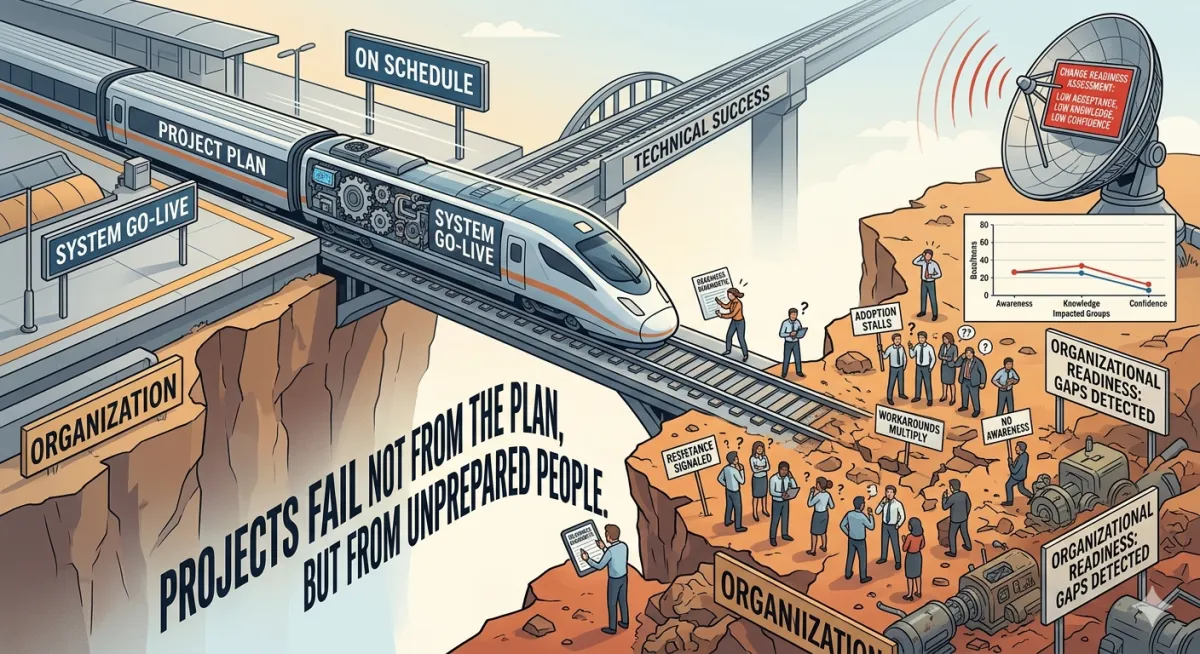
Most project teams do not fail because the plan was wrong. They fail because the people the plan depended on were never genuinely prepared to carry it out. The system goes live on schedule, the technical deliverables pass quality review, and then something quietly goes wrong in the weeks that follow. Adoption stalls. Workarounds multiply. Employees who never pushed back openly are now doing the job exactly the way they always did, system or no system.
This is not resistance in the dramatic sense. It is the predictable consequence of a question nobody asked early enough: are we actually ready for this?
Change readiness assessment is the Organizational Change Management practitioner’s most powerful early warning system. It does not predict the future. It illuminates the present state of the organization honestly enough that the team can act on what they find before the project absorbs the cost of what they ignored.
Key Takeaways
Readiness Is Not an Assumption: The fact that leadership approved a project does not mean the organization is prepared to absorb it. Approval and readiness are two entirely different conditions that must be assessed separately.
Early Assessment Is Early Advantage: Assessing organizational readiness evaluates the organization’s capacity for change by examining current workload, past change experiences, and cultural factors, revealing potential obstacles before they become problems.
Resistance Is a Signal, Not a Personality Trait: When employees push back against a change, they are communicating something about their awareness, their understanding, or their confidence. A readiness assessment gives that signal a name and a plan.
Buy-In Is Built, Not Announced: To have buy-in from employees, it is imperative that the goals of a change are clear with benefits outlined for all impacted. A readiness assessment is the diagnostic that tells you whether that clarity currently exists.
Readiness Is a Moving Target: A single assessment at the start of a project is a baseline, not a verdict. At minimum, two change management surveys for readiness should be given: the first as a baseline, and the second prior to the go-live date to gauge how successful change management has been in readying impacted stakeholders.
What Is Change Readiness and Why Does It Function as an Early Warning System?
Change readiness refers to an organization’s ability to prepare, adapt, and respond effectively to new initiatives, processes, or transformations. It measures how well leaders, employees, and systems are positioned to embrace change. In the professional practice of organizational change management, this means treating preparedness not as an attitude to be assumed but as a condition to be measured, mapped, and actively managed before it has the chance to derail a project from the inside.
The early warning system framing is not metaphorical. A change readiness assessment involves analyzing each impacted group’s readiness to adopt the change, allowing you to determine how ready a group is to transition from their current way of operations to the target state model, and to understand each group’s awareness and acceptance of the transformation. When you map that data across your stakeholder landscape, patterns emerge. A department that scores low on awareness is not a resistant department. It is an uninformed one, and that is an entirely solvable problem if you catch it in week three rather than week seventeen.
What makes this assessment function as a genuine warning system is its ability to surface the gap between where the organization believes it is and where it actually is. Leadership confidence about an upcoming change is not the same as employee readiness for it. Even if a new technology promises to transform your organization for the better, employees may be hesitant to embrace the new workflows. The readiness assessment creates a shared, evidence-based picture of that gap and gives the change team a structured foundation for closing it before Go-Live turns that gap into a measurable drop in productivity and adoption.
Why Skipping the Readiness Assessment Is One of the Most Expensive Decisions a Project Can Make
It converts manageable risks into live incidents. Every gap in readiness that is not identified before implementation becomes a problem that must be solved under pressure, with less time, less goodwill, and a project team already focused on stabilization rather than prevention. An awareness gap found in the assessment phase costs a targeted communication. The same gap found after Go-Live costs weeks of reactive engagement, retraining, and damage control.
It leaves resistance without a diagnosis. On a personal level, change readiness is about individuals being ready, willing, and able to embrace and carry out the change. When that readiness is absent and nobody has assessed why, the change team has no diagnostic basis for intervention. They can see that adoption is low. They cannot tell whether the cause is insufficient awareness, unresolved concerns about job impact, inadequate training, or a lack of confidence in leadership’s commitment to the change. Without a readiness assessment, every response is a guess.
It undermines the credibility of the entire organizational change management effort. When employees observe that their concerns, their skill gaps, and their readiness to absorb a change were never formally assessed, they draw a reasonable conclusion: the change is being done to them, not with them. That perception alone is enough to generate the kind of quiet, sustained non-compliance that no communication campaign can reverse after the fact. A readiness assessment, conducted early and transparently, signals to employees that their preparedness is being taken seriously as a genuine project input rather than an afterthought.
It produces a false picture of project health. A project that is on schedule technically but organizationally unprepared is not a healthy project. It is a delayed crisis. Without readiness, even the most well-planned transformation can fail. The readiness assessment is what makes the human side of the project visible in the same dashboard as the technical side, giving sponsors and project managers an honest picture of where the real exposure lives before it becomes a post-mortem finding.
How to Conduct a Change Readiness Assessment: A Step-by-Step Framework
Step 1: Define the Scope and Impacted Groups
Before you design a single survey question or schedule a single focus group, you need a clear picture of who the assessment is for and what it needs to measure.
What to do: Identify every group that will be materially affected by the change, going beyond the primary users to include managers, support teams, and any function whose workflow will shift as a result of the transformation.
Action: When performing a readiness assessment, consider the company as a whole, your employees, your sponsors and stakeholders, and your organizational culture and history.
Goal: A scoped assessment that covers the full landscape of impact rather than only the groups that raised their hand to be involved.
Step 2: Establish Your Readiness Dimensions
A readiness assessment without a defined measurement framework produces data that is difficult to act on. Before you gather any input, define what you are actually measuring.
What to do: Structure your assessment around four core dimensions for each impacted group: their current level of awareness of the change, their level of acceptance of it, their knowledge of what is specifically changing in their role, and their confidence in their ability to perform in the new state.
Action: Use common metrics in your change management survey questionnaire, such as asking respondents to rate their level of awareness between high, medium, and low, which makes it significantly easier to graph answers and compare results across groups.
Goal: Quantifiable readiness scores per group that can be tracked over time and used to prioritize where engagement effort is directed first.
Step 3: Gather Data Across Multiple Channels
A single survey sent to a broad distribution list will tell you what people are willing to say in writing. That is useful data, but it is not the complete picture.
What to do: Combine quantitative survey data with qualitative input from focus groups, manager interviews, and where available, historical performance data from past change initiatives.
Action: Facilitate in-depth discussions with representative groups of employees to gather qualitative data on their perspectives and concerns, and review historical data on employee performance and adoption of past changes to provide insights into the organization’s overall change agility.
Goal: A layered picture of readiness that captures both the measurable scores and the nuanced human concerns that numbers alone will never surface.
Step 4: Analyze the Gaps and Prioritize the Risks
Raw assessment data is not an action plan. The value comes from what you do with it once it is in front of you.
What to do: Map each group’s scores against your readiness dimensions and identify where the largest gaps between current state and required readiness exist.
Action: Ask yourself how well positioned the organization is to absorb all planned changes without creating significant risk of overload in affected areas, what the resources involved are and what their degree of skills and experience looks like, and what leadership’s capability for sponsoring and supporting the change is.
Goal: A prioritized risk register that names the specific groups, specific dimensions, and specific timeframes where readiness gaps pose the greatest threat to successful adoption.
Step 5: Build Targeted Interventions and Re-Assess
A readiness gap without a corresponding intervention plan is simply a documented problem. The assessment is only valuable if it generates action.
What to do: For every significant gap identified, design a targeted intervention that addresses the specific dimension where readiness is low: awareness gaps require targeted communication, knowledge gaps require role-specific training, confidence gaps require hands-on practice opportunities and visible leadership support.
Action: Develop training programs specific to different roles and learning styles, offer a variety of resources for easy access to information, and encourage peer-to-peer learning through internal communities and change champion networks.
Goal: A measurable improvement in readiness scores between the baseline assessment and the pre-Go-Live reassessment, giving the project team evidence that the people's side of the transformation is moving in the right direction.
Frequently Asked Questions
How early in the project should a change readiness assessment be conducted?
As early as possible, and always before the communications and training plan is finalized. The assessment exists to inform those plans, not to validate them after the fact. The first phase of the change management process involves conducting a series of assessments to understand the scope, scale, impacts, and overall nature of the project, providing the vital information the organizational change management team needs to formulate a change management strategy and plan.
Conducting the assessment after your engagement strategy is already locked is like running a diagnostic after you have already prescribed the treatment.
What if leadership is confident but the employee assessment results tell a different story?
This is one of the most common and most important findings a readiness assessment produces. Leadership confidence and employee readiness are not the same condition, and conflating them is one of the primary reasons transformations stall at the adoption stage. Present the gap as data rather than disagreement. The readiness scores are not a challenge to leadership’s judgment. They are a picture of the current organizational state that the change strategy needs to account for.
How many times should a readiness assessment be repeated during a project?
At minimum twice: once as a baseline at the start of the engagement, and once in the period leading up to Go-Live. In longer or more complex transformations, an interim assessment at a major project milestone will surface whether engagement activities are actually moving readiness in the right direction before it is too late to course correct.
What do you do when a group’s readiness score is critically low close to Go-Live?
Be direct with the project sponsor immediately. A critically low readiness score close to Go-Live is a project risk, not just an OCM challenge, and it needs to be named as such. Present the specific gap, the group it affects, the likely impact on adoption if unaddressed, and a realistic set of options. That may mean accelerating targeted interventions, adjusting the go-live scope for that group, or formally acknowledging the post-go-live support that will be needed. What it should never mean is silence.
Final Thoughts
A project that delivers on time but adopts poorly has not succeeded. It has simply deferred its failure to a point where it is harder to attribute and more expensive to fix. Change readiness assessment is what prevents that outcome, not by making transformation easy, but by making it honest.
When a change manager uses readiness data to surface gaps early, design interventions that are specific rather than generic, and track improvement over time, they are doing something far more valuable than managing communications. They are protecting the organization’s return on investment in the change itself.
The question “are we actually ready?” is not a sign of doubt. It is the most strategically intelligent question a change professional can ask. Ask it early, ask it repeatedly, and build every engagement plan around the honest answer it produces.
Reflective Question: Think about a project currently in your pipeline. If you sent a readiness survey to the three most impacted groups today, what do you genuinely believe the awareness scores would look like? If you are not confident in that answer, you already know what your next step should be.
Get practical insights on change and business analysis delivered to your inbox. Join our mailing list


