Your Leaders Want to Support This Change. They Just Cannot Find It on Their Calendar
Introduction
Most change managers have experienced a version of this conversation. A senior leader sits across from you, nods through the briefing, confirms their commitment to the transformation, and then does exactly nothing visible for the next six weeks. The communication they were supposed to send never goes out. The team meeting where they were meant to reinforce the change narrative never addresses it. The one-on-one coaching session with their direct reports that appeared in the communication plan never happens.
This is not apathy. It is overload.
Change fatigue and limited manager willingness remain top barriers to success in organizational change management. Active and visible executive sponsorship is one of the most reliable predictors of program outcomes, but the gap between a leader's stated commitment and their actual behavior is one of the most consistent failure patterns in organizational transformation. The reason that gap exists is almost never a lack of genuine support for the change. It is the absence of a Leadership Action Plan designed for the reality of an executive's calendar rather than for the ambitions of a change manager's communication strategy.
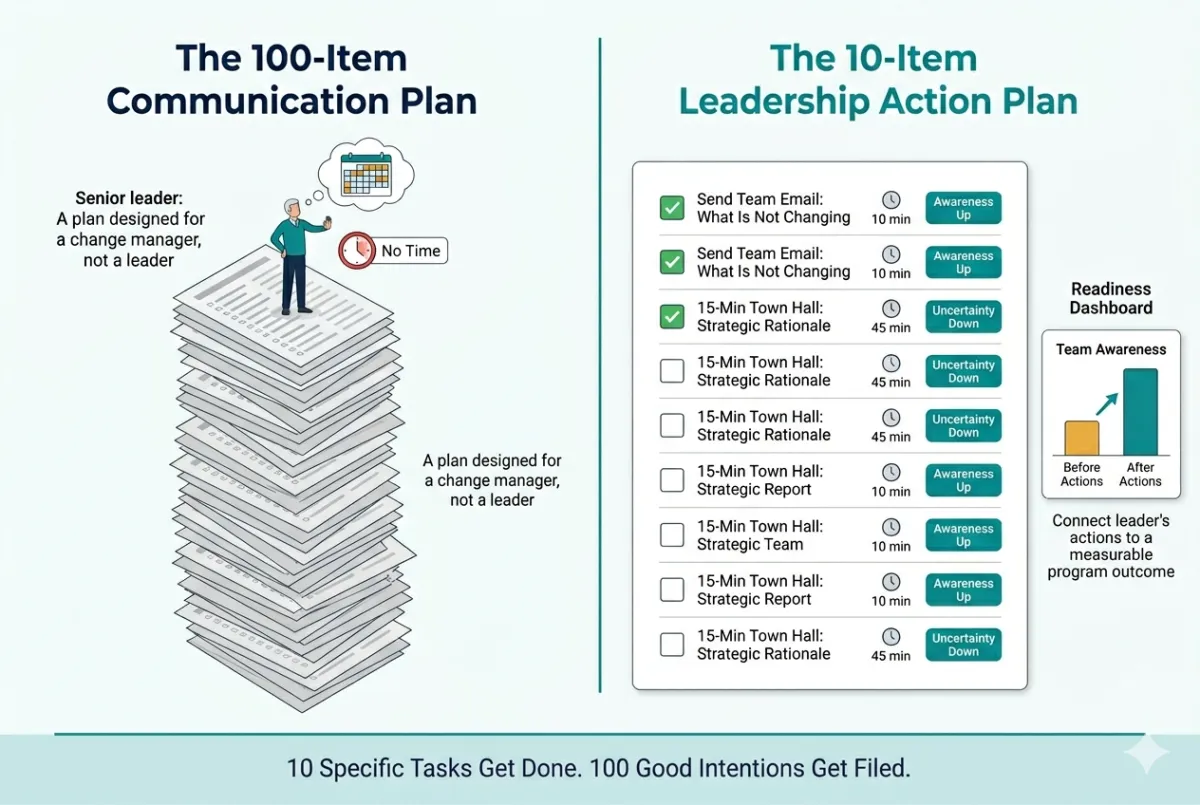
A hundred-item communication plan handed to a senior leader is not a call to action. It is a document that will be filed, forgotten, and quietly abandoned the moment the next operational priority arrives. Ten specific, sequenced, time-bounded tasks with a clear purpose for each one is what gets done.
Key Takeaways
Active and visible sponsorship is so critical to change efforts that it can make or break a project or initiative. Executive sponsors must visibly support the change, build coalitions, and communicate directly. But visible sponsorship requires a plan that fits into an executive's actual working week, not one that was designed for a change manager's ideal engagement model.
The Leadership Action Plan Is Not the Communication Plan: The communication plan describes what needs to be communicated and when. The Leadership Action Plan describes what specific leaders need to do, personally and visibly, in what sequence, with what supporting materials, to make those communications credible and effective.
Change sponsorship must be built from the executive sponsor to frontline supervisors and team leaders. Change messaging throughout the sponsor cascade at all levels of supervisors and managers must be aligned and ongoing to build and sustain momentum and support for the change project. A Leadership Action Plan is the operational document that makes that cascade manageable rather than aspirational.
Bite-Sized Tasks Get Done. Overwhelming Plans Get Filed: The single most reliable predictor of whether a leader will execute their change management responsibilities is the simplicity and specificity of what they have been asked to do. A task that takes fifteen minutes and comes with a prepared script gets done. A responsibility that requires the leader to independently design their approach does not.
Measurement Closes the Loop: Adoption dashboards are becoming standard in executive governance packs, helping sponsors see exactly how changes are landing with different audience segments. When leaders can see the direct connection between their specific actions and the readiness data the OCM team is tracking, visible sponsorship becomes a data-informed discipline rather than a behavioral expectation with no feedback loop.
What Is a Leadership Action Plan and Why Does It Function as the Bridge Between Commitment and Behavior?
A Leadership Action Plan is a structured, sequenced set of specific actions assigned to individual leaders at defined points in the project timeline, each one designed to make their sponsorship of the change visible to the employees who need to see it. In organizational change management, it is the document that converts a leader's stated commitment into a calendar event, a prepared script, a specific team meeting, and a defined fifteen-minute task that produces a measurable outcome.
The leadership action plan guides how the executive sponsor will support and participate in the project. It maps out where the change manager can help support the executive sponsor to help them be successful in their role, including the specific coaching, communication, and engagement activities the sponsor needs to complete at each stage of the program. The critical distinction between this document and the broader communication plan is audience and granularity. The communication plan is designed for the OCM team. The Leadership Action Plan is designed for the leader, and every element of it must be calibrated to what that leader can realistically execute in the context of everything else competing for their time and attention.
There is more than one type of executive sponsor, and each type will have a slightly different role. Using a sponsorship roadmap and plan is essential to assess and manage the project's sponsors, tracking what these sponsors need to complete to increase the program's success as well as when those activities have been completed. The Leadership Action Plan is that roadmap made operational, translated from a strategic responsibility framework into a week-by-week, task-by-task schedule that a leader can follow without requiring change management expertise to interpret.
Why Most Sponsorship Plans Fail Before the First Leader Action Is Due
They were designed for an ideal leader with unlimited time. A communication plan that assigns forty-seven leadership responsibilities across a twelve-week project timeline is not a plan. It is a wish list. The leaders who receive it do not have forty-seven available slots in their calendar for change management activities. They have approximately two to three hours per week that are not already committed to operational responsibilities, and those hours must compete with every other strategic initiative the organization is running simultaneously. A Leadership Action Plan that does not account for that reality will not be executed regardless of how committed the leader is to the change.
They fail to distinguish between what the leader needs to know and what they need to do. Most sponsorship plans are informational. They tell leaders what the change involves, what the impact will be, and what the communication strategy looks like. Very few of them tell leaders specifically what to say on Tuesday morning, to which audience, in how many minutes, using which prepared materials. Change sponsors must be able to articulate a compelling vision, benefits, and the path forward. They need the supporting materials that make that articulation possible, not just the expectation that they will develop it independently.
They provide no feedback mechanism that connects leader action to program outcomes. A leader who executes their action plan tasks without any visibility into whether those actions are producing movement in the readiness data has no evidence to sustain their engagement. Sponsorship behaviors that produce no visible connection to outcomes gradually deprioritize themselves. When leaders can see adoption dashboards and readiness scores alongside their own action completion rates, the connection between their specific sponsorship behaviors and the program's measurable progress becomes visible. That visibility is what sustains active sponsorship through the middle phases of a project when the initial commitment energy has faded and competing priorities are at their peak.
They conflate visibility with activity. A leader who attends every steering committee meeting, reviews every OCM status report, and responds to every change manager email is not necessarily a visible sponsor. Visibility in a change management context means being seen by the employees who are being asked to change, in the channels and formats that reach them, saying the specific things that address their specific concerns. A leader who is active in the governance structure but invisible to the impacted workforce is not providing the sponsorship that adoption depends on.
How to Build a Leadership Action Plan That Leaders Actually Execute: A Step-by-Step Framework
Step 1: Assess Each Leader's Available Bandwidth Before Assigning Any Actions
The Leadership Action Plan must be built around the reality of each leader's calendar, not around the ideal version of their sponsorship role. An action plan that a leader cannot realistically execute is not a plan. It is a list of things that will not happen.
What to do: Before drafting a single task, have a direct conversation with each leader or their executive assistant about the realistic number of hours per week that can be dedicated to change-related activities. Identify the existing meeting structures where change-related content can be embedded rather than requiring separate calendar slots. Confirm the preferred communication channels and formats for each leader.
Action: Map the project timeline against each leader's known peak demand periods, such as budget cycles, board reporting periods, and major operational reviews, and design the action plan around those constraints rather than assuming consistent availability throughout the project.
Goal: A baseline capacity profile for each leader that becomes the maximum envelope within which the Leadership Action Plan is designed, ensuring that every task assigned is assigned because it fits the leader's reality rather than because it fits the OCM team's ideal engagement model.
Step 2: Build a Task List of Ten Core Actions Per Phase, Not a Hundred-Item Program
The principle of the bite-sized task list is not a compromise. It is the design decision that determines whether the plan gets executed. Ten specific, sequenced, time-bounded actions per project phase is the format that gets done. A hundred-item program organized by communication channel and audience segment is the format that gets filed.
What to do: For each project phase, identify the ten most critical leader behaviors that the OCM strategy depends on. These will typically cluster around four categories: visible communication actions where the leader sends or delivers a specific message to a specific audience; active engagement actions where the leader participates in a defined session or meeting; individual coaching actions where the leader has a specific conversation with a direct report about the change; and resistance response actions where the leader addresses a specific concern or objection that the readiness data has surfaced.
Action: Assign each of the ten actions a specific time estimate, a defined output, and a prepared supporting material. A ten-minute email to a team of thirty with a prepared draft template is a task. A forty-five-minute town hall with a prepared talking points document and a Q&A briefing is a task. An undefined responsibility to support the change at every opportunity is not.
Goal: A ten-item action list per phase that every leader can see fits within their available bandwidth, that every item is specific enough to be scheduled as a calendar event, and that every item comes with everything the leader needs to execute it without requiring additional preparation on their part.
Step 3: Prepare Every Supporting Material Before Handing the Leader Their First Task
A leader who receives a task without the materials needed to execute it will either improvise, delegate, or defer. All three outcomes produce the same result: the visible sponsorship the change strategy depends on does not happen in the way the plan intended.
What to do: For every action in the plan, prepare the specific supporting material before the task is assigned. Email templates with the key messages pre-written and a note indicating where personalization is welcome. Talking points documents with three to five bullet points that cover the why, the what, and the what is not changing. One-page briefing notes for one-on-one conversations with direct reports who have raised specific concerns in the readiness data.
Action: Build a leadership coaching plan that gives frontline managers the resources needed to support their staff effectively, with materials specific enough that the manager's preparation requirement is thirty minutes of review rather than two hours of independent drafting. The same principle applies to all leaders at every level of the sponsor cascade.
Goal: A Leadership Action Plan where the change manager has already done the preparation work that would otherwise prevent execution, leaving the leader with only the judgment calls and personal relationship elements that genuinely require their specific voice and authority.
Step 4: Connect Each Leader Action to a Specific Readiness Outcome
Leaders execute their action plans more consistently when the connection between a specific task and a measurable program outcome is visible. An action that exists in isolation on a task list competes with every other priority on the leader's calendar on equal terms. An action that is explicitly connected to a readiness metric the leader has been briefed on has a business case that justifies the time investment.
What to do: For each action in the Leadership Action Plan, add a single line that describes the specific readiness outcome the action is designed to produce. A team communication on what is not changing is designed to reduce the uncertainty score in the next pulse check for that team. A town hall on the strategic rationale is designed to move the awareness score for a specific department from its current level to the target level before the next phase gate.
Action: Identify three to five adoption-related KPIs at the start of every project and report them consistently to sponsors and leadership, so that the dashboard the leader reviews at each milestone includes both the program's readiness data and their own action completion rate side by side.
Goal: A Leadership Action Plan where every task is connected to a measurable outcome that the leader can track, creating the feedback loop that sustains active sponsorship through the phases of the project when initial commitment energy has naturally faded.
Step 5: Review and Update the Plan at Every Project Milestone
The actions that were critical in the awareness phase are not the same actions that are critical in the training phase or the Go-Live phase. A Leadership Action Plan that is set once and never updated becomes progressively less relevant as the project evolves, and leaders who follow an outdated plan are executing the right behaviors for a phase the project has already left.
What to do: At each project milestone, review the Leadership Action Plan alongside the current readiness data and update the next phase's ten-item task list to reflect what the data shows is most needed from leadership at that specific point in the employee journey.
Action: Present the updated plan to each leader as a brief at the milestone review rather than as a document drop. A five-minute verbal brief that covers what the data shows, what the next ten actions are, and why each one matters at this specific phase is significantly more likely to produce execution than an updated document that requires the leader to independently interpret its relevance.
Goal: A Leadership Action Plan that evolves with the program, is always calibrated to the current state of employee readiness, and is never more than ten specific tasks ahead of the leader's current position in the change journey.
Frequently Asked Questions
What do I do when a leader consistently fails to execute their action plan tasks?
The first diagnostic question is whether the plan was designed for their actual bandwidth or for an idealized version of their availability. If the actions are genuinely within the time envelope the leader confirmed, the next conversation is about the specific barrier: do they lack confidence in delivering the message, are they uncertain about how to handle the questions the action might generate, or is there a competing operational priority that has displaced the change management commitment? Each barrier has a different solution, and none of them is resolved by adding more items to the plan.
How do I handle a leader who wants to customize the prepared materials significantly?
Encourage meaningful personalization while protecting the core message. A leader who rewrites the prepared email template in their own voice and adds a personal anecdote about why they believe in the change is executing exactly the kind of authentic visible sponsorship that the plan is designed to produce. A leader who removes the specific commitment language or changes the factual content about what is and is not changing is creating a consistency risk that needs to be addressed directly before the message goes out.
How many leaders should have their own Leadership Action Plan?
Every leader whose direct reports are materially impacted by the change should have a plan. This typically includes the executive sponsor, the senior leaders of each significantly impacted department, and the frontline managers whose team meetings are the primary channel through which the change narrative reaches employees. The plan's complexity and the number of actions per phase should be calibrated to each leader's level in the hierarchy and the size of their impacted team.
Is the Leadership Action Plan an OCM document or a project management document?
It is both, and it needs to live in both places to be effective. The OCM team owns the content and the update cycle. The project manager owns the milestone integration and the accountability tracking. When the Leadership Action Plan is treated as an OCM-only document, it sits outside the project's formal governance structure and is easier for leaders to deprioritize. When it is integrated into the project milestone reviews alongside technical deliverables, leadership action completion becomes a project health indicator with the same visibility as requirements sign-off or testing completion.
Final Thoughts
The most committed sponsor in the organization cannot drive adoption from a hundred-item plan they cannot execute. The most carefully designed change strategy produces no visible leadership behavior if the actions it requires are too numerous, too vague, or too disconnected from the reality of a senior leader's calendar to find their way onto it.
The Leadership Action Plan is the document that closes the gap between a leader's genuine commitment and their visible behavior. Build it around their actual bandwidth. Keep each phase to ten specific, prepared, time-bounded tasks. Connect every action to a measurable readiness outcome. And update it at every milestone so that what leaders are doing is always calibrated to what their employees currently need from them.
Reflective Question: Think about the last engagement where a leader's sponsorship was weaker than the program needed. Was there a specific Leadership Action Plan that told them exactly what to do, when to do it, and with what materials? If the answer is no, that document is the gap between the sponsorship you had and the sponsorship the program required.
Get practical insights on change and business analysis delivered to your inbox. Join our mailing list


