Your Employees Lied on That Survey and You Built Your Entire Change Plan Around It
Introduction
Most organizations assess change readiness the same way. An email goes out. A link to a fifteen-question survey follows. Responses trickled in over a week, skewed toward the people who were either most enthusiastic or most anxious about the change, and largely ignored by the majority who clicked delete. The results are compiled into a report, a readiness score is calculated, and the change plan is built on the assumption that the data is representative.
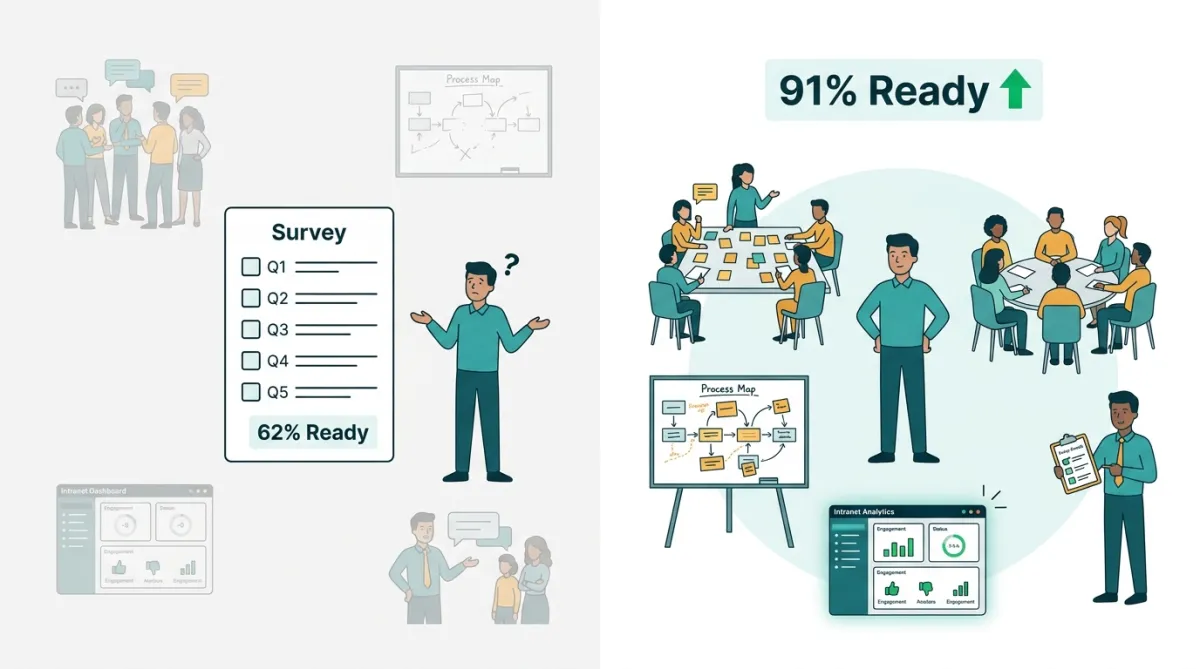
It rarely is. Survey data measures awareness, attitudes, and confidence levels at scale, but it cannot explore underlying concerns, organizational history, or the gap between what employees say in writing and what they actually believe about the change. The problem is not that surveys are useless. The problem is that they have been treated as the complete picture when they are at best one layer of it.
Change managers who consistently deliver high adoption rates do not rely on a single measurement method. They know that genuine organizational readiness lives in the conversations nobody is having in writing, the behaviors visible in team meetings, the patterns buried in intranet data, and the candid observations that only surface when someone asks the right question in the right setting. Measuring readiness accurately requires moving beyond the survey and into the organizational environment itself.
Key Takeaways
Surveys Measure What People Are Willing to Say in Writing: That is a narrow and often sanitized version of how they actually feel about the change. Qualitative methods surface what quantitative data consistently misses.
Readiness Is Behavioral, Not Just Attitudinal: An employee who says they are ready on a survey but continues to use the old process two weeks after Go-Live was never actually ready. Measuring readiness means measuring behavior, not just stated intention.
Combining quantitative and qualitative data builds a comprehensive picture of organizational readiness that no single method can produce on its own. The most accurate readiness assessment uses multiple methods in deliberate combination.
The Environment Holds Data Your Survey Cannot Capture: Intranet usage patterns, training completion rates, support ticket volumes, and manager meeting behaviors all carry readiness signals that do not require a single survey response to surface.
Creative Methods Build Readiness While Measuring It: A well-facilitated workshop or focus group does not just collect data. It builds the psychological safety and shared understanding that make people more prepared for the change in the process of assessing how prepared they already are.
Why the Survey-Only Approach Produces a False Picture of Organizational Readiness
The standard change readiness survey has a specific and well-documented limitation that most organizations choose to overlook. It asks people to self-report their own preparedness for a change that, in many cases, they do not yet fully understand. The result is a dataset that reflects confidence in the abstract rather than readiness in the specific.
Conducting interviews and focus groups provides qualitative insights into employees' thoughts and feelings that facilitate open discussions, uncovering deeper issues that may not surface in surveys. These deeper issues are almost always the ones that determine whether a change succeeds or stalls. The employee who responds positively to a readiness survey but is privately certain that the new system will break their team's most critical workflow is not a readiness risk your survey will ever identify. They are a resistance risk that only a conversation will surface.
Observation and process reviews assess how work is currently done and where the gaps between current practice and future state requirements actually lie. This is the dimension of readiness that no survey question can reach, because it requires watching how people work rather than asking them to describe it. The gap between how a process is documented and how it is actually executed is one of the most consistent predictors of post-Go-Live resistance, and it is invisible to any method that relies solely on self-reporting.
The organizations that build the most accurate readiness pictures are the ones that treat measurement as a multidimensional diagnostic rather than a compliance exercise. They combine the breadth that surveys provide with the depth that qualitative and observational methods produce. The result is a readiness assessment that reflects the organization as it actually is rather than the version of it that employees present when they know they are being formally evaluated.
5 Creative Ways to Measure Organizational Readiness Beyond the Survey
Method 1: Facilitated Readiness Workshops
A readiness workshop is not a training session. It is a structured environment where groups of impacted employees work through scenarios related to the upcoming change, revealing their actual level of preparation through the quality of their responses rather than through their answers to explicit questions.
What to do: Design a scenario-based workshop where participants are asked to walk through how they would handle specific situations in the new environment. Frame each scenario around a real workflow or decision point that the change will affect.
Action: Observe where participants hesitate, where they defer to others, and where they default to the old process when describing their approach. These behavioral signals are your most accurate readiness indicators.
Goal: Build the shared psychological state in which organizational members feel committed to implementing the change and are confident in their collective abilities to do so, while simultaneously generating the qualitative readiness data that a survey cannot produce.
Why it matters: A workshop that surfaces a critical knowledge gap in week four of a project costs a targeted training intervention. The same gap surfacing at Go-Live costs adoption rates, support ticket volume, and leadership confidence in the OCM function.
Method 2: Small-Group Focus Groups Designed Around Honest Dialogue
The standard focus group fails for the same reason the standard survey fails: when people feel they are being formally evaluated, they tend to represent their best version of readiness rather than their actual version. The design of the focus group determines whether you get data or performance.
What to do: Keep groups small, between five and eight participants, and structure the conversation around open-ended questions about their current understanding of the change rather than their readiness for it. People who cannot accurately describe what is changing are not ready for it, regardless of what they report on a scale of one to five.
Action: Facilitate in-depth discussions with representative groups of employees to gather qualitative data on their perspectives and concerns, and use this data alongside survey results rather than in place of them.
Facilitation tip: Ask participants to describe a specific situation in their current role that the change will affect. Their ability to connect the change to their own daily work is one of the most reliable early indicators of genuine readiness at the individual level.
Goal: A qualitative readiness dataset that segments resistance by type, distinguishing between employees who are unaware, employees who are aware but concerned, and employees who understand the change but lack confidence in their ability to execute it, because each type requires a different intervention.
Method 3: Team Whiteboard Sessions for Process Mapping
One of the most consistently underused readiness measurement tools is also one of the most revealing: asking teams to map their current process on a whiteboard and then overlay what they understand of the new one. The gaps, contradictions, and blank spaces that appear in that exercise are your most accurate picture of where readiness is genuinely low.
What to do: Schedule thirty to forty-five-minute whiteboard sessions with representative teams from each impacted department. Ask them to draw their current end-to-end workflow for a specific process that the change will affect, and then ask them to annotate it with what they expect will be different in the new environment.
Action: Pay attention not just to what they draw but to what they cannot draw. A team that cannot describe how a specific handoff point will work in the new process has a readiness gap that no amount of survey data would have surfaced because they would not have known how to express it in a multiple-choice format.
Goal: A process-level readiness map that identifies specific workflow gaps, training needs, and communication priorities for each impacted team, grounded in their actual understanding rather than their self-reported confidence.
Method 4: Passive Data Observation Through Intranet and System Behavior
Organizational readiness leaves a behavioral trail that most change managers never look at. Intranet page views, training module completion rates, support ticket categories, and help-desk inquiry volumes all carry readiness signals that do not require a single survey response to generate.
What to do: Work with your IT and communications teams to set up tracking on the change-related intranet pages, training completion dashboards, and any system that employees are expected to engage with as part of the readiness process.
Action: Monitor which departments are engaging with readiness materials and which are not. Track training completion rates by team and by role. Review the categories and volumes of support queries being raised in advance of Go-Live. Each of these data streams tells you something specific about where readiness is building and where it is stalling.
Goal: Use organizational metrics as objective indicators of readiness that complement the attitudinal data your surveys collect, giving you a behavioral layer of evidence that self-reporting cannot produce.
Why it matters: A team with a thirty percent training completion rate two weeks before Go-Live is not a team with a readiness problem that requires communication. It is a team with a readiness crisis that requires an immediate, targeted intervention from their manager and sponsor.
Method 5: Manager Pulse Checks as a Distributed Sensing Network
Managers sit closer to employee sentiment than any survey or focus group. They hear the informal conversations, observe the behavioral signals, and absorb the team's emotional temperature around the change on a daily basis. Most change managers fail to deploy this resource systematically, which means the most granular readiness intelligence in the organization stays trapped in the heads of a hundred middle managers rather than flowing into the organizational change management team's planning process.
What to do: Facilitate leadership alignment workshops and stakeholder briefings that equip managers not just to communicate the change but to listen for and report readiness signals from within their teams.
Action: Establish a simple, structured pulse check cadence with managers, a brief weekly or biweekly conversation using three to four consistent questions about their team's current awareness, their most common concerns, and any behavioral signals of resistance they have observed. Document responses and track patterns across departments over time.
Goal: A distributed readiness sensing network that gives the organizational change management team near real-time visibility into the human state of the organization between formal assessment points, surfacing emerging resistance before it becomes entrenched and identifying pockets of strong readiness that can be used to build change champion momentum.
Frequently Asked Questions
How do I get leadership to approve methods that take more time than a survey?
Frame every method in terms of the risk it prevents rather than the time it requires. A facilitated workshop that identifies a critical process gap in week six of a project costs two hours and produces an actionable intervention. The same gap discovered at Go-Live costs adoption rates, productivity, and executive confidence in the change program. Present the comparison as a risk-adjusted investment, not as an optional enhancement to the standard approach.
How do I choose which methods to use given constraints on time and resources?
Start with the impacted groups that carry the highest risk to adoption. High-power, low-readiness groups warrant the most intensive methods, including workshops and focus groups. Broader populations can be assessed through passive data observation and manager pulse checks, which scale without requiring significant time from the OCM team. A tiered approach allows you to deploy intensive methods where they generate the most value and lighter-touch methods where coverage is more important than depth.
What do I do with the qualitative data I collect from focus groups and workshops?
Categorize responses by readiness dimension: awareness, acceptance, knowledge, and capability. Look for patterns across departments and roles rather than focusing on individual responses. The goal is to identify systemic gaps that require a programmatic response, not to evaluate individual employees. Present findings to the project sponsor as a prioritized risk register with a corresponding set of targeted interventions, not as a raw collection of employee quotes.
How do I maintain psychological safety in focus groups so I get honest responses?
Be explicit at the outset about how responses will be used. Make it clear that the session is not an evaluation of individual performance and that findings will be reported in aggregate without attribution. Remove anyone from the session whose presence might inhibit honest discussion, including direct line managers. The quality of the data you collect is directly proportional to the level of safety participants feel in sharing what they actually think rather than what they believe is expected of them.
Final Thoughts
A readiness score calculated from a survey that half the organization ignored is not a readiness assessment. It is a measurement of the willingness of engaged employees to complete a form. The change plan built on top of it is not grounded in the organization's actual state. It is grounded in the version of the organization that was willing to respond.
The five methods in this post do not replace surveys. They complete them. Used in deliberate combination, they give a change manager the kind of multidimensional readiness picture that makes every subsequent decision, from communication design to training prioritization to Go-Live timing, grounded in evidence rather than approximation.
The organizations that achieve the highest adoption rates are not the ones with the most sophisticated survey tools. They are the ones whose change managers went into the rooms where the real conversations were happening and asked the questions that a multiple-choice scale was never designed to answer.
Reflective Question: Think about the last readiness assessment you conducted. Beyond the survey, what qualitative data did you gather? If the honest answer is very little, which of these five methods could you implement in the next two weeks on your current engagement, and what specific gap in your readiness picture would it most likely fill?
Get practical insights on change and business analysis delivered to your inbox. Join our mailing list


