Why Your Single Change Plan Keeps Failing to Drive Real Adoption
Introduction
Have you ever supported a change initiative that went live successfully, only to watch adoption quietly stall a few months later?
If so, the problem was likely not the technology or the timeline. It was the change strategy.
Most projects rely on a single Change Plan to manage the human side of transformation.
But one plan cannot address the diverse needs of frontline employees, middle managers, and executives at the same time.
It cannot scale to meet unexpected resistance, and it rarely survives contact with reality past the Go-Live date.
This post breaks down a better approach: the Organizational Change Management Blueprint, and the sub-plans that make it work.
Key Takeaways
Move Beyond the Checklist: Real change requires a strategy that tracks human milestones, not just technical Go-Live dates.
Address Stakeholder Diversity: Different groups require different messages, levels of training, and support structures to thrive.
Manage Resistance Proactively: Resistance is a natural part of the process; a blueprint provides the tools to listen, resolve concerns, and move forward.
Plan for the Long Term: Sustainability is the goal. Without a plan for what happens after launch, teams often revert to old habits within months.
Align with Project Management: The Organizational Change Management Blueprint must be integrated with the master project plan to ensure human readiness matches technical availability.
What is the Organizational Change Management Blueprint?
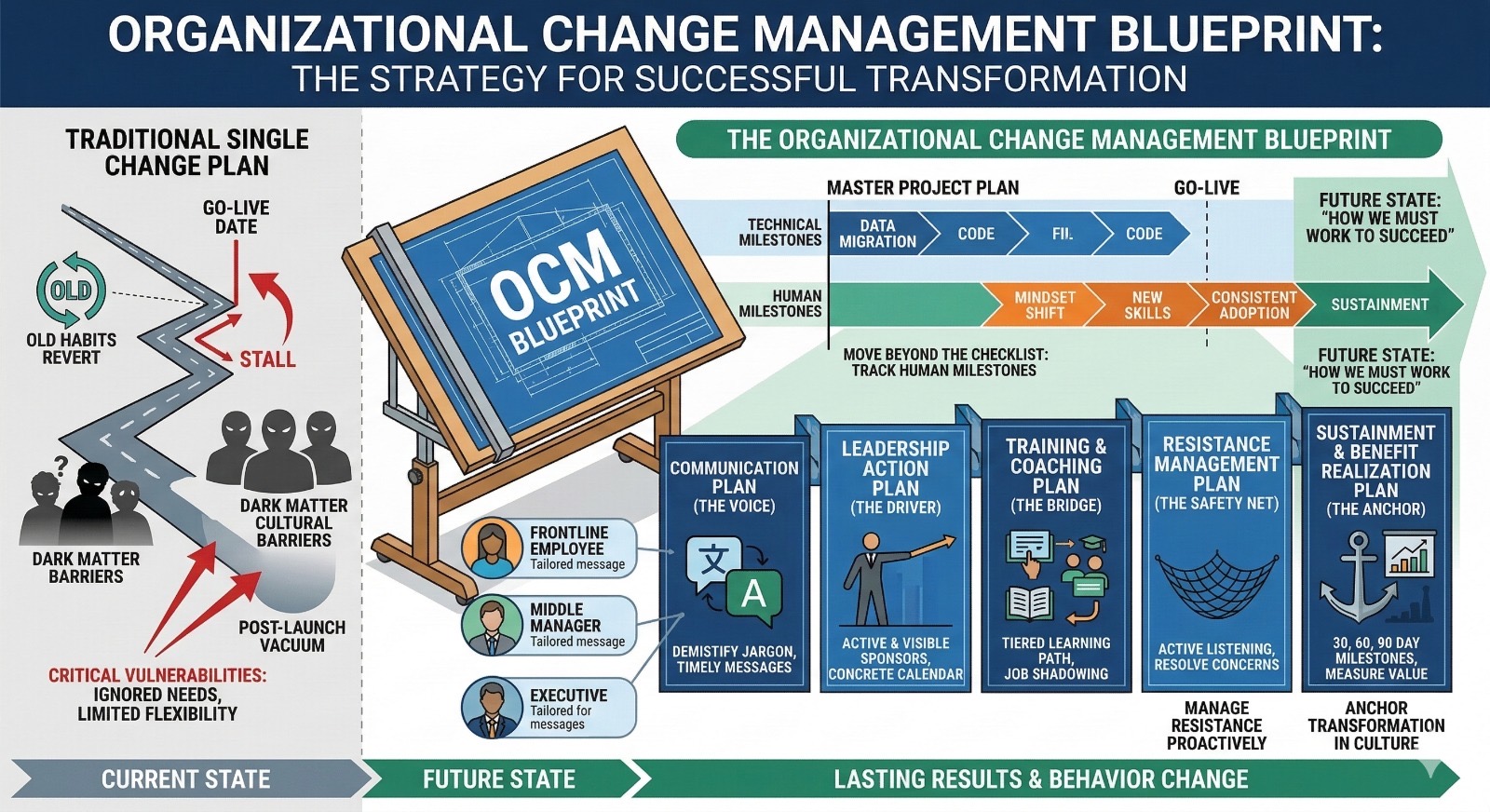
The Organizational Change Management Blueprint is a comprehensive framework composed of several interconnected sub-plans that work in parallel to enable successful organizational transformation. While a master project plan tracks technical milestones such as data migration, environment setup, or software coding, the OCM Blueprint tracks the human milestones that determine whether those technical tools will actually be used.
In the context of change management, these human milestones include mindset shifts, the acquisition of new skills, and the consistent adoption of new behaviors. The blueprint serves as the central reasoning engine for the change, ensuring that no stakeholder group is left behind and no cultural risk is left unaddressed. It is the architectural plan for how the organization will move from its current state of how we do things now to a future state of "how we must work to succeed."
Why is an OCM Blueprint Important?
Without a holistic blueprint, change initiatives often suffer from dark matter, those unspoken organizational assumptions and cultural barriers that lead to project failure. Relying on a single plan creates several critical vulnerabilities:
1. Diverse Stakeholder Needs Are Ignored
A frontline employee needs to know how their specific daily tasks will change and whether their job is secure. An executive, conversely, needs to know how to defend the project’s budget to the board and how the change aligns with the company's three-year vision. You cannot effectively reach both groups with the same generic email or town hall. The blueprint allows you to segment your approach based on the specific context of each group.
2. Cultural Risks Are Left to Chance
Every project faces different hurdles. One initiative might have high technical complexity but low cultural resistance (requiring a heavy Training Plan). Another might be technically simple but face high resistance because it disrupts established power structures (requiring a robust Resistance Management Plan). A single plan lacks the flexibility to scale the effort toward the area of greatest risk.
3. The Post-Launch Vacuum
Most single plans end abruptly at the Go-Live date. This creates a vacuum where employees, feeling the friction of the new system, quickly revert to old, comfortable habits once the project team departs. A blueprint includes a Sustainment Plan to anchor the change in the organizational culture, ensuring that the benefits of the project are realized for years, not just weeks.
How to Build a High-Impact Organizational Change Management Blueprint (Step-by-Step)
To drive successful adoption, a Change Management professional should develop these five essential sub-plans in parallel. Here is a simple step-by-step framework you can follow:
Step 1: Develop the Communication Plan (The Voice)
This plan defines what is being said, who is saying it, and which channels are most effective for different audiences. It acts as the translator, demystifying complex technical project jargon into simple, actionable language.
Action: Map your messages to the project timeline. Ensure stakeholders receive information exactly when they need it, not too early to forget, and not too late to panic.
Why it matters: Effective communication reduces the split-attention effect, where stakeholders are overwhelmed by too much information at once.
Tip: Use the “You” Attitude in all communications, focusing on the benefits for the reader rather than just the goals of the project.
Step 2: Create the Leadership Action Plan (The Driver)
Change is top-down, and leadership sponsorship is often the #1 predictor of project success. This plan outlines specific actions for executives and managers to show they are active and visible supporters.
Action: Don't just ask leaders to support the change; give them a concrete calendar of events where they need to appear, speak, or physically demonstrate the new tool.
Common Pitfall: Assuming leaders know what to do. You must act as their coach, providing talking points and guiding their interactions.
Why it matters: Active leadership builds trust and signals that the change is a priority, not an optional request.
Step 3: Design the Training and Coaching Plan (The Bridge)
This bridges the gap between knowing about a change and being able to execute it. Training must be more than a one-time lecture; it should be a tiered learning path.
Action: Segment your training based on user proficiency. Power users may need deep-dive technical sessions and worked examples, while casual users might only need Quick Start, guides or completion tasks.
Tip: Incorporate Job Shadowing into your design to see how users actually work. This ensures training addresses real-world workarounds and not just theoretical processes.
Why it matters: It manages the germane load, the productive mental effort needed to build new mental models (schemas) for the new way of working.
Step 4: Implement the Resistance Management Plan (The Safety Net)
Resistance is not a sign of failure; it is a natural, human response to the loss of the familiar. This plan identifies potential hot spots of resistance and defines how to resolve concerns.
Action: Identify Change Champions, influential, well-respected peers within the teams who can provide honest feedback to the project team and help move their colleagues along.
Approach: Be an active listener. Portraits of failure or skepticism are often feedback in disguise. Addressing them directly builds empathy and helps you fix flaws in the solution.
Goal: Move from command and control toward an autonomy-supportive tone that empowers employees to own their piece of the change.
Step 5: Execute the Sustainment and Benefit Realization Plan (The Anchor)
This plan answers the most important question: Is it working? It tracks adoption metrics and identifies where corrective actions are needed after the launch.
Action: Set specific milestones for 30, 60, and 90 days post-launch. Audit usage data, conduct pulse surveys, and celebrate early wins to keep momentum high.
Validation: Check if the solution is actually delivering value. Has it improved the quality of work? Has it made processes more efficient?
Why it matters: Without sustainment, the organization will not realize the planned business benefits, rendering the entire project investment a loss.
Frequently Asked Questions
Does every project need a 50-page Organizational Change Management Blueprint?
No. You must size to fit. A small process update might only require a light communication schedule and a single FAQ sheet. A massive ERP implementation, however, requires the full depth of all five sub-plans. The complexity of your blueprint should always match the scale of the human impact.
How do we integrate Organizational Change Management milestones into an Agile project?
In an Agile environment, the OCM Blueprint becomes iterative. You reflect and adapt your sub-plans at the end of every sprint. Instead of one giant training session, you might deliver bite-sized learning modules as new features are released.
What is the biggest risk to a Change Plan?
The biggest risk is dark matter, making assumptions about stakeholder readiness without actually eliciting their feedback. If you don't engage with the people doing the work, you will build a plan for a reality that doesn't exist.
When should the Sustainment Plan begin?
Sustainment planning should actually begin during the design phase of the project. You need to know how you will measure success long before you flip the switch to Go-Live.
Final Thoughts
A single Change Plan is a good start, but an OCM Blueprint is a strategy for success. By breaking your approach down into specialized sub-plans that address communication, leadership, training, resistance, and sustainment, you ensure that every stakeholder is supported and every project benefit is realized.
Look at your current project. Do you have a plan for what happens 90 days after Go-Live? If not, start drafting a simple Sustainment Plan this week. Your goal is not just to launch a project; it is to anchor a transformation that leads to lasting results for your organization.


