Why Your Change Strategy Might Be the Biggest Source of Disruption on Your Project
Introduction
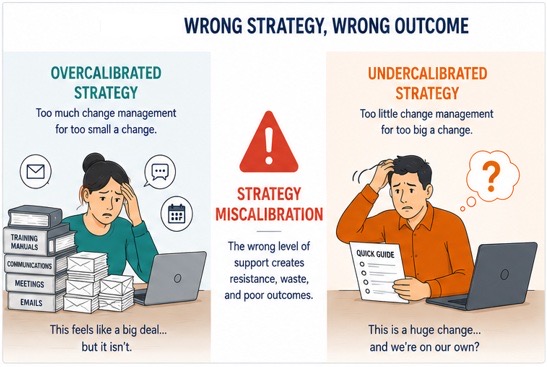
There is a specific kind of change management failure that receives very little attention in the professional literature, not because it is rare but because its consequences look like something else entirely. The project is overmanaged. The communication volume is disproportionate to the scale of the shift. The training program was built for a workforce undergoing a fundamental transformation but deployed on a team switching from one digital platform to a slightly better one. Employees are not resisting the change. They are resisting the change management response to it.
This failure has a name. It is called strategy miscalibration, and it begins with a diagnostic step that most change managers either skip entirely or complete without the rigor it demands: assessing the actual amount of change that is taking place.
The magnitude of a given change will impact how employees react and how you should manage the change. Assessing the disruptive nature of your change requires asking how big the gap is between the future state and the current state, how different the future state is from the current state, and how much of a departure from current operations the future state actually represents. These may seem like simple questions, but they are often overlooked. The change manager who cannot answer them precisely before building a strategy is building a plan calibrated to an imagined change rather than the actual one.
Key Takeaways
The Amount of Change Determines the Intensity of the Strategy: Your change management strategy and plans should reflect whether the change is incremental or radical. Do not treat every group the same way. Adjust your approach based on how the change uniquely impacts individuals and groups. An incremental change receiving a radical change strategy wastes organizational resources and generates unnecessary anxiety. A radical change receiving an incremental strategy produces catastrophic under-support at the moment of highest employee need.
Radical change involves significant and abrupt shifts that can be disruptive to an organization, typically requiring a large investment of resources and often involving a complete overhaul of existing systems and processes. Incremental change involves making small improvements over time, allowing organizations to test and refine their approaches and build momentum gradually. The OCM response to each must be proportional to its nature.
The Gap Between Current State and Future State Is the Single Most Important Variable: A change that moves people from one digital platform to another similar one is not the same change as one that moves people from a fully manual process to a fully digital one, even if both are described as system implementations in the project charter.
Miscalibration in Either Direction Has a Cost: An overcalibrated strategy wastes resources, over-communicates to audiences who were never anxious, and trains capabilities that were never at risk. An undercalibrated strategy fails to prepare employees for a transition they genuinely need support through and produces the adoption gaps that become the program's legacy.
Implementing changes in phases and rolling them out incrementally when possible minimizes disruption and allows for adjustments based on early feedback. Phased implementation reduces risk and builds confidence, but this approach is only appropriate when the change genuinely supports it. Applying it to a radical shift as a risk-reduction strategy often simply delays the disruption rather than managing it.
What Is the Amount of Change and Why Does It Function as the Foundation of Every Strategic Decision?
In the context of incremental versus radical change, the key questions are how big the gap is between the future state and the current state, how different they are from each other, and how much of a departure from current operations the future state represents. In organizational change management practice, answering these questions precisely is not a philosophical exercise. It is the diagnostic that determines the size, intensity, and design of every element of the change strategy that follows it.
An incremental change is one where the future state is recognizably similar to the current state. The core workflows remain the same. The skills required are an extension of existing ones rather than a replacement of them. The cultural and behavioral expectations of the organization do not fundamentally shift. Switching from one project management software platform to a newer version of the same product is incremental. Upgrading to a new smartphone model after years on the same operating system is incremental. The learning curve is real but short, the anxiety is manageable, and the support required is calibrated accordingly.
A radical change is one where the gap between the current state and the future state is large enough that employees cannot bridge it through familiarity, informal learning, or minor adjustment. Moving an entire workforce from paper-based manual processes to a fully integrated digital platform is radical. Restructuring a departmental operating model around entirely new roles and accountability frameworks is radical. Implementing an enterprise system that changes how every employee in the organization records, accesses, and reports information is radical. Radical change often requires a large investment of resources and a complete overhaul of existing systems and processes, which means the change management strategy must be designed to match that scale rather than to approximate it.
Why Getting This Assessment Wrong Costs More Than Building the Wrong Strategy
An overcalibrated strategy generates resistance where none existed. When employees receive a high-intensity change management program for a change they perceive as minor, the message they hear is not that the organization values their experience. It is that something about this change is more threatening than they were told. Extensive communication programs, mandatory training requirements, and formal resistance management plans deployed against an incremental change do not reassure people. They alarm them. The strategy becomes its own source of organizational anxiety.
An undercalibrated strategy fails people at the moment they need support most. A radical change that receives an incremental change management response leaves employees without the awareness, the skills, or the leadership support to make the transition successfully. The gap between where they are and where the new environment requires them to be is real, it is significant, and it does not close on its own without the structured support that an appropriately calibrated strategy would have provided. Assessing organizational readiness by examining current workload, past change experiences, and cultural factors reveals potential obstacles before they become problems. This assessment is only meaningful when the change magnitude has been correctly identified as the baseline.
It misaligns sponsor investment with actual risk. A sponsor who is asked to invest heavily in a change that does not warrant it will lose confidence in the OCM function's judgment. A sponsor whose attention is directed away from a radical change by a strategy that underestimates its magnitude will be unprepared for the level of visible leadership engagement the transition requires. Both outcomes damage the credibility of the change manager and the program in ways that compound over the course of the project.
It produces a communication program that either overwhelms or underinforms. The frequency, depth, and format of communications must be proportional to the size of the gap employees are being asked to cross. The size of the disruption of the change impacts the change management plans, including the communication strategy. An incremental change requires targeted, efficient communication designed to inform rather than to prepare. A radical change requires a sustained, layered communication program designed to build awareness, reduce anxiety, and incrementally develop the employee's readiness for a fundamentally different future state.
How to Correctly Identify the Amount of Change: A Step-by-Step Framework
Step 1: Map the Current State With Precision Before Assessing the Future State
The assessment of change magnitude is only as accurate as the picture of the current state it is measured against. A vague current state description produces a vague gap assessment and therefore a miscalibrated strategy.
What to do: Document the current state across three dimensions for each impacted group: the processes they currently follow, the systems and tools they currently use, and the skills and behaviors the current environment requires of them on a daily basis.
Action: Do not rely solely on documented process maps or system descriptions. Speak directly with frontline employees and managers about how the work is actually done, because the gap between the documented current state and the lived current state is often where the most significant change impact lives.
Goal: A current state profile for each impacted group that is specific enough to measure a precise gap against, rather than a high-level summary that obscures the detail the magnitude assessment depends on.
Step 2: Describe the Future State at the Same Level of Specificity
The project charter describes the future state in terms of the solution being delivered. The change manager needs to describe it in terms of what each impacted group will be doing differently on the day after Go-Live.
What to do: For each impacted group, translate the future state solution description into a role-level impact statement. What will this person start doing that they do not do today? What will they stop doing? What will they continue doing but in a fundamentally different way?
Action: Focus on the 10 Aspects of Change Impacts to build a more complete view of the change and better engage impacted groups. The goal is to understand the human experience of the future state, not just its technical specification. Pay particular attention to the behavioral and cultural dimensions of the future state, because these are the dimensions most likely to be underestimated in a project-management-led change narrative.
Goal: A future state profile for each impacted group that mirrors the format of the current state profile, making the gap between them immediately visible and measurable rather than implied by the difference between two differently structured documents.
Step 3: Measure the Gap Across Four Specific Dimensions
The gap between the current state and the future state is not a single variable. It has four distinct dimensions that each carry different implications for the change strategy, and each must be assessed independently before the overall magnitude can be accurately characterized.
What to do: Assess the gap across Process Change, which measures how significantly the workflows and procedures will shift; Technology Change, which measures how different the systems and tools will be from what employees currently use; Role Change, which measures how significantly the responsibilities, skills, and accountability of specific roles will shift; and Culture and Behavior Change, which measures how significantly the expected norms, values, and working relationships of the organization will need to evolve.
Action: Rate each dimension on a simple three-point scale: low impact, meaning the future state is a familiar extension of the current one; medium impact, meaning the future state requires meaningful new skills or adjusted behaviors; and high impact, meaning the future state requires employees to fundamentally abandon familiar ways of working in favor of new ones with no meaningful bridge from the current state.
Goal: A four-dimension gap profile that tells the change manager specifically where the magnitude is incremental and where it is radical, because a single project can be incremental on technology change and radical on culture change simultaneously, and both dimensions require different strategic responses.
Step 4: Classify the Overall Change Magnitude and Calibrate the Strategy Accordingly
With the four-dimension gap profile complete, the change manager can make an evidence-based classification of the overall change magnitude and use that classification to set the intensity of every subsequent strategic decision.
What to do: If the majority of dimensions score low to medium impact, the change is incremental and the strategy should be efficient and targeted: focused communication on what is changing and why, role-specific training on the new skills required, and a light-touch support model that provides access to resources without implying that the transition requires heroic effort.
Action: If one or more dimensions score high impact, particularly in the culture and behavior or role change dimensions, the change is radical in those areas regardless of how incremental the technology dimension appears. Radical change requires a large investment of resources and a comprehensive approach that builds awareness, desire, knowledge, ability, and reinforcement across each impacted group in proportion to the magnitude of what they are being asked to absorb.
Goal: A strategy calibration that is explicitly documented and presented to the project sponsor as the analytical foundation for the resource and timeline recommendations the OCM team is making, so that the investment in the change management program is connected to the evidence rather than to convention or estimation.
Step 5: Revisit the Magnitude Assessment at Each Project Milestone
The initial magnitude assessment is a snapshot of the gap between the current state and the planned future state at the point of project initiation. As the project evolves, the scope of the future state may expand, contract, or shift in ways that change the gap significantly.
What to do: Treat the magnitude assessment as a living document that is reviewed and updated at each major project milestone, with particular attention to any scope changes that alter the role impact, process impact, or culture and behavior impact dimensions.
Action: When a scope change significantly increases the magnitude of the change for a specific impacted group, escalate the strategy calibration implications to the project sponsor immediately rather than absorbing the change into the existing plan without adjustment.
Goal: A change strategy that is always calibrated to the actual magnitude of the change as the project currently stands, not the magnitude it was assessed at six months ago when the scope was different and the impacted population was less well understood.
Frequently Asked Questions
What do I do when different impacted groups face different levels of magnitude for the same change?
Design the strategy at the group level rather than the program level. A finance team moving from a paper-based approval process to a digital workflow is experiencing a radical change on the process and technology dimensions even if the sales team using the same system experiences only incremental disruption. Do not treat every group the same way. Adjust your approach based on how the change uniquely impacts individuals and groups, building tailored plans that match the actual magnitude each group is facing rather than averaging across the population.
How do I communicate a lower-intensity strategy to a sponsor who wants a large, visible change management program?
Frame the calibration as a credibility decision rather than a cost decision. A high-intensity program deployed against an incremental change does not make the organization look committed to its people. It makes the change management function look like it cannot distinguish between a simple upgrade and a fundamental transformation. Present the evidence base for the calibration clearly, and make the risk of overcalibration as explicit as the risk of undercalibration.
Is it ever appropriate to deliberately apply a higher-intensity strategy than the magnitude warrants?
There is one scenario where this is justified: when the organization has a poor historical track record with change and employee trust in the change management function is low. In this context, a slightly more intensive communication and engagement approach than the objective magnitude requires can help rebuild the credibility that future changes will depend on. The key is to be deliberate about this choice rather than to default to high intensity as a way of avoiding the diagnostic work that the magnitude assessment requires.
What is the most reliable indicator that a change has been miscategorized as incremental when it is actually radical?
The most reliable early indicator is the pattern of questions and concerns employees are raising in the first communication touchpoints. Incremental change generates operational questions: when does this happen, who do I contact if I need help, and how is my workflow affected. Radical change generates existential questions: will my role still exist, do I have the skills to succeed in this new environment, and why is this happening now. The nature of the questions tells you which type of change the organization is experiencing, regardless of how the project charter classified it.
Final Thoughts
The change manager who correctly identifies the amount of change before building a strategy is not just producing better plans. They are protecting the organization from the cost of being over-managed through a simple upgrade and under-supported through a fundamental transformation. Both failures are expensive. Both are preventable with a structured magnitude assessment conducted before the first communication is drafted.
The iPhone upgrade and the manual-to-digital transition are both changes. They are not the same change. They do not require the same strategy, the same communication program, the same training investment, or the same level of sponsor engagement. The diagnostic that distinguishes them is not complicated. The discipline to apply it consistently, on every project regardless of how confident the initial impression is, is where the professional practice is built.
Reflective Question: Think about the most recent change you managed or observed. Was the strategy calibrated to the actual gap between the current state and the future state, or was it calibrated to the category of change in the project charter? If the honest answer is the latter, the magnitude assessment is the exercise you do first on the next engagement.
Get practical insights on change and business analysis delivered to your inbox. Join our mailing list


