Why Your Case for Change Needs a Rationale
Introduction
Most transformation efforts don’t fail because the solution was wrong. They fail because adoption didn’t happen.
Yet in many organizations, the Case for Change is still presented in language that doesn’t land with executives. When leaders are thinking profitability, risk exposure, and execution, a people-centered pitch can feel like HR support rather than a strategic lever.
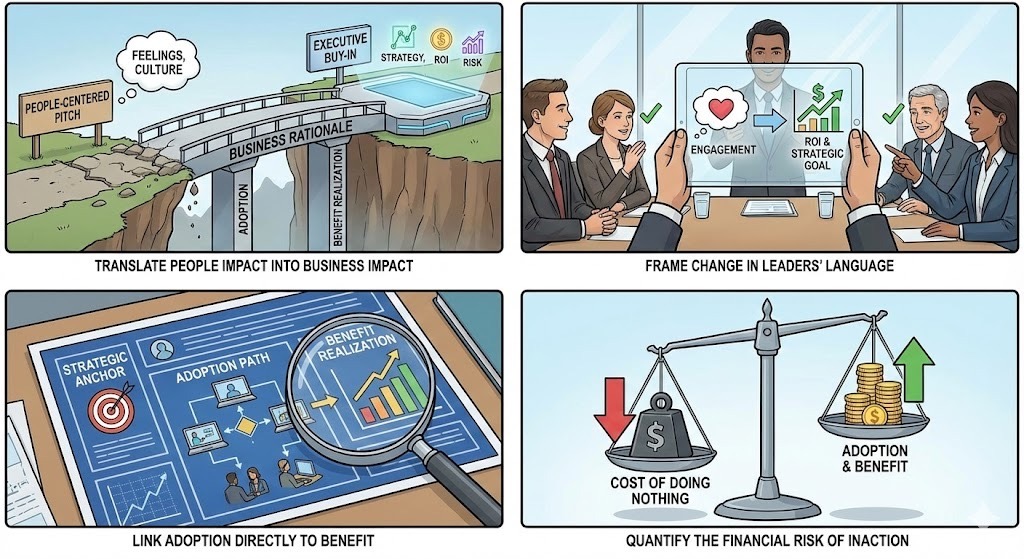
To get real sponsorship, you need to frame change in terms leaders prioritize. The most effective way is to present your Case for Change as a Business Rationale, one that links adoption directly to benefit realization.
What is a Business Rationale?
A Business Rationale is the logical, evidence-based justification for an initiative. While a standard Case for Change focuses on the journey of the people, a Business Rationale focuses on the Strategic Why.
It connects the human effort of changing habits and adopting new behaviors directly to the organization’s ability to meet its financial and operational goals. Essentially, it translates people impact into business impact.
Why is a Business Rationale Important?
Secures Funding and Resources: Executives don't fund feelings; they fund logical solutions to specific business problems.
Aligns Senior Leadership: A clear rationale gives leaders a unified script they can use to defend the project to shareholders and other departments.
Prioritizes Effort: When the rationale is clear, it becomes easy to identify which change activities are must-haves versus nice-to-haves based on their impact on the ultimate business goal.
Proves Value: It moves change management from a support function to a value-adding partner by showing exactly how people-readiness drives ROI.
How to Build a Business Rationale (Step-by-Step)
Use this framework to translate Change speak into Business speak for your next project pitch:
Step 1: Identify the Strategic Anchor
What to do: Determine the top-level business goal. Is it reducing customer churn? Complying with new regulations? Increasing market share?
Action: Find the KPI (Key Performance Indicator) that this initiative supports.
Example: Instead of saying, We need a better culture, say, We are targeting a 15% reduction in employee turnover costs.
Step 2: Quantify the Cost of Doing Nothing
What to do: Business leaders are naturally risk-averse. Instead of talking about unhappy employees, talk about the financial risk of staying the same.
Action: Calculate the lost revenue or increased operational costs associated with maintaining the current manual or inefficient process.
Step 3: Link Adoption to ROI
What to do: This is the most critical step. You must explain that the project’s Return on Investment (ROI) is mathematically dependent on people actually using the new tool or process.
Action: State it clearly: To achieve the projected $1M in savings, we require 85% of the staff to adopt the new process by the end of Q3.
Step 4: Present the Rationale Using Professional Terminology
What to do: Combine these points into a concise summary.
Tip: Avoid jargon like emotional transition and instead use terms like operational readiness, benefit realization, and solution proficiency.
Frequently Asked Questions (FAQ)
How do I make a business leader care about soft change activities?
The secret is to talk in dollars and time. If a change activity cannot be measured or linked to a cost, it is incredibly difficult for a business leader to value it. Instead of discussing engagement, discuss the reduction in downtime or mitigation of productivity loss that your change plan provides.
How do I ensure my change strategy doesn't get cut from the budget?
You must connect the ‘How’ to the ‘What.’ Every change activity, whether it’s a workshop, a newsletter, or a training session should directly support a specific business outcome. If a task doesn't have a straight line to a strategic goal, it will be viewed as overhead.
What is the best way to get executives to listen to my proposals?
Mirror their language. Stop using internal change management jargon and start using the vocabulary found in your company’s annual report or recent quarterly town halls. If the CEO is talking about operational excellence, your Business Rationale should explain how your change plan enables exactly that.
What should I be reporting on to show progress?
Focus on outcomes, not activities. Senior leadership doesn't need to know the number of emails you sent or the number of posters you hung up. Instead, report on stakeholder readiness levels and how that readiness is impacting project milestones and benefit realization.
Final Thoughts
By shifting your vocabulary from a Case for Change to a Business Rationale, you fundamentally change your position within the organization. You move from being a support function to a strategic advisor. This shift proves to leadership that you aren't just managing feelings, you are managing the organization's very ability to realize its strategic goals.
Your Next Steps:
Audit Your Pitch: Review your current project’s pitch or status report. Identify any jargon that might be perceived as soft.
The Language Test: Try to explain why the people side of your current project matters using only financial or operational terms.
Take Action: Use the step-by-step framework above to perform a quick change impact assessment on an upcoming initiative to identify its primary Strategic Anchor.


