Which Change Management Methodology Actually Fits Your Project?
Introduction
Business landscapes are evolving at breakneck speed, and the tools we use to manage that change must keep pace. For any change professional or business leader, the challenge isn't just managing the logistics of a project; it’s selecting the right lens through which to view the transformation. With several heavy-hitting frameworks available, how do you know which one will actually move the needle for your specific initiative?
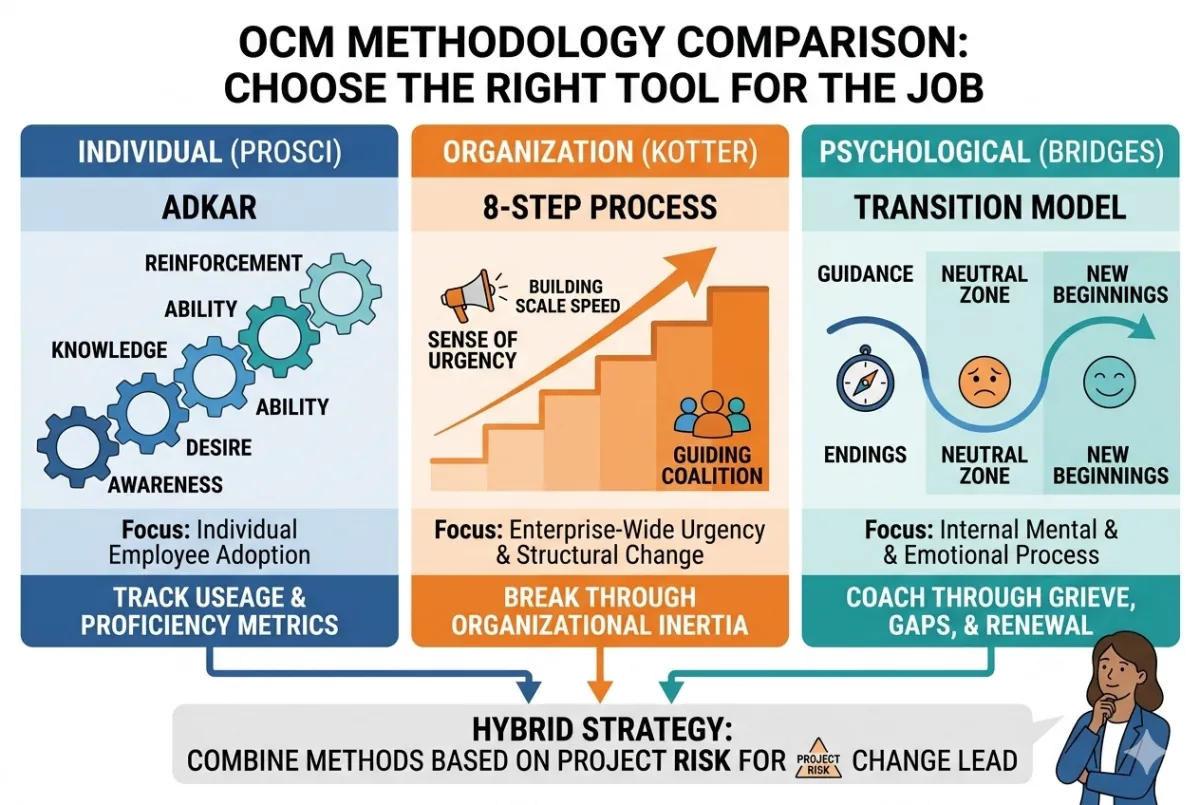
The answer is that the right methodology depends entirely on your project's primary source of risk. Choosing the correct framework is not about finding the best model in a vacuum, but about identifying whether your biggest hurdle is organizational momentum, individual adoption, or the psychological transition of your team. Prosci (ADKAR) is your tool for individual proficiency, Kotter’s 8-Step Process is your engine for organizational drive, and Bridges’ Transition Model is your compass for navigating human emotion. By matching the methodology to the specific problem you are solving, you ensure that your change effort is surgical rather than superficial.
Key Takeaways
Focus on the Risk: Choose your methodology based on whether the risk is cultural, individual, or strategic.
Methodologies are Tools, Not Religions: The most effective change leads are multi-lingual in these frameworks and apply them where they fit best.
Prosci for Adoption: Use the ADKAR model when project success depends heavily on individual users changing their daily habits.
Kotter for Scale: Use the 8-Step process when you need to break through organizational inertia and build top-down urgency.
Bridges for Empathy: Use the Transition Model when the change involves significant loss, re-branding, or cultural shifts.
The Power of the Hybrid: Don't be afraid to combine elements of all three to address different layers of a complex transformation.
What is the Right Change Management Methodology?
In the world of Organizational Change Management, a methodology is a structured process and set of tools used to lead the people's side of change to achieve a desired business outcome. While there are dozens of niche frameworks, three heavyweights dominate the industry. Understanding what they are is the first step in making an informed choice.
1. Prosci (The ADKAR Model)
Prosci is a goal-oriented change management model that focuses on the individual. It is built on the realization that organizational change only happens when each person affected by the change successfully transitions. It utilizes the ADKAR acronym:
Awareness of the need for change.
Desire to support the change.
Knowledge of how to change.
Ability to demonstrate new skills.
Reinforcement to make the change stick.
Prosci is highly data-driven and provides a granular way to measure exactly where a change effort is failing at the individual level.
2. Kotter’s 8-Step Process
Developed by Dr. John Kotter, this is a high-level strategic framework that focuses on the organization as a whole. It is designed to drive large-scale structural or cultural shifts from the top down. It focuses on building a Guiding Coalition and creating a Sense of Urgency to overcome the massive inertia often found in large corporations. It is less about the individual’s psychological state and more about the collective momentum of the enterprise.
3. Bridges’ Transition Model
William Bridges’ model is a psychological framework that focuses on Transition rather than Change. Bridges makes a critical distinction: Change is the external event (a new software, a new office, a merger), while Transition is the internal mental and emotional process people go through as they come to terms with the new situation. His model follows three stages:
Ending, Losing, and Letting Go: Helping people deal with the loss of the old way.
The Neutral Zone: The uncomfortable in-between time where the old is gone but the new isn't fully operational.
The New Beginning: Embracing the new identity and energy.
Why is Choosing the Right Framework Important?
Using the wrong framework is like using a map of New York to navigate London. While both are maps, they describe entirely different terrains. Selecting the appropriate methodology ensures that your resources: time, money, and political capital, are spent where they will have the most impact.
Precision in Application
If your project is a relatively small software update where the primary risk is that employees won't know which buttons to click, a high-level Kotter strategy focused on creating urgency might be overkill. You need the precision of Prosci to ensure individual Ability. Conversely, if you are attempting a massive cultural shift to become a digital-first company, focusing only on individual training (ADKAR) will fail because you haven't addressed the organizational barriers that Kotter’s model is designed to break.
Maximizing ROI and Adoption
The Return on Investment (ROI) of most business initiatives depends on People Dependent ROI. This is the portion of project benefits that only realized if people actually change how they do their jobs. If people don't adopt the new system, the ROI is zero. By choosing the right framework, you target the specific adoption friction of your project. This reduces the dip in productivity that usually accompanies change and ensures the new behaviors become permanent.
Avoiding Change Fatigue
One of the greatest risks in modern business is change fatigue, the exhaustion employees feel when faced with too many poorly managed transitions. Using a mismatched framework adds to this fatigue. For example, if employees are grieving the loss of a beloved company founder, but leadership is pushing a Sense of Urgency (Kotter) without acknowledging the Ending (Bridges), the workforce will likely burn out or resist. Proper methodology selection shows respect for the human experience of change, which builds trust and long-term resilience.
How to Choose the Right Methodology
Choosing a methodology shouldn't be a matter of habit or personal preference. Here is a simple step-by-step framework you can follow to diagnose which model fits your current project needs:
Step 1: Analyze the Scope and Scale of the Change
Before you pick a tool, you must understand the size of the Change Unit you are trying to move. Is this a localized shift or a global transformation?
Action: Determine if the change requires a massive shift in company culture or the way the entire organization thinks.
Why it matters: Large-scale shifts require top-down momentum.
Framework Choice: If the scope is enterprise-wide and structural, start with Kotter. It excels at mobilizing large groups and breaking through organizational inertia by creating a powerful guiding coalition.
Step 2: Evaluate the ROI Dependency on Individual Behavior
Ask yourself: If every person in this company continues to do their job exactly as they do today, will this project still succeed?
Action: Calculate how much of the project's success depends on people using a new tool, following a new process, or adopting a new habit.
Why it matters: If the success is 80% dependent on people doing things differently (like using a new CRM), you need a model that tracks individual progress.
Framework Choice: Use Prosci (ADKAR). It provides the metrics needed to see exactly where an individual is stuck. For example, knowing if they have the Knowledge to use the tool but lack the Desire because they don't see the benefit.
Step 3: Audit the Emotional and Psychological Landscape
Is the change replacing something that people are deeply attached to? Is there a death of an old way of working?
Action: Assess the level of loss associated with the change. This includes loss of status, loss of a physical workspace, or loss of long-standing team structures.
Why it matters: Humans are biologically wired to resist loss. If you don't manage the psychological transition, the Neutral Zone will swallow your project's productivity.
Framework Choice: If you are rebranding, restructuring, or moving offices, lean heavily on Bridges. This model is essential for helping people let go of the old way so they can reach a New Beginning.
Step 4: Orchestrate a Hybrid Strategy
The most successful practitioners recognize that these models are not mutually exclusive.
Action: Map out your change plan using the strengths of each model.
How to do it: 1. Use Kotter at the start to get executives aligned and create a Guiding Coalition.
2. Use Bridges to train managers on how to handle the emotional Endings and Neutral Zone during the middle of the project.
3. Use Prosci to manage the actual Knowledge and Ability training sessions and track adoption rates as you go live.
Step 5: Validate and Iterate
Methodology selection is not a set it and forget it task.
Action: Regularly review your OCM metrics.
Tip: If you started with Kotter but find that leadership is aligned while frontline staff are confused, pivot your focus toward the Awareness and Desire stages of ADKAR.
Frequently Asked Questions (FAQs)
Can I switch methodologies in the middle of a project?
Absolutely. In fact, it is often necessary. A project might start as a high-level strategic shift (Kotter) but as it moves into the implementation phase, the focus must shift to individual adoption (Prosci). The key is to ensure your communication remains consistent even if your internal framework changes.
Is one methodology better for Agile projects?
Prosci (ADKAR) is often favored in Agile environments because its iterative nature aligns well with sprints. You can apply the ADKAR cycle to each individual feature or release. However, Bridges is still vital if those Agile releases are causing significant disruption to the user's daily experience.
Do I need a formal certification to use these frameworks?
While certifications (like Prosci's) provide deep technical knowledge and credibility, the core principles of all three frameworks are accessible to anyone. The most important thing is the consistent application of the steps rather than the certificate on the wall.
What is the biggest mistake people make when choosing a methodology?
Choosing a methodology because it is the one the company always uses rather than the one the project needs. Every project has a different risk profile. Always audit the project's specific needs before defaulting to a standard framework.
Final Thoughts
There is no perfect methodology in change management; there is only the methodology that addresses your project's greatest risks. Whether you are focusing on mobilizing the organization, supporting the individual, or guiding the psychological transition, having these three frameworks in your toolkit ensures you can handle whatever transformation comes your way.
By accepting that change is a multi-dimensional journey, you allow your project to remain flexible, empathetic, and most importantly, successful.
Reflective Question: Look at your current initiative. Is the biggest threat to your success a lack of executive urgency, a lack of user skill, or a sense of loss among the staff? Identify that risk today and apply the core principle of the corresponding model to your plan this week.
Get practical insights on change and business analysis delivered to your inbox. Join our mailing list


