The Question That Reduces More Resistance Than Any Communication You Will Ever Send
Introduction
Most change communications follow the same structure. They explain what is changing, why it is changing, and what employees need to do to prepare. They are forward-looking, benefit-focused, and carefully crafted to build enthusiasm for the new state. And many of them quietly generate more anxiety than they resolve, not because the message is wrong but because it leaves the most important question unanswered.
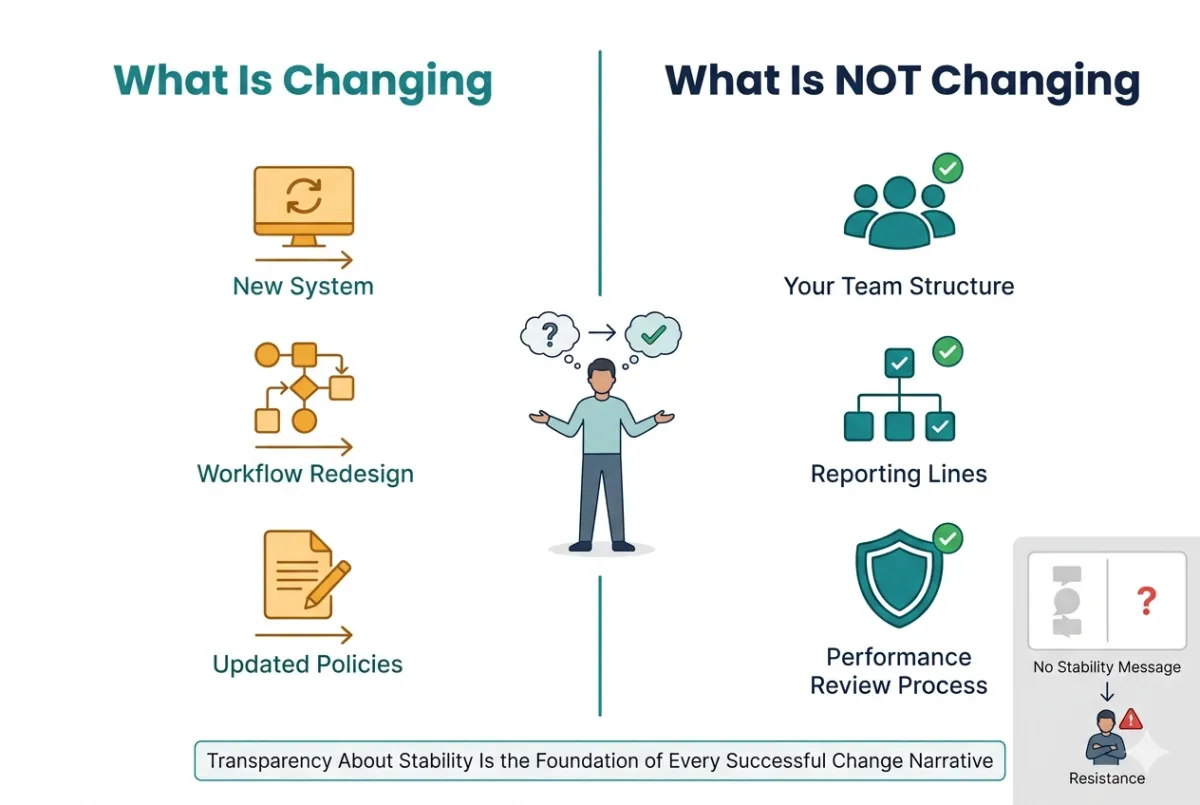
That question is not what is changing. It is what is not.
Research shows that employee resistance to change typically stems from fear of the unknown at thirty-eight percent, a lack of trust in leadership at forty-one percent, and a failure to understand why the change is happening at thirty-nine percent. The fear of the unknown is not primarily a fear of the new thing being introduced. It is a fear of everything familiar disappearing at once. When employees hear about a significant change without also hearing what will remain stable, their minds naturally fill the silence with the worst version of the answer. Job security, team structure, working relationships, and established processes all become uncertain in the absence of explicit confirmation that they are not.
The change managers who consistently build the strongest cases for change are not the ones who communicate the future state most compellingly. They are the ones who anchor that future state in a foundation of explicitly named stability. Transparency about what is not changing is not a footnote to the change narrative. It is the psychological infrastructure that makes the rest of the message receivable.
Key Takeaways
Ambiguity Is Not Neutral: When communication breaks down or people feel that decisions are being made to them rather than with them, resistance is almost guaranteed. Ambiguity is a breeding ground for fear, and the only antidote to it is radical transparency.
Psychological safety is defined as a belief that one will not be punished or humiliated for speaking up with ideas, questions, concerns, or mistakes. At organizations with a low degree of psychological safety, employees are less prepared to handle change, worry about job security, and struggle with engagement. Communicating what is not changing directly addresses the conditions that undermine that safety.
Stability Is Not the Absence of Change. It Is a Communication Choice: Every transformation preserves something. The processes, policies, values, and relationships that are remaining intact are just as real as the ones that are shifting. The difference between organizations that navigate change smoothly and those that struggle is often simply whether that stability was named out loud.
Communicating early and regularly builds trust through organizational shifts. While the timing of communications is important, transparency about initial change decisions helps employees feel more involved and trusted, which directly reduces the anxiety that produces resistance.
The What Is Not Changing Message Belongs at the Beginning, Not the End: Most organizations bury stability information in FAQs or follow-up communications after the initial resistance has already formed. The most effective change managers lead with it.
Why Employees Fear Change and What That Fear Is Actually About
The impact of organizational change on employees differs depending on the type of change and the context in which it occurs. The introduction of new technology, for example, may lead to concerns about job security in manufacturing environments or fear of being unskilled in service and administrative settings. Both the nature of the change and the context in which it takes place play a crucial role in determining its overall impact on employee well-being and engagement.
What this means for the change manager is that the fear employees experience in the face of a significant transformation is rarely irrational. It is a rational response to incomplete information about a situation that affects their daily work, their professional identity, and in many cases their livelihood. When a communication about change is silent on the things that will remain the same, the employee's threat assessment process fills that silence with assumptions. And those assumptions are almost always more threatening than the reality.
Transparency involves openly sharing information, motives, and actions in straightforward and plain language. When transparency is prioritized, it fosters trust. As trust grows within teams, it creates conditions for psychological safety. And when people feel psychologically safe, they are more likely to be open, engaged, and willing to participate in change rather than resist it. The what is not changing message is the most direct and most underused application of this principle in organizational change management. It is the communication act that most directly tells an employee: your concerns have been considered, and here is the honest answer to the ones that matter most.
Why Transparency About Stability Is the Most Underused Tool in the Change Manager's Toolkit
It addresses resistance at its source rather than at its surface. Most resistance management strategies focus on converting resistant employees through repeated communication, stakeholder engagement, or leadership coaching. These approaches work, but they work on a resistance that has already formed. Resistance often stems from fear of the unknown, concerns about job security, or skepticism about the change's necessity. Overcoming it requires involving employees early in the planning process and creating forums where they can voice concerns and receive honest answers. Communicating what is not changing before those fears have solidified is not just more humane. It is significantly more efficient.
It builds the kind of trust that makes every subsequent communication more credible. When a leader or change manager explicitly names the things that will remain stable, including the processes, the policies, the reporting lines, and the team structures that are not part of the change scope, they are doing something that employees rarely experience in a change context: they are volunteering information that reduces uncertainty rather than managing it. Leaders who strive to be transparent about organizational decisions, changes, and challenges build trust by providing clarity and avoiding a sense of secrecy or hidden agendas. That trust becomes the credibility bank that every future communication draws from.
It creates the psychological safety that makes dialogue possible. Psychologically safe workplaces mitigate the employee anxiety that leads to change fatigue. Employees in a psychologically safe workplace are more likely to adapt to change when they can share their concerns or ideas openly with leadership, without fear of retribution. The two key components of building psychological safety are communication and trust. An employee who has been explicitly told what is not changing is an employee who can now engage with what is changing from a position of reduced threat. They are more likely to ask questions, raise genuine concerns, and participate in the transition rather than withdraw from it.
It makes the case for change stronger, not weaker. There is a persistent but mistaken belief among some leaders that naming what is not changing will somehow signal weakness or indecision about the transformation. The opposite is consistently true. A change narrative that is specific about both what is shifting and what is staying communicates a level of organizational clarity and deliberateness that vague, all-encompassing change messaging never achieves. For employees to have genuine buy-in, the goals of a change must be clear with benefits outlined for all impacted. Clarity about what is not changing is a direct contribution to that clarity because it defines the boundaries of the change rather than leaving them open to interpretation.
How to Build the What Is Not Changing Message Into Your Change Strategy: A Step-by-Step Framework
Step 1: Conduct a Stability Audit Before Any Communication Is Drafted
Before you can tell employees what is not changing, you need to know with certainty what that includes. This is not an exercise in reassurance. It is a structured analysis of the change scope that produces a formally verified list of stable elements.
What to do: Work with the project sponsor, the project manager, and key subject matter experts to identify every process, policy, system, reporting relationship, team structure, and organizational value that falls outside the scope of the change. Document each one explicitly and confirm that its stability has been formally verified rather than assumed.
Action: For each element identified as stable, note the specific concern it addresses. A confirmed stable reporting structure addresses concerns about management changes. A confirmed stable performance review process addresses concerns about how success will be evaluated in the new environment. This mapping ensures the stability message is targeted to the fears that actually exist rather than the ones the communications team assumes exist.
Goal: A verified stability inventory that becomes the foundation for every communication in the change program, with each stable element linked to the specific employee concern it is designed to address.
Step 2: Lead With Stability in the Initial Change Communication
The sequence of information in a change communication is not a stylistic choice. It is a psychological one. Employees who hear what is not changing first are in a fundamentally different emotional state when they hear what is changing than employees who hear the new state first and then receive reassurance about stability as an afterthought.
What to do: Restructure the initial change communication to open with an explicit acknowledgment of what will remain the same. Name the specific processes, policies, and structures that are confirmed to be stable, using plain language that connects directly to the daily realities of the people receiving the message.
Action: Avoid vague reassurances such as our values remain the same or our commitment to our people has not changed. These phrases are heard as corporate language rather than genuine transparency. Replace them with specific, named elements: your team structure is not changing, your performance review process is not changing, your reporting line is not changing.
Goal: An opening communication that creates a foundation of named stability before introducing the scope of change, so that employees can process what is new from a position of confirmed security rather than generalized uncertainty.
Step 3: Build a Formal What Is Not Changing Section Into Every Key Communication
The stability message is not a one-time inclusion in the launch communication. It needs to be present, in some form, in every significant communication throughout the project lifecycle, because the questions employees ask about stability do not disappear after the first announcement. They re-emerge at every phase transition, every milestone, and every moment when the change becomes more concrete and more personally relevant.
What to do: Create a standard section in your communication template labeled What Is Not Changing and populate it with relevant, specific stable elements for each communication. Update this section as the project progresses and new elements are confirmed as either stable or in scope.
Action: Establish multiple communication channels to keep stakeholders informed throughout the process and address concerns promptly with honest answers rather than with generic reassurance that does not correspond to the specific concerns being raised. The what is not changing section should be available in every format the change team uses, from town hall presentations to manager toolkits to intranet updates.
Goal: A communication program where every significant message includes both what is changing and what is not, so that employees never have to choose between the official communication and their own worst-case interpretation of the silence.
Step 4: Equip Managers to Deliver the Stability Message at the Team Level
The most credible voice for the what is not changing message is not the project sponsor or the change manager. It is the employee's direct manager, speaking in a one-to-one or small-group context where specific concerns can be named and addressed directly.
What to do: Build a manager communication toolkit that includes a specific script or talking points for the what is not changing conversation, along with guidance on how to handle questions that fall outside the confirmed stability list.
Action: Train managers to distinguish between what they can confirm as stable, what is not yet determined, and what is genuinely in scope for the change. A manager who overpromises stability and is later contradicted by events does more damage to psychological safety than no stability message at all. The discipline is in being specific about what is confirmed rather than expansive about what is hoped for.
Goal: A manager community that is equipped, confident, and consistent in delivering the stability message at the team level, creating the kind of localized psychological safety that a company-wide communication can signal but never fully produce on its own.
Step 5: Use Stability Confirmation as a Resistance Management Tool Throughout the Project
When resistance surfaces mid-project, the first diagnostic question should not be how do we overcome this resistance. It should be what specific fear or uncertainty is producing it. In most cases, the answer traces back to an element of stability that was either never confirmed or was confirmed once and then allowed to become uncertain again as the project evolved.
What to do: Build a resistance tracking log that captures not just the existence of resistance but the specific concern driving it. For every concern that relates to something outside the change scope, issue a targeted stability confirmation through the appropriate channel, whether a manager conversation, a project update, or a direct communication from the sponsor.
Action: Create forums where employees can voice concerns and receive honest answers. The goal is not to suppress resistance but to guide people from opposition to participation by addressing the specific fears that are generating the resistance rather than the generalized anxiety of being in a change.
Goal: A resistance management approach that is diagnostic rather than reactive, treating each instance of resistance as a data point about what the change communication program has left ambiguous rather than as an inevitable feature of organizational transformation that must be managed from outside.
Frequently Asked Questions
What if some elements I thought were stable turn out to be in scope as the project evolves?
Address this directly and immediately rather than hoping it goes unnoticed. When something that was communicated as stable becomes part of the change scope, the fastest path to sustained trust is an honest, specific communication that names what changed, explains why, and confirms what is currently stable. When leaders are vague or inconsistent, people fill in the blanks themselves, usually not in a good way. Rumors start, anxiety builds, and trust evaporates. A prompt correction is far less damaging to trust than the discovery that a previous stability commitment was quietly abandoned without acknowledgment.
How do I handle the what is not changing message when genuinely very little is staying the same?
This is the most challenging scenario and the one that most demands honesty. If the scope of change is genuinely broad, the stability message needs to shift from specific process and policy confirmations to the organizational foundations that remain intact: the mission, the values, the core team relationships, and the commitment to supporting employees through the transition. These are real anchors even in large-scale transformations, and naming them explicitly is more credible than overstating operational stability that does not exist.
How do I get leaders to commit to a formal stability audit when the project is moving quickly?
Frame it as a risk mitigation activity with a defined time cost. A two-hour session to confirm which elements are outside the change scope will generate the stability inventory that prevents weeks of resistance management later. Present it to the project sponsor in those terms, with a specific example of what it costs when stability assumptions are left unverified and then contradicted mid-project.
Should the what is not changing message be included in every communication or only in the major ones?
It should be present in proportion to the significance of the communication and the current anxiety level in the organization. Every major communication, including the initial announcement, phase gate updates, and pre-Go-Live messaging, should include an explicit stability section. Routine updates can reference the stability inventory without restating it in full. The principle is that no significant communication should leave an employee with more uncertainty about what is staying the same than they had before they read it.
Final Thoughts
The case for change is built on two foundations, not one. The first is the compelling vision of the future state and the clear rationale for why the change is necessary. The second is the explicit, verified, and consistently communicated confirmation of what the change does not touch.
Most change communication programs invest heavily in the first foundation and almost nothing in the second. The result is a change narrative that is technically complete and emotionally incomplete, one that tells employees where they are going without telling them what they are taking with them.
The question what is not changing is not a soft addendum to the case for change. It is the psychological infrastructure that makes the case receivable. Ask it first, answer it honestly, and build it into every significant communication from the initial announcement to the post-Go-Live reinforcement.
Reflective Question: Think about the last change communication you sent or reviewed. Did it explicitly name at least three specific processes, policies, or structures that are confirmed to be outside the change scope? If the answer is no, that omission is where your revision starts.
Get practical insights on change and business analysis delivered to your inbox. Join our mailing list


