The 10 Core Responsibilities of a Change Manager
Introduction
In many organizations, there is a common misconception that Change Management is simply about making people feel good or acting as a project cheerleader.
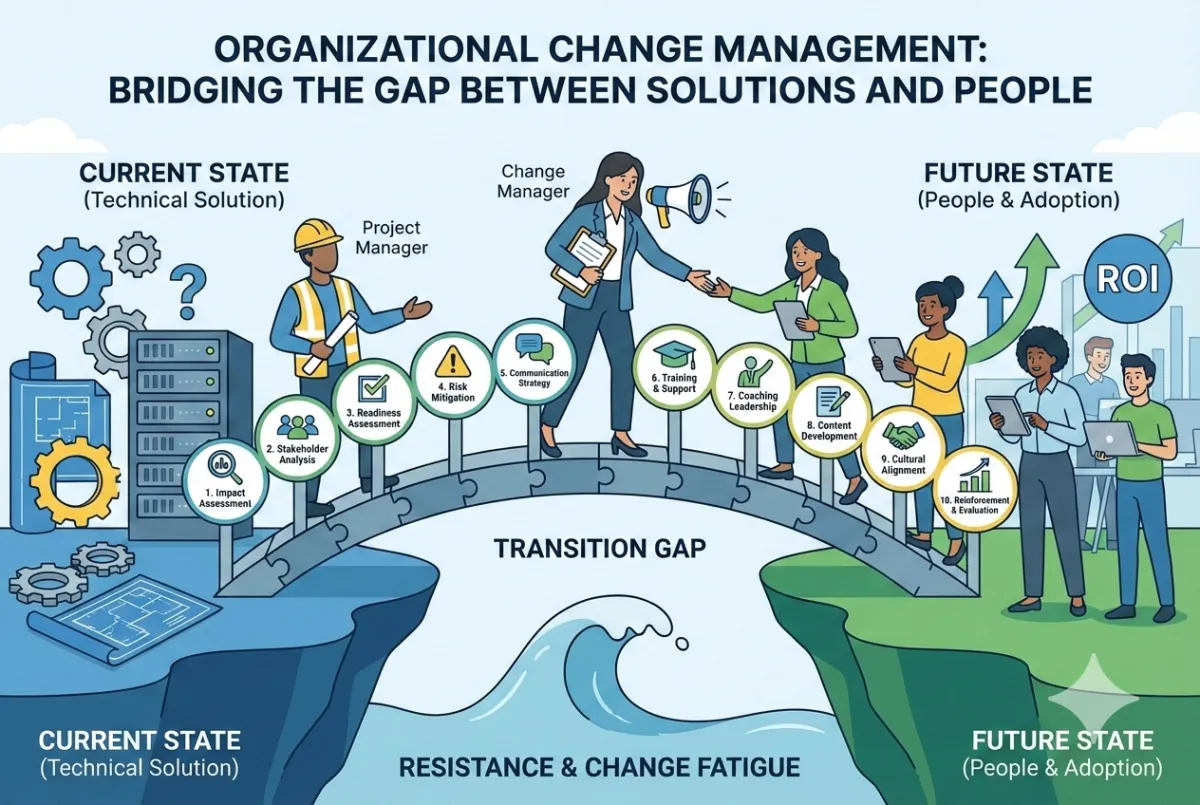
While morale is important, Organizational Change Management (OCM) is actually a rigorous, data-driven discipline designed to bridge the gap between a technical solution and the people who must use it.
Whether you are a business analyst, a project lead, or a dedicated change professional, understanding these responsibilities is essential.
Without active change management, projects often suffer from low adoption rates, employee resistance, and realized benefits that fall far short of expectations.
What is a Change Manager?
A Change Manager is a strategic partner responsible for the people side of organizational transitions. While a Project Manager focuses on the design, development, and delivery of a solution (the technical side), the Change Manager focuses on the embrace, adoption, and usage of that solution.
In practice, this means identifying how a project will alter daily workflows and then creating a structured path to move individuals from the current state to the future state.
Why is This Role Important?
Organizations don’t change, people do. If employees do not adopt new processes or technology, the organization's investment is wasted.
Effective change management:
Reduces Change Fatigue: By managing the pace and volume of changes hitting a single group.
Protects Productivity: By anticipating resistance and providing the support needed to navigate the dip in performance that often accompanies new tools.
Ensures ROI: By ensuring that the Solution is actually used as intended by the Stakeholders.
The 10 Core Responsibilities of an OCM Practitioner (Step-by-Step)
If you are stepping into a change role, here is a simple step-by-step framework of the responsibilities you will handle throughout a project lifecycle:
Step 1: Conduct a Change Impact Assessment
You cannot manage what you haven't defined.
You must identify exactly who is being impacted and how their work will change. Be it their tools, their reporting lines, or their daily tasks.
Action: Create a "From-To" analysis for every impacted stakeholder group.
Step 2: Stakeholder Analysis & Mapping
Not all stakeholders are created equal. Some have high influence but low interest; others are highly impacted but have little power.
Action: Map stakeholders to determine who needs deep engagement and who simply needs to be kept informed.
Step 3: Change Readiness Assessment
Is the organization actually ready for this?
You must evaluate the cultural climate and the organization's history with past changes to identify potential roadblocks.
Action: Use surveys or interviews to gauge the "appetite" for change.
Step 4: Risk Identification and Mitigation
Resistance is a predictable risk.
A Change Manager identifies where resistance will likely come from (e.g., fear of job loss, lack of digital literacy) and develops plans to address it.
Action: Build a "Resistance Management Plan" early in the project.
Step 5: Developing the Communication Strategy
This is more than just sending emails.
It involves crafting the right message, for the right audience, delivered by the right sender at the right time.
Action: Define the "WIIFM" (What’s In It For Me) for every group.
Step 6: Creating Training and Support Plans
If people don't know how to change, they won't.
You must collaborate with subject matter experts to ensure the training is practical and timely.
Action: Align training delivery with the actual "Go-Live" date so knowledge is fresh.
Step 7: Coaching Leadership and Sponsors
Change starts at the top.
A Change Manager coaches executives on how to be active and visible sponsors of the initiative.
Action: Provide Sponsor Briefings to help leaders communicate effectively with their teams.
Step 8: Content and Asset Development
From newsletters and FAQ documents to town hall presentations and "how-to" videos, you are responsible for the collateral that guides the journey.
Action: Ensure all materials are clear, jargon-free, and visually engaging.
Step 9: Cultural Alignment and Assessment
Every organization has unwritten rules.
You must ensure the change doesn't clash with the core values of the company culture.
Action: Identify Change Champions within the ranks to model the new behaviors.
Step 10: Solution Reinforcement and Evaluation
Change doesn't end at Go-Live.
You must monitor adoption, collect feedback, and implement corrective actions" to ensure the new way of working sticks.
Action: Measure adoption metrics 30, 60, and 90 days post-launch.
Key Takeaways & Practical Tips
Be Proactive, Not Reactive: Start your impact assessment during the project's initiation phase, not two weeks before launch.
Listen More Than You Talk: Feedback from the front lines is your most valuable data point for mitigating risk.
Focus on the Middle: Mid-level managers are often the biggest barrier or the biggest bridge to change. Give them extra support.
Define Success Early: Know exactly what successful adoption looks like (e.g., 95% of users logged in within week one).
Conclusion & Next Steps
A Change Manager is a diagnostic expert, a strategist, and a communicator rolled into one.
By moving beyond cheerleading and embracing these ten core responsibilities, you ensure that organizational changes deliver the value they promised.
Next Steps:
Identify one upcoming change in your department.
Ask yourself: Do we have a clear 'From-To' analysis for the people impacted?
If the answer is no, start your Change Impact Assessment today.


