Most Change Initiatives Fail Before They Begin. The Case for Change Is Where It Starts
Introduction
Only thirty-four percent of organizational change initiatives are clearly successful, according to a 2024 Gartner study, with unclear ownership, stakeholder overload, and poor communication cited as the key inhibitors. What that statistic does not capture is how early in the project lifecycle most of those failures are actually determined. The communication plan was inadequate not because it was poorly executed but because it was built on a case for change that was never properly developed. The sponsorship was weak not because the sponsor lacked authority but because nobody had equipped them with a clear, validated articulation of why this change was necessary right now.
The case for change is the first mile of every transformation. It is the document, the narrative, and the validated organizational story that answers the questions every stakeholder will ask before they commit to anything: why is this happening, why is it happening now, and what specifically is at stake if the organization does not move. A case for change that cannot answer those three questions with precision is not a foundation for a change program. It is a starting gun for resistance.
Effective OCM does not begin with process. It begins with purpose. Leaders must articulate the why behind change before defining the how. Without shared purpose, communication plans and training programs simply inform. They do not inspire. Organizations with clear change purpose achieve twenty-nine percent higher employee alignment and forty percent greater transformation return on investment. The three-phase framework in this post is the structured process for building that purpose before a single communication is drafted.
Key Takeaways
The Case for Change Is Not a Presentation Slide: It is a rigorously developed, stakeholder-validated narrative that answers why this change is necessary, why it is necessary now, and what the organization risks by not acting. A case built on assumptions rather than evidence will be challenged at the exact moment it needs to hold.
Preparation Determines the Quality of Everything That Follows: Effective OCM tailored messages must answer why, why now, and what it means for me, delivered by credible senders with feedback loops built in from the start. None of those elements can be designed without the foundation that the preparation phase produces.
The Why Now Question Is the Most Important One Nobody Asks Formally: Every stakeholder who hears about a change will privately ask it. A case for change that does not explicitly address urgency leaves the answer to rumor, assumption, and the individual's own threat assessment process.
Building a compelling need for change means winning hearts. Creating opportunities for dialogue and collaboration means winning minds. Both are required, and neither is possible without a case for change that is grounded in verified organizational data rather than leadership assertion.
Playback Is Validation, Not Presentation: The final phase of the case for change process is not a reveal. It is a structured stakeholder challenge session designed to test whether the narrative holds before the project depends on it.
What Is a Case for Change and Why Does It Function as the Foundation of the Entire Organizational Change Management Strategy?
A case for change is the structured, evidence-based articulation of the organizational problem or opportunity that the transformation is designed to address. It answers three questions with precision: what is the current state problem or opportunity, why does it matter enough to act on now, and what will the organization gain or protect by making this change successfully. In organizational change management, this document is not a project management artifact. It is the human foundation of the entire change strategy.
OCM entails anchoring the desired change into a new way of working by building a compelling need for change, creating opportunities for dialogue and collaboration, and supporting those impacted throughout their change journey. The case for change is the starting point for all three of these activities, because you cannot build a compelling need without a rigorously developed and validated articulation of what that need actually is.
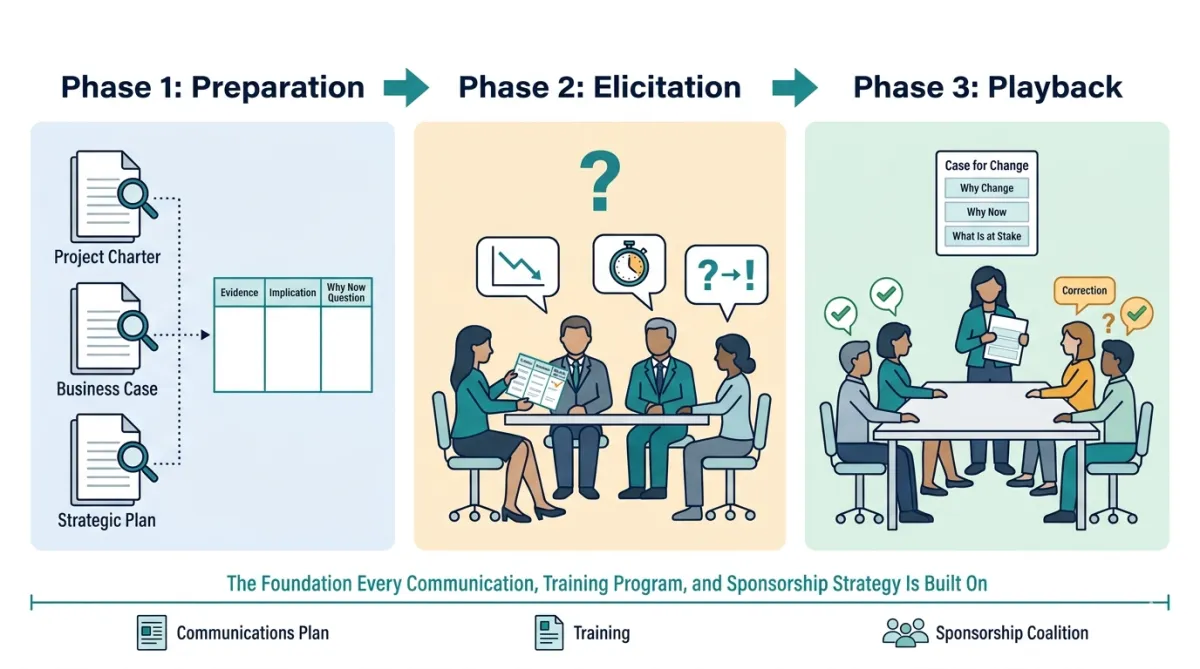
What makes the case for change framework genuinely powerful is its three-phase structure. The preparation phase is where the change manager builds the evidentiary foundation by reading and interrogating existing organizational documents. The elicitation phase is where that foundation is tested and deepened through structured stakeholder conversations specifically designed to surface the urgency that documents alone cannot capture. The playback phase is where the completed case is validated against the stakeholders whose buy-in the transformation depends on, before it is used to build anything else. The case for change must communicate a compelling vision for change that addresses unique stakeholder needs and attitudes across different groups. This three-phase process is what makes that possible.
Why Getting the Case for Change Wrong Costs the Entire Program
It leaves the sponsor unable to advocate convincingly. Business leaders tend to focus almost all their attention on what needs to be accomplished with a project without focusing on the why or the how. When it comes to change, it is the leaders' job not only to lead the way but to prepare others. A sponsor who has not been through a rigorous case for change process does not have the language, the data, or the urgency narrative to do that preparation work effectively. They can announce the change. They cannot advocate for it in the conversations that actually shift organizational sentiment.
It makes every subsequent communication feel like a sales pitch rather than a genuine imperative. When the case for change is built on assertion rather than evidence, stakeholders sense it. The communication may be well-crafted and the delivery may be polished, but the underlying message lacks the specificity and urgency that genuine organizational intelligence produces. Employees who feel they are being sold to rather than informed become skeptical contributors at best and active resistors at worst.
It skips the urgency question that determines whether people act or wait. Tailored messages must answer why now, and this element is consistently the most underdeveloped part of the case for change in organizations that treat the document as a strategic summary rather than a stakeholder-validated narrative. Why now is not a rhetorical question. It is the specific organizational intelligence about the competitive pressure, the regulatory deadline, the operational cost, or the market window that makes the current moment the right moment. Without it, the case for change is a description of a problem, not an argument for urgency.
It produces a change strategy built on assumptions that surface as gaps mid-program. An effective OCM strategy must assess which processes will change, who will be impacted, the degree of impact, and the capacity of the organization for change. All of this depends on a case for change that has been validated through genuine stakeholder elicitation rather than built entirely from desk research and leadership input. The gaps in a case for change that was never properly elicited do not stay hidden. They appear as misaligned communications, resistance from groups that were never consulted, and sponsor credibility problems that are significantly harder to repair mid-program than they would have been to prevent.
The First Mile: A 3-Phase Framework for Developing a Compelling Case for Change
Phase 1: Preparation. Build the Evidentiary Foundation From Existing Documents
The preparation phase is not a reading exercise. It is an active analytical process designed to extract the organizational intelligence that will anchor every subsequent conversation in evidence rather than assumption.
What to do: Request and review the project charter, the business case, relevant strategic and annual plans, industry benchmarking data, any internal performance reports related to the problem or opportunity the change is addressing, and any prior initiative documentation that touches the same organizational domain.
Action: As you read, build a structured evidence log with three columns. The first captures the specific organizational data point: a metric, a trend, a regulatory requirement, or a strategic commitment. The second captures the implication of that data point for the organization's current state. The third captures the specific why now question the data point raises that only a stakeholder conversation can answer. This log is the bridge between the preparation phase and the elicitation phase.
Goal: An evidence foundation that is specific enough to inform targeted elicitation questions, comprehensive enough to withstand stakeholder challenge, and honest enough to acknowledge the gaps that the documents alone cannot fill. Goal: Review existing documentation and align the case for change with organizational strategy, ensuring that every element of the case connects to a verified strategic priority rather than a leadership assumption about what matters.
Phase 2: Elicitation. Ask the Questions the Documents Cannot Answer
The elicitation phase is where the case for change moves from a document-based summary to a stakeholder-informed narrative. The questions you ask in this phase are not generic change management discovery questions. They are targeted conversations built specifically around the gaps, contradictions, and urgencies that the preparation phase identified.
What to do: Structure individual conversations with the project sponsor, key business leaders, and representative members of the most significantly impacted stakeholder groups. Each conversation should be grounded in the evidence log from Phase 1, with specific questions designed to test, deepen, or challenge what the documents suggested.
Action: The single most important question in every elicitation session is the one most change managers ask too casually and too briefly: why now? Ask it directly, ask it specifically, and ask it of multiple stakeholders. Communications must answer why now and what it means for me, delivered by credible senders with feedback loops. Elicitation builds the data that makes those answers specific, credible, and compelling rather than generic and forgettable. Listen for the urgency signals that do not appear in any document: the competitive threat that leadership is privately concerned about, the operational cost that the annual report does not capture, the regulatory timeline that the project charter references but does not quantify, and the employee concern that will become resistance if the case for change does not address it explicitly.
Goal: A validated, stakeholder-informed urgency narrative that answers why this change is necessary, why it is necessary right now, and what the organization specifically risks by delaying or diluting it. This narrative, grounded in both document evidence and stakeholder intelligence, is what transforms a change announcement into a change imperative.
Phase 3: Playback. Validate the Case Before the Program Depends on It
The playback phase is the most underestimated step in the entire case for change process. Most change managers treat it as a presentation of the completed work. The most effective ones treat it as a structured challenge session designed to test whether the narrative holds before it is used to build a communication plan, a training program, or a sponsorship strategy.
What to do: Compile the case for change into a structured summary that covers the current state problem or opportunity with supporting evidence, the urgency rationale that answers why now with specifics, the expected future state with clear organizational benefits, and the risks of inaction expressed in terms that connect to each stakeholder group's specific interests and concerns.
Action: Present this summary to the project sponsor and a representative cross-section of key stakeholders, including at least one senior leader who was not part of the elicitation process, and at least one representative from a group whose resistance is anticipated. Everyone wants to be heard and their concerns validated. The playback session creates that opportunity before the program is in motion, which is significantly less expensive than creating it after resistance has already formed. Ask explicitly whether the narrative is accurate, whether the urgency is compelling, and whether anything significant is missing or overstated.
Goal: A formally validated case for change that every key stakeholder has had the opportunity to challenge, correct, or confirm, which means the strategy built on top of it is grounded in verified organizational reality rather than the change manager's best interpretation of the documents and conversations they had access to.
Frequently Asked Questions
What if the project sponsor cannot articulate a compelling why now during elicitation?
This is one of the most important findings the elicitation phase can produce, and it needs to be treated as such. A sponsor who cannot articulate why the change is necessary right now is a sponsor who will not be able to advocate for it effectively when resistance surfaces. Before the program moves forward, invest time in a dedicated sponsor alignment session that builds the urgency narrative collaboratively, drawing on the evidence log from the preparation phase and the stakeholder input gathered in elicitation. A sponsor who has been through that process is significantly better equipped than one who has simply been briefed on the project scope.
How do I handle conflicting urgency narratives from different stakeholders?
Document the conflict rather than resolving it prematurely. Different stakeholder groups will often have different and sometimes contradictory views of why the change is necessary and why it is necessary now. These conflicts are valuable data. They reveal the segmentation of the stakeholder landscape that the communication strategy will need to address, and they surface the organizational tensions that the change itself may need to navigate. Present the conflicting narratives to the project sponsor at the playback session as a communication design requirement rather than a problem to be managed before the playback happens.
How long should the case for change development process take?
The answer depends on the complexity and scale of the change, but a useful principle is that the case for change should take at least as long as the first communication took to write. If the initial change announcement took a week to develop, the case for change process that should have preceded it took at least two. On large-scale transformations, the preparation and elicitation phases alone may take three to four weeks. The investment is not overhead. It is the foundation that every subsequent program activity either benefits from or is compensated for in reactive resistance management.
What is the difference between the case for change and the business case?
The business case is a project management document that justifies the investment in a solution. It focuses on cost, benefit, risk, and return. The case for change is an OCM document that justifies the disruption to the people who will be living through the transformation. It focuses on organizational urgency, stakeholder impact, and the human rationale for why the change is necessary now. Both are necessary. Neither is a substitute for the other. The change manager who relies on the business case as their case for change is working with a document that was designed to secure project approval, not to build organizational commitment.
Final Thoughts
The first mile of a transformation is the one that most programs treat as a sprint. Get the project charter, brief the sponsor, draft the communication, and launch. The pressure to move quickly is real, and the organizational appetite for lengthy preparation work before visible progress is limited.
But the programs that cover the first mile well, that build the evidence foundation before the first conversation, that ask the why now question explicitly rather than assuming the answer, and that validate the case before the program depends on it, these are the programs that do not spend their middle miles recovering from the gaps the first mile left behind.
Prepare before you elicit. Elicit before you draft. Validate before you launch. That sequence is not complicated. Holding the discipline to follow it when the pressure to produce is already building is where the professional development actually lives.
Reflective Question: Think about the last case for change you built or reviewed. Did it explicitly answer why now with specific, stakeholder-validated evidence rather than a general reference to strategic alignment? If the answer is no, that specificity is what the next version needs before the first communication is written.
Get practical insights on change and business analysis delivered to your inbox. Join our mailing list


