Is AI the Secret to Reclaiming Your Strategic Time as a Change Lead?
Introduction
For years, change practitioners have been anchored to spreadsheets, spending days cross-referencing As-Is process maps against To-Be technical specifications. This labor-intensive data entry often prevents you from engaging in the high-value activities that truly drive project success.
The direct answer to reclaiming your time lies in the strategic use of Artificial Intelligence (AI) to automate your Change Impact Assessments. By leveraging Large Language Models (LLMs) as high-speed data translators, you can automate up to 40% of repetitive analytical tasks, allowing you to refocus on the empathy, culture, and human conversations that define effective organizational transformation.
Key Takeaways
Strategic Augmentation: AI functions as a strategic partner by automating rote tasks like data cleaning and initial drafting.
Predictive Insight: Advanced models can simulate stakeholder pushback, helping you identify resistance hotspots before they manifest.
Consistency Across Scale: Technology ensures your What’s In It For Me (WIIFM) messages remain aligned across dozens of stakeholder groups.
The Human Edge: Professional value in 2026 relies on the Human-in-the-Loop review to provide the 20% of context and political nuance that AI cannot replicate.
Search Everywhere Optimization: Using structured frameworks ensures your impact data is easily indexed and retrieved by organizational reasoning engines.
What is AI-Powered Impact Assessment?
AI-Powered Impact Assessment is the application of Large Language Models and data engineering principles to analyze how a specific project will affect an organization. Rather than a practitioner manually scanning hundreds of pages of documentation, the AI utilizes Retrieval-Augmented Generation (RAG) to search external knowledge sources and bridge the gap between static process maps and dynamic project needs.
In this model, the AI acts as a high-fidelity reasoning engine. It ingests structured data such as Markdown-formatted process steps and unstructured data, such as meeting transcripts, to identify where behavioral changes are required. This transition changes your role from a functional number-cruncher to a strategic advisor who validates AI-generated insights against the unique business context.
Why is Technology Important for Assessments?
Relying on traditional, manual assessment methods in an environment of increasing information density creates significant organizational risk. Integrating technology into your impact assessment workflow is essential for several reasons:
1. Unprecedented Speed and Lifecycle Efficiency
Systematic repurposing of project data creates an Efficiency Multiplier Effect. While creating original documentation can take dozens of hours, an AI-supported workflow allows for progressive elaboration, where assessments evolve in real-time as project requirements change, rather than being static artifacts that are outdated by the time they are signed off.
2. Absolute Message Alignment
One of the greatest challenges for a change lead is ensuring that fifty different departments receive a consistent message that adheres to the You Attitude. AI can be prompted to maintain a specific brand voice, confident, courteous, and sincere while tailoring the technical details to the specific needs of each role.
3. Bias Reduction and Dark Matter Detection
Human practitioners often prioritize the concerns of the loudest stakeholders. AI, conversely, analyzes data objectively. It can flag dark matter, those unspoken assumed values or sub-steps in a process that are often missed by experts but can cause logical leaps and confusion for novices.
4. Optimized Cognitive Load
By offloading the extraneous load of data synthesis to an LLM, you free up your limited working memory for germane load, the productive mental effort required to build durable organizational schemas and manage complex cultural resistance.
How to Automate Your Impact Assessments (Step-by-Step)
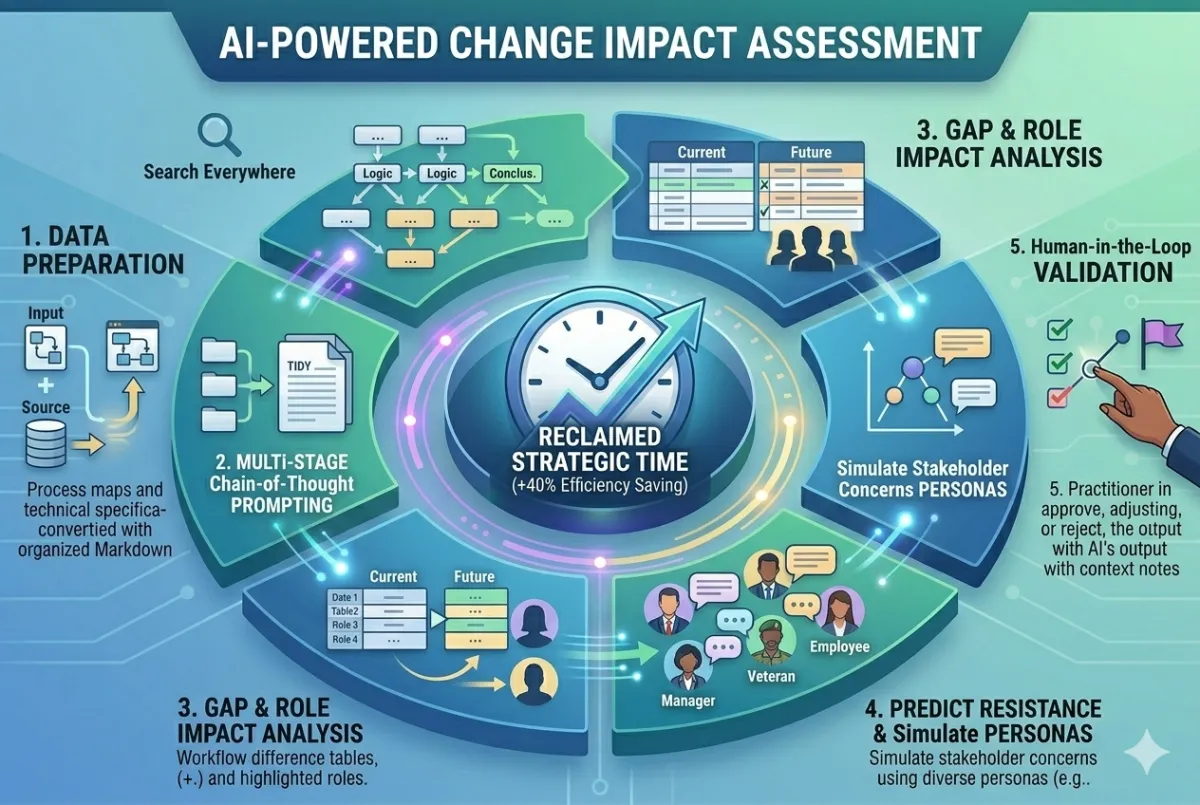
Here is a practical, five-step framework to transition your impact assessments into an AI-powered strategic asset:
Step 1: Prepare and Structure Your Source Data
The quality of an AI’s output is a direct function of the structure of the input. Gather your As-Is current state maps and To-Be technical requirements.
Action: Convert your documentation into Markdown format. Use clear header hierarchies (# for main sections, ## for sub-sections) to provide semantic signaling for the AI.
Tip: Use Semantic Chunking to break large documents into coherent segments. This ensures the AI retrieves a complete unit of meaning rather than a fragmented instruction.
Step 2: Execute Multi-Stage Prompting
Do not ask the AI for a final report in a single prompt. This can lead to hallucinations or oversimplification.
Action: Use the CO-STAR Framework to set the context.
Example: Context: You are an expert Change Manager. Objective: Compare the 'Current Procurement Process' in Document A with the 'New ERP Workflow' in Document B. Identify every sub-step that has been removed or modified.
Method: Explicitly command Chain-of-Thought reasoning, forcing the model to generate intermediate logical steps before reaching its final conclusion.
Step 3: Predict Resistance Hotspots via Simulation
Proactive change management involves identifying risks that have not yet occurred.
Action: Prompt the AI to simulate a specific stakeholder persona.
Prompt: Given these process changes, list the 5 most likely concerns for a frontline manager. Use the '5 Whys' technique to identify the root cause of their potential resistance.
Goal: Use these simulated concerns to identify Change Champions who can proactively address these issues through peer-to-peer influence.
Step 4: Generate Role-Based Key Messages
Once the impacts are identified, you must translate them into actionable language for the workforce.
Action: Use the Inverted Pyramid structure for your message drafts. Place the most critical impact, the 5 W's, in the very first paragraph.
Formatting: Instruct the model to use the active voice and an autonomy-supportive tone. Avoid controlling language (must, required) and instead focus on the personal benefits for the employee.
Step 5: The Human-in-the-Loop Contextual Validation
This is the most vital step for maintaining your professional author authority (E-E-A-T).
Action: Review the AI's output for logical leaps or hallucinations.
Refinement: Adjust the text for political sensitivity and cultural nuances that only a human practitioner can understand.
Verification: Ensure the final assessment aligns with the biologically secondary knowledge required for the project, skills that don't come naturally and require explicit, carefully designed instructions.
Frequently Asked Questions
Is it safe to upload sensitive company process maps to an AI?
Privacy must be your first priority. Never use public, consumer-grade AI for proprietary data. Always utilize your organization's approved, secure environment that supports Retrieval-Augmented Generation (RAG) to ensure data remains within your firewall.
How do I know if the AI is hallucinating my impact data?
Implement Answer Verification. Ask the model to cite the specific Summary Content Units (SCUs) from the original documentation it used to reach its conclusion. If the model provides information not supported by an SCU, its faithfulness score is compromised.
Will using AI reduce my credibility with stakeholders?
Quite the opposite. By automating the technical side of assessments, you move from being an administrative order-taker to a strategic data translator. This transition allows you to provide high-fidelity insights faster, which earns you a seat at the table with leadership.
How should I handle disfluent data, such as a rough meeting transcript?
Before summarizing a transcript for an impact assessment, you must perform Transcript Repair. Use AI tools to strip filler words (ums, ahs) and repair false starts where a speaker abandons a thought mid-sentence. Models perform significantly better on repaired text than on raw, disfluent speech.
Final Thoughts
The goal of Artificial Intelligence in the change management domain is not to replace the human practitioner, but to supercharge your capacity for strategic influence. By automating the labor-intensive technical side of impact assessments, you free yourself to be more present, more empathetic, and more effective in navigating the human elements of organizational change.
The true differentiator in 2026 is the ability to synthesize data with technology while leading people with heart. Look at your project workload for the coming week. Identify one complex process change and try simulating the From-To state using a secure AI tool. How much strategic time can you reclaim today?
Get practical insights on change and business analysis delivered to your inbox. Join our mailing list


