How Can You Successfully Pivot from HR or Customer Service into an Impactful Career in Change Management?
Introduction
Making a career transition often feels like learning an entirely new language from scratch. However, for those moving from Human Resources (HR) or Customer Service into the field of Organizational Change Management (OCM), the shift is more of a dialect change than a total transformation.
While the job titles, technical frameworks, and daily acronyms might differ, the core mission remains exactly the same: navigating the complexities of human behavior to drive better organizational outcomes. If you have spent your career managing employee relations, resolving customer frustrations, or navigating corporate policy, you already possess the high value skills that complex change initiatives desperately need to succeed.
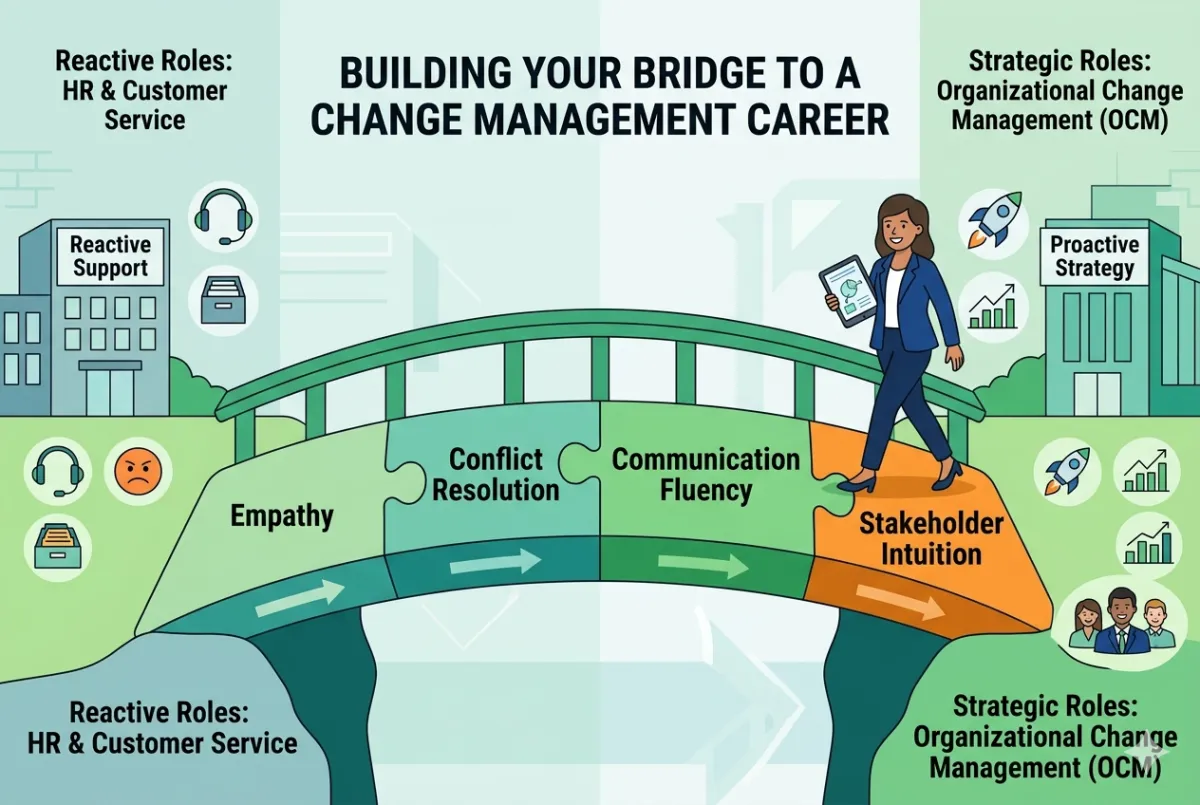
The direct answer to making this transition successful lies in the strategic translation of your existing people management expertise into the structured language of change strategy. By learning how to wrap your natural empathy and communication skills in established methodologies like Prosci or Kotter, you can move from a reactive support role into a proactive strategic leadership position. This article will explore why your background is a secret weapon in the world of transformation and provide a practical framework to help you navigate your own professional shift.
Key Takeaways
Recognize Transferable Value: Your experience in HR and Customer Service has already built the empathy and conflict resolution skills essential for OCM.
Master the Language: Success in a pivot depends on rebranding soft skills into formal Change Competencies.
Adopt a Framework: Use established methodologies to provide a logical structure for your intuitive understanding of human behavior.
Focus on Business Impact: Learn to connect employee adoption and proficiency directly to the project's return on investment.
Build Strategic Partnerships: Collaborate with technical teams and business analysts to ensure the human side of change is integrated with the technical side.
What is the OCM Career Pivot?
An Organizational Change Management career pivot is the process of formalizing and scaling interpersonal skills to manage large scale transitions. In many HR or Customer Service roles, practitioners are often reacting to individual needs or solving problems after they have already occurred. In Change Management, those same interpersonal insights are applied proactively to entire departments or global organizations facing a shift in technology, process, or culture.
Organizational Change Management is the discipline that guides how we prepare, equip, and support individuals to successfully adopt change in order to drive organizational success. When you pivot into this field, you are moving from managing people operations or customer satisfaction to managing people transitions. You are essentially becoming a professional guide for employees who are moving from a familiar current state, through a messy transition state, and into a new, often uncertain future state.
This career path is particularly suitable for those who enjoy the human element of business but want to have a more direct impact on the strategic direction of the company. Instead of handling a single grievance or a single customer complaint, you are designing the communication and training strategies that prevent thousands of grievances or complaints from happening in the first place. It is a move from the micro to the macro level of human behavior.
Why is a Background in People-Centric Roles Important for Change Management?
Many technical projects fail not because the code was wrong, but because the people refused to use the new system. This is why a background in HR or Customer Service is so valuable: you already understand the emotional and psychological barriers to adoption.
1. Empathy as a Diagnostic Tool
HR and Service professionals are trained to hear what is not being said. You can sense tension in a room or identify the underlying fear behind a sharp question. In Change Management, this serves as a powerful diagnostic tool. It allows you to identify silent resistance or cultural dark matter before it has the chance to derail a project. While a technical lead might only see a delayed milestone, a change professional with your background sees the lack of trust that caused the delay.
2. High Fidelity Communication Fluency
You have likely spent years delivering difficult news, explaining complex policies, or de-escalating angry callers. This experience makes you a natural at crafting What Is In It For Me (WIIFM) messages. You know how to tailor a message so that it resonates with the specific fears and motivations of your audience. In the world of OCM, this ability to translate corporate speak into human speak is what builds the desire for change.
3. Conflict Resolution and De-escalation
Major organizational changes often trigger a fight or flight response in employees. Your experience in navigating tense situations and finding common ground is exactly what is needed during a high stakes project Go-Live event. You understand how to acknowledge someone's frustration without letting it stall the project's progress.
4. Stakeholder Intuition
Through your previous roles, you have likely developed a keen understanding of organizational hierarchies and the informal power maps that exist in every company. You know that the person with the biggest title is not always the person who holds the most influence on the shop floor. This intuition is the foundation of effective stakeholder mapping, a core task in any change initiative.
How to Transition Your Career into Change Management (Step-by-Step Framework)
If you are ready to make the professional jump from a support-focused role into a strategy-focused OCM role, follow this simple step-by-step framework to bridge the gap:
Step 1: Audit and Rebrand Your Current Competencies
The first hurdle is often your own resume. You must stop describing your work in terms of tasks and start describing it in terms of change outcomes.
Review your accomplishments: Look for times when you helped a team through a transition, even if it was not officially called a project.
Translate the language: Change Handled employee grievances to Managed stakeholder resistance and facilitated conflict resolution. Change Explained benefits packages to Developed and executed targeted communication strategies for complex organizational updates.
Focus on the User: Emphasize how you acted as an advocate for the end user or employee, as this is a core responsibility of an OCM lead.
Why it matters: Recruiters and hiring managers need to see that you understand the formal language of the industry. Rebranding your skills shows that you are already thinking like a change professional.
Step 2: Master the Technical Language of Change Frameworks
To be taken seriously as a strategic partner, you must wrap your intuition in a methodology. This provides the Why behind your recommendations.
Study the heavy hitters: Familiarize yourself with models like Prosci (ADKAR), Kotter’s 8-Step Process, or Bridges’ Transition Model.
Learn the terminology: Understand terms like Change Impact, Readiness Assessment, and Adoption Metrics.
Connect the dots: Practice explaining a previous HR situation using one of these models. For example, explain an employee's low performance through the lens of a lack of Knowledge or Ability in the ADKAR framework.
Why it matters: Frameworks give you the structure to explain your gut feelings in a way that executives and technical leads can respect and act upon.
Step 3: Shift from Reactive Task Management to Proactive Impact Assessment
In Customer Service and HR, you are often a service taker. In OCM, you must be a strategy maker. This requires looking at projects through the lens of a Change Impact Assessment.
Ask the right questions: Instead of just looking at what a new software does, ask how it will specifically change the daily behavior of a specific team.
Identify the From-To state: Document exactly what employees are doing today and exactly what they will be expected to do tomorrow.
Predict the friction: Use your people skills to identify which parts of that From-To shift will cause the most emotional or operational stress.
Why it matters: The Impact Assessment is the foundation of your entire change plan. If you miss an impact, you will miss a resistance hotspot later in the project.
Step 4: Connect Human Behavior to Business Value
One of the biggest challenges for those pivoting from HR is learning to speak the language of the bottom line. Change Managers are strategic business partners, not just the people who do the communications.
Understand People-Dependent ROI: Learn to explain how much of a project's success depends on people actually using the new solution.
Build a Business Rationale: Practice explaining how a 10 percent increase in user adoption leads to a specific dollar amount in saved time or increased revenue.
Use data to tell the story: Instead of saying Employees are unhappy, say Our readiness assessment shows a 30 percent gap in the 'Desire' stage, which puts our January launch at risk.
Why it matters: Linking people to profit is how you earn a seat at the leadership table. It transforms OCM from a nice to have into a must have for the organization.
Step 5: Build Cross-Functional Partnerships with Technical Teams
A successful Change Lead does not work in a vacuum. You must learn to work hand-in-hand with Business Analysts, Project Managers, and Developers.
Learn the Business Analysis side: Understand how Business Analysts gather requirements. This helps you ensure that human requirements are included in the technical build.
Speak their language: You do not need to be a coder, but you should understand the purpose of the technologies being implemented and the Agile or Waterfall methods being used to build them.
Offer value early: Show the technical teams how your stakeholder analysis can help them get their technical requirements signed off faster.
Why it matters: When the technical team and the change team are aligned, the transition for the end user is much smoother and the risk of rework is significantly reduced.
Frequently Asked Questions (FAQs)
Do I need a formal certification like Prosci to pivot into OCM?
While a certification is not strictly required, it is highly recommended. For someone pivoting from a different field, a certification acts as a seal of approval that you understand the formal methodologies of the industry. It helps bridge the credibility gap when you are moving away from an HR or Service title.
How is OCM different from traditional Human Resources?
HR generally focuses on the ongoing management of the employee lifecycle, including hiring, benefits, and compliance. OCM is project-based and focused specifically on helping people navigate a particular transition. While HR is often about stability, OCM is about managed instability as the company moves to a new state.
Can I move into OCM if I don't have a background in technology?
Yes. You do not need to be a technical expert to be a great Change Manager. Your job is to understand the impact of the technology on the people, not the code behind it. As long as you are willing to learn the What and Why of the tech, your people expertise will do the rest.
What is the most common mistake when pivoting from Customer Service?
The most common mistake is remaining in a reactive mindset. In Customer Service, you wait for a problem to arrive and then solve it. In OCM, you must be proactive. You need to hunt for potential problems months before they happen and design strategies to mitigate them.
Final Thoughts
The leap from Human Resources or Customer Service to Organizational Change Management is shorter than you think. You have spent years developing the muscles required for this work: empathy, communication, and a deep understanding of human motivation.
By shifting your focus from reactive support to proactive strategy, and by adopting the formal language of change frameworks, you can turn your professional reputation into a high demand career as a change leader.
Change is the only constant in modern business, which means your skills will always be in demand. The key is to stop seeing yourself as a support person and start seeing yourself as a transition architect.
Reflective Question: Identify a recent change at your current company, such as a new expense policy or a software update. If you were the Change Manager for that initiative today, what is the single biggest human risk you would have identified, and how would your current skills help solve it?
Get practical insights on change and business analysis delivered to your inbox. Join our mailing list


