Hired During Testing and Expected to Deliver Results? Here Is What No One Told You
Introduction
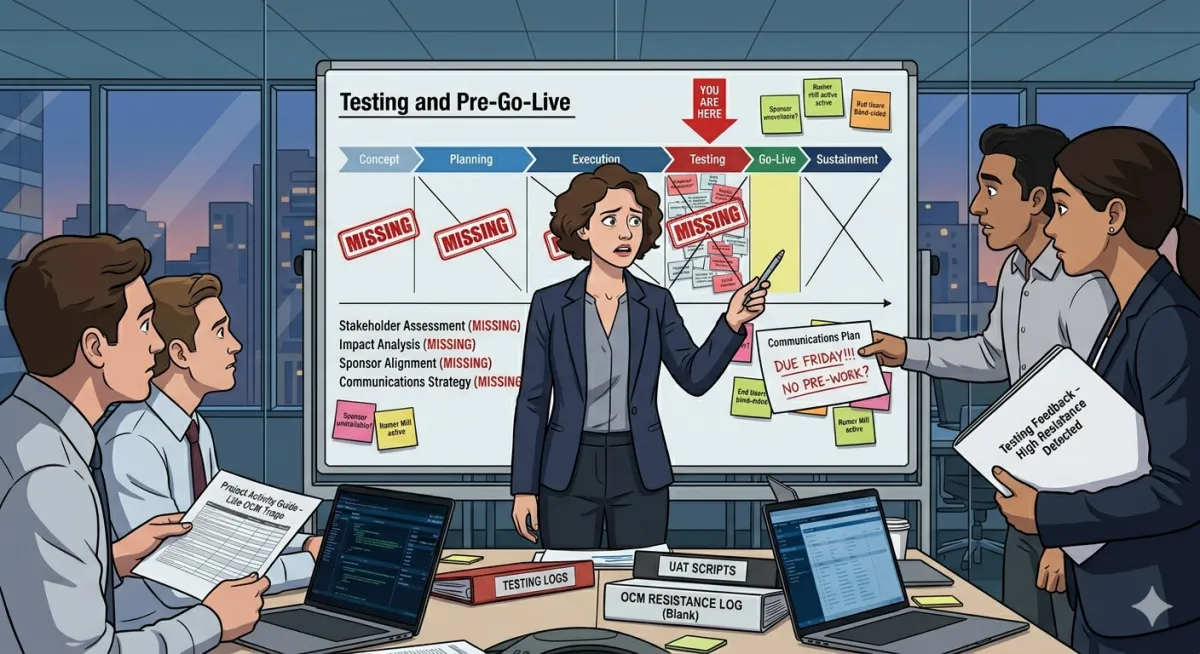
Every change manager has been there. You receive the call, accept the engagement, and show up to a project already deep into its Testing phase. The system is half-built, the timeline is shrinking, and the project team looks at you expecting a communications plan by Friday. Nobody mentions that the stakeholder assessment was never done, the sponsor has barely been briefed, and the impacted employees have not heard a single word about what is coming.
This is one of the most dangerous positions a change professional can occupy, not because the work is impossible, but because the foundation it depends on was never laid. Understanding where organizational change management activities belong in the project lifecycle is not just academic knowledge. It is what separates a change manager who drives adoption from one who spends the entire engagement doing damage control.
Key Takeaways
Know Your Entry Point: Where you join a project determines what you can realistically deliver. Entering during Testing without pre-work in place is a risk that must be named and managed immediately.
Oganizational Change Management Is a Lifecycle Practice: Change management is not a phase you activate before Go-Live. It is a discipline that runs in parallel with every stage of the project from Concept through to Sustainment.
Pre-Work Is Non-Negotiable: Stakeholder assessments, impact analyses, sponsor alignment, and communication strategies must be developed early. Skipping them does not save time; it creates compounding delays later.
Resistance Does Not Appear at Go-Live: It builds silently throughout the project when people feel uninformed, excluded, or blindsided. By the time it is visible, it is already expensive.
Your Value Is Upstream: The most impactful organizational change management work happens long before the system goes live. If you are only being called in at the end, part of your job is making the case for why that needs to change.
What Is the Change Manager's Project Activity Guide?
Change management is not an event. It is a process of helping individuals understand, internalize, and support a change throughout the project's lifecycle. The Project Activity Guide is the organizational change management practitioner's roadmap for what needs to happen, when it needs to happen, and what is at risk if it does not. It maps every major change management deliverable to the corresponding phase of the project lifecycle, ensuring that the people side of the transformation keeps pace with the technical side.
Think of project management as delivering the "what," the system, process, or tool, and organizational change management as delivering the "how," ensuring people actually use it successfully. The activity guide operationalizes that distinction. It tells you that during the Concept phase, your job is to assess the magnitude of the change and establish your sponsorship model.
During Planning, you are building your strategy, your communications framework, your training plan, and your resistance management approach. During Execution, you are deploying those plans, activating change champion networks, and monitoring adoption signals in real time. During Sustainment, you are reinforcing new behaviors, tracking value realization, and transitioning responsibilities to permanent teams.
Organizational change management lifecycle management requires continuous coordination with the project manager to ensure the organizational change management effort is integrated with other project activities and milestones. A change manager who understands this does not wait to be invited into project meetings. They position themselves as a parallel work-stream lead who is accountable for the human side of every milestone, from the first stakeholder workshop to the final post-go-live review.
Why Joining Late Costs More Than Anyone Budgets For
Resistance does not wait for your arrival. When you integrate change management late, your project has already begun to experience difficulties, including productivity declines, resistance, and possible loss of valued employees, all of which can be prevented or minimized when you integrate change management at the planning stages. By the time a change manager is brought in during Testing, the organizational rumor mill has already been running for months.
People have formed opinions, drawn conclusions, and in some cases already decided whether they will support the change or resist it. Your first task is not to build momentum. It is to undo damage.
Shadow behaviors take root before Go-Live. When employees feel uninformed about an incoming change, they do not sit still and wait. They find unofficial workarounds, cling to old processes, and develop the kind of quiet non-compliance that only becomes visible after the system goes live and adoption metrics come in well below target. These behaviors are nearly impossible to reverse after the fact. They are entirely preventable with early engagement.
Sponsor alignment cannot be rushed. One of the most critical pre-work activities in any organizational change management engagement is building an active, visible, informed project sponsor. A project sponsor is important to have in place at the start of a project. Too often the project sponsor becomes less involved once the project has been approved; however, it is critical to keep them engaged throughout. A sponsor who is briefed for the first time in week fourteen of a twenty-week project cannot course correct what has already happened. They can only manage the consequences of a gap that should never have existed.
Late organizational change management inflates cost and compresses timelines. Many teams wait until Stage 3 to engage organizational change management, missing crucial early buy-in and momentum. Every activity that was skipped in the early phases must be retrofitted under pressure, with less time, less stakeholder patience, and a project team that is already focused on go-live. The work does not disappear because it was deferred. It reappears later, more urgent and more expensive than it would have been if it had been done in the right sequence.
The Change Manager's Project Activity Guide: Phase by Phase
Phase 1: Concept and Initiation
This is where the foundation of the entire organizational change management effort is established. Before a single communication goes out or a training module is built, the change manager must understand the scope and nature of what is being asked of the organization.
What to do: Assess the magnitude of the change by examining what is shifting, how significantly it will affect daily work, and how ready the organization is to absorb it.
Action: Conduct a preliminary stakeholder identification, secure your sponsorship model, and establish your presence within the project governance structure.
Goal: Enter the Planning phase with a clear picture of the change landscape and a sponsor who understands their role and is committed to playing it actively.
Phase 2: Planning and Strategy Development
This is the most leveraged phase in the organizational change management lifecycle. The decisions made here shape everything that follows. Cutting corners at this stage is the single most common reason change management fails to deliver measurable results.
What to do: Create the organizational change management strategy and playbook, build detailed communication, training, and engagement plans, and align the organizational change management roadmap with project milestones.
Action: Complete a full stakeholder assessment, conduct a change impact analysis across all affected departments, and define your resistance management approach before the first impacted employee hears anything about the project.
Goal: A complete, integrated organizational change management plan that is formally embedded in project governance and reviewed alongside technical deliverables at every milestone gate.
Phase 3: Execution and Deployment
This is where the plans you built in Phase 2 come to life. The quality of your execution is directly proportional to the quality of your pre-work. A well-prepared Phase 2 makes Phase 3 structured and manageable. A skipped Phase 2 makes Phase 3 reactive and exhausting.
What to do: Launch communications to build awareness and readiness, kick off change champion networks for peer support, and enable leaders with coaching and toolkits.
Action: Execute your communication calendar, deliver role-based training to impacted employees, and maintain a live resistance log that is reviewed with the project sponsor on a regular cadence.
Goal: Employees who arrive at Go-Live informed, equipped, and supported, rather than surprised, confused, and unprepared.
Phase 4: Testing and Pre-Go-Live
This is the phase most change managers are hired into, and it is the phase that exposes every gap in the pre-work most brutally. If you are joining here without Phases 1 through 3 behind you, your first task is triage.
What to do: Conduct an immediate assessment of what has and has not been done. Identify the highest-risk stakeholder groups, the most significant communication gaps, and the current state of sponsor engagement.
Action: Take the pulse of the organization, identify the source of resistance, why it has emerged, and manage it effectively and quickly before it reaches Go-Live.
Goal: Contain the exposure created by late engagement, accelerate the most critical pre-work activities, and be transparent with the project sponsor about what is realistic to achieve in the time remaining.
Phase 5: Sustainment and Value Realization
Go-Live is not the finish line. It is the moment when adoption either takes hold or quietly unravels. This lifecycle ensures adoption is achieved, sustained, and tied to business outcomes. The change manager's job does not end when the system goes live; it shifts from deployment to reinforcement.
What to do: Monitor adoption metrics, provide ongoing support through office hours and feedback channels, and recognize early wins in a way that reinforces the behaviors the organization needs to sustain.
Action: Track value realization indicators alongside adoption data, continue targeted communication for lagging stakeholder groups, and begin transitioning organizational change management responsibilities to permanent business-as-usual teams.
Goal: A change that sticks, measured not by whether the system went live on schedule, but by whether people are actually using it six months later in the way it was designed to be used.
Frequently Asked Questions
What should I do first if I am hired during the Testing phase with no pre-work in place?
Start with a rapid assessment before you agree to any deliverable timelines. Understand what has already happened on the people side of the project: what communications have gone out, whether a stakeholder analysis was ever completed, and what the current state of sponsor engagement looks like.
Only once you have that picture can you make an honest recommendation about what is achievable before Go-Live and what will need to be managed as a post-go-live risk.
How do I make the case for earlier organizational change management involvement on future projects?
Use the current engagement as your evidence. Document the gaps you inherited, quantify the time and cost required to address them under pressure, and present that data to the project sponsor and PMO at the close of the engagement.
Aligning organizational change management deliverables directly with project gate reviews ensures leadership sees the change strategy as an essential success factor, not a side activity. When leadership can see the cost of late engagement in concrete terms, the conversation about earlier involvement becomes significantly easier.
Can organizational change management still be effective if it starts late?
Yes, but the definition of effective changes. Starting change management at any point will help you get the project on track, but the scope of what is achievable is directly constrained by how much of the lifecycle has already passed without it. A late-stage change manager can contain resistance, accelerate critical communications, and improve go-live readiness.
What they cannot do is recover the trust that was never built, the sponsor alignment that was never established, or the impact analysis that was never conducted. Partial organizational change management is better than none. Early organizational change management is better than partial.
How do I manage stakeholder expectations when I know the pre-work was skipped?
Be direct and be specific. Vague reassurances that everything will be fine before Go-Live are the fastest way to lose credibility with a project team that already knows the situation is fragile. Name the gaps clearly, present a prioritized plan for addressing the most critical ones, and be explicit about the risks associated with the ones that cannot be fully closed in the time available. Stakeholders respect honesty paired with a plan far more than confidence without substance behind it.
Final Thoughts
The change manager who understands the full project lifecycle is not just a practitioner with a communications plan. They are a risk manager, a relationship architect, and a strategic partner to the project from the moment the initiative is conceived. The Project Activity Guide is the tool that makes that possible, giving you a clear picture of where you are, what should have happened before you arrived, and what needs to happen next.
If you have been hired into a project that is already mid-stream, the most valuable thing you can do is be honest about what that means. Assess what exists, prioritize ruthlessly, and focus your energy on the gaps that carry the highest risk to adoption. And when the engagement closes, make sure the next project sponsor understands why the conversation about change management needs to happen on day one, not week fourteen.
Reflective Question: Think about the last project you joined. At what phase did organizational change management formally begin? Looking back at the lifecycle, which pre-work activities were skipped, and where did their absence show up later in the project? That gap is your starting point for the next conversation about when change management should start.
Get practical insights on change and business analysis delivered to your inbox. Join our mailing list


