You Are Not Taking Notes in That Workshop. You Are Losing Requirements in Real Time
Introduction
Every project team has lived through a version of the same scenario. Two senior stakeholders hold opposing positions on a requirement. Both have legitimate concerns. Neither has the authority to override the other. The business analyst documents both positions, schedules a follow-up meeting, and watches the project calendar fill with increasingly tense discussions that produce nothing but more documentation of the same disagreement.
Two weeks pass. The requirement is still unresolved. The development team is waiting. The timeline is absorbing the cost of a decision that nobody is empowered to make, and the BA who was hired to bridge requirements gaps is now managing a political standoff that has nothing to do with requirements analysis and everything to do with the absence of a defined decision-making structure.
Project governance defines how decisions will be made, who has the authority to make them, and how conflicts or escalations will be handled. Transparent decision-making processes help maintain momentum and prevent bottlenecks throughout the project lifecycle. The difference between a project team that resolves conflict in forty-eight hours and one that carries the same disagreement through three consecutive status meetings is almost always the presence or absence of a governance framework built before the first conflict arrived.
Key Takeaways
Governance Is Decision Insurance, Not Bureaucracy: A project governance plan establishes decision-making authority and oversight structures before work begins. It defines approval hierarchies, escalation procedures, and stakeholder roles that prevent authority confusion, which is the confusion that causes project delays, budget overruns, and stakeholder conflicts throughout delivery.
Every Project Needs One and Only One Accountable Sponsor: Multiple accountable parties is a structural contradiction that produces the same result as no accountable party. The governance framework must name a single person whose authority is final, whose budget is at stake, and whose sign-off closes a decision.
Escalation is not about pointing fingers. It is about fostering transparency and ownership. It helps sustain progress, keeps communication open, and prevents small setbacks from turning into full-blown delivery failures. Every robust governance framework must include a clearly defined escalation process that gives the project team a structured path to resolution.
Time-Bound Triggers Are What Separate Governance From Good Intentions: An escalation process without a defined trigger is a suggestion. A trigger that automatically escalates any unresolved requirement after a defined number of business days is a mechanism. One produces accountability. The other produces documentation.
The Decision Log Is the Governance Framework's Memory: A decision made through the governance path and never formally recorded is a decision that will be contested the moment a new stakeholder joins the project or a phase transition creates pressure to reopen settled questions.
What Is Project Governance and Why Does It Function as the Project's Decision Infrastructure?
Project governance is the framework that outlines the hierarchy, decision rights, and escalation paths. It includes the governance committees, reporting structures, and the mechanisms for monitoring project progress and resolving the conflicts that project delivery consistently generates. In the professional practice of business analysis, this framework is not the project manager's responsibility alone. It is the structural environment within which the BA's requirements work either progresses smoothly or stalls repeatedly at the same decision points.
An escalation plan is the specific component of the governance framework that defines what happens when a conflict or decision cannot be resolved at the working level. Escalation management is about passing problems that could jeopardize a project to higher levels in a structured manner in order to facilitate quick decisions and solutions. Clear communication with decision-makers is essential, including a detailed description of the problem, the potential impact on the project, and the attempts already made to resolve it at the working level. Without this structure, every unresolved conflict defaults to whoever is most persistent, most politically connected, or most willing to escalate informally through channels that leave no documentation trail and create no shared accountability.
Developing a project governance plan requires gathering stakeholder requirements first, then documenting agreed authority structures, approval thresholds, and escalation procedures. The process begins with interviewing the executive sponsor to understand organizational priorities and decision-making preferences, then mapping existing approval structures, defining decision authority levels, and designing escalation pathways with conflict procedures specifying timeframes and intervention triggers. A governance framework built from that sequence is not a document the project team produces for compliance. It is the operating system that keeps the project moving when the human complexity of multi-stakeholder delivery generates its inevitable friction.
Why Projects Without a Governance Framework Pay Compounding Interest on Every Unresolved Decision
Analysis paralysis becomes the default operating mode. Without a defined decision-maker for strategic conflicts, teams default to the instinct that more research, more consultation, and more meetings will eventually produce a consensus that allows work to resume. That consensus rarely arrives on its own. Decision-making bottlenecks and delays in leadership approvals or strategic inputs that stall progress are among the most common causes of project escalation, and they are almost always products of unclear authority rather than genuinely complex decisions that require extended deliberation. The governance framework eliminates the structural condition that produces the bottleneck.
Scope bloat replaces decision-making when authority is absent. When no one has the authority to say no to a competing requirement, teams often attempt to resolve the conflict by building both options. The result is a solution that is more expensive, more complex, and less coherent than either of the original proposals, designed not to deliver value but to avoid the political cost of a clear choice. A governance framework with a defined Accountable Sponsor makes that choice available within a defined timeframe rather than allowing the project to absorb both alternatives indefinitely.
The BA's credibility is spent managing politics instead of driving analysis. A business analyst caught in the middle of an unresolved stakeholder conflict without a governance structure to refer the decision to is not doing business analysis. They are doing political mediation without the authority or the mandate for it. Clearly documenting each role's responsibilities and authority within the governance structure avoids the ambiguity that places the BA in the position of managing conflicts that belong at a higher level of the project hierarchy. The governance framework is what gives the BA the professional standing to escalate rather than absorb.
Retroactive pushback erodes every decision made without structural authority. When a BA or project manager is forced to make a high-level policy decision because no defined authority exists to make it, that decision carries no organizational legitimacy. The stakeholder who disagreed did not consent to the process. They simply ran out of time. When pressure increases later in the project, that unlegitimized decision becomes a flashpoint, and the BA who made it bears the reputational cost of a governance failure that was never their structural responsibility to prevent.
How to Design a Project Governance and Escalation Framework: Step by Step
Step 1: Identify the Single Accountable Sponsor Before the Project Begins
The governance framework cannot be built until the ultimate decision authority is named and confirmed. Everything else in the structure reports upward to this person.
What to do: Identify the executive whose budget is directly at stake in the project's outcome, who has the organizational authority to accept risk or change scope, and who can be held accountable for the project's final decisions without ambiguity.
Action: Confirm this person's role in writing, including the specific categories of decision that require their sign-off and the expected response time for escalated decisions. A sponsor who agrees to the role in conversation but is never formally confirmed in writing is not an accountable sponsor. They are a name on an org chart that the project will struggle to hold to any specific commitment.
Goal: A single, formally confirmed Accountable Sponsor whose authority is documented, communicated to all stakeholders during onboarding, and referenced in the escalation path before the first conflict arises.
Step 2: Define the Decision Tiers and the Authority at Each Level
Not every disagreement belongs in front of the executive sponsor. A governance framework that sends every unresolved question to the top of the hierarchy creates a bottleneck at exactly the level that has the least available time and the broadest scope of organizational responsibility.
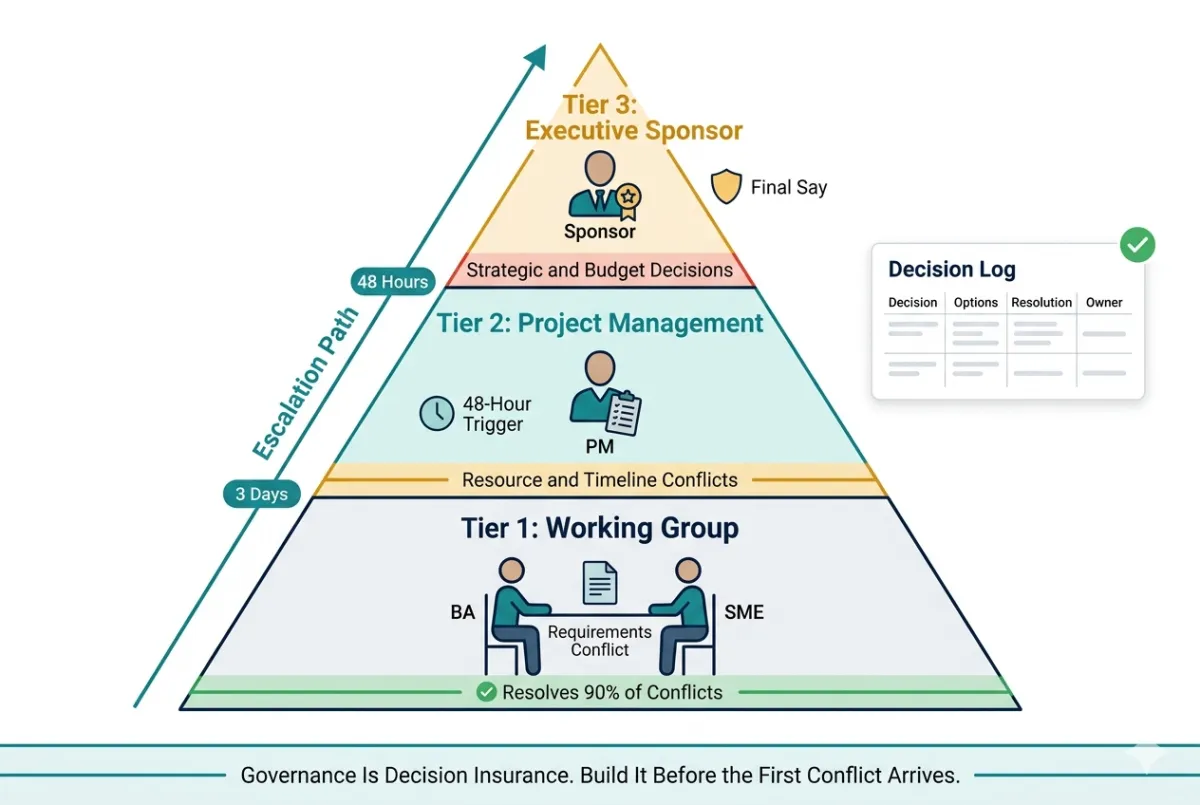
What to do: Define a three-tier decision ladder that distributes authority appropriately across the project. Tier One covers the working group, where BAs and subject matter experts resolve technical and process-level requirements. Tier Two covers project management, where the project manager resolves resource and timeline conflicts. Tier Three covers the steering committee or executive sponsor, where strategic misalignments, budget shifts, and scope decisions that exceed Tier Two authority are resolved.
Action: Document each tier's decision scope explicitly, including spending authorities, scope change thresholds, and the categories of conflict that automatically bypass Tier One and Tier Two and go directly to the sponsor. Map these authority levels against the existing organizational hierarchy so that the governance structure reinforces rather than contradicts the reporting relationships already in place.
Goal: A decision ladder where ninety percent of working-level conflicts are resolved at Tier One, ten percent reach Tier Two, and the sponsor's time is reserved for the genuinely strategic decisions that require their authority and organizational standing.
Step 3: Set Time-Bound Escalation Triggers for Every Tier
A conflict resolution process without a deadline is not a process. It is a recommendation. Time-bound triggers are what convert the governance framework from a document into a mechanism that operates automatically when conflict arises.
What to do: Define a specific escalation trigger for each tier. At Tier One, if a requirement remains unresolved after three business days, it automatically escalates to the project manager. At Tier Two, if the project manager cannot resolve the conflict within forty-eight hours, it escalates to the steering committee or sponsor. These numbers should reflect the project's actual risk profile and timeline pressure rather than a universal standard.
Action: Before escalation is initiated, the escalating party must complete a problem analysis and preparation step, ensuring that the higher level receives a structured description of the issue rather than a raw conflict that requires them to reconstruct the background before they can make a decision. The trigger activates the escalation. The preparation step determines whether the escalation produces a useful decision or simply moves the confusion upward.
Goal: A time-bound escalation mechanism where no unresolved conflict can remain static beyond its defined trigger window, and where every escalation arrives at the next tier fully prepared for a decision rather than requiring extended context-setting before the decision-maker can act.
Step 4: Define the Decision Brief as the Standard Escalation Currency
The quality of a decision made under escalation is directly proportional to the quality of the information presented to the decision-maker. A governance framework that escalates problems without a defined information format produces slow, poorly informed decisions that generate as much controversy as the original conflict.
What to do: Establish a standard Decision Brief format that every escalation must use. The brief should include four components: a one-paragraph description of the two conflicting positions in plain language, the specific impact of each option on the project's business rationale, the project team's recommendation with a clear rationale, and the consequence of inaction expressed in terms of timeline, cost, or risk.
Action: Train every BA and project manager on the Decision Brief format before the first conflict arises, not as a response to the first escalation. The brief is most effective when it has been practiced rather than created under the pressure of an active conflict with a sponsor waiting for resolution.
Goal: A standardized escalation artifact that gives the decision-maker everything they need to act in one document, in one meeting, within the escalation window, without requiring additional rounds of clarification that consume the time the trigger was designed to protect.
Step 5: Socialize the Governance Framework at Project Onboarding
A governance framework that is introduced for the first time when the first conflict arises is not a governance framework. It is a reactive escalation attempt that the losing party will contest on the grounds that they never agreed to the process.
What to do: Present the full governance structure, including the decision tiers, the escalation triggers, the Decision Brief format, and the Decision Log, during the project onboarding meeting. Make it a standing agenda item, not an appendix that stakeholders may or may not read.
Action: Frame the escalation process explicitly as a professional tool rather than a failure mechanism. Stakeholders who understand that escalation protects the project's timeline rather than assigns blame are significantly more likely to use it early and cleanly rather than treating it as a last resort deployed only when the situation has already become adversarial.
Goal: A project community where every stakeholder knows the governance rules before the first conflict arises, has formally acknowledged their role within the structure, and understands that the escalation path exists to protect the project's momentum rather than to override anyone's professional judgment.
Frequently Asked Questions
What do I do when the executive sponsor is disengaged and consistently unavailable for Tier Three decisions?
This is the governance framework's most significant failure mode and one that must be addressed proactively rather than managed reactively. Using a sponsorship roadmap and plan is essential to assess and manage sponsor involvement, tracking what the sponsor needs to complete to increase the program's success as well as when those activities have been completed. When a sponsor's disengagement pattern becomes clear, escalate the pattern itself rather than individual decisions. Present the sponsor's manager or the steering committee chair with a documented record of unresolved decisions and their cumulative impact on the project timeline. Make the cost of disengagement visible before it becomes a project-wide crisis.
How do I prevent the escalation process from being used as a power tool by politically motivated stakeholders?
The Decision Brief requirement is the primary defense against this. A stakeholder who must present two balanced positions, including the legitimate case for the opposing view, and who must provide evidence for the impact of each option on the business rationale, cannot easily weaponize the escalation process without that weaponization being visible in the brief itself. The time-bound trigger also reduces the incentive for strategic delay, because the escalation clock runs regardless of whether one party is using the conflict window to build political support for their position.
Should the governance framework be different for agile projects versus waterfall ones?
The authority structure and escalation triggers remain relevant in both methodologies, but the decision cadence differs significantly. Agile governance relies on iterative feedback loops, short development cycles, and empowered teams that can make on-the-spot decisions, with frequent stand-ups and sprint reviews serving as the natural decision checkpoints where issues and risks are discovered early. The escalation trigger in an agile context is typically tied to sprint boundaries rather than business day counts, reflecting the methodology's emphasis on rapid iteration over extended deliberation.
How do I handle a situation where the Decision Log reveals that the same stakeholder's decisions are consistently being overturned at Tier Three?
Treat the pattern as a governance data point rather than an interpersonal conflict. If a specific stakeholder's Tier One decisions are being regularly overturned at the sponsor level, there is a mismatch between their assigned authority and the scope of the decisions they are attempting to make. Review the Tier One decision scope definition with the project manager, confirm whether the stakeholder understands the boundary of their authority within the framework, and adjust the tier definition if the boundary was never clearly communicated.
Final Thoughts
The projects that deliver on time and within scope are not the ones that avoid conflict. They are the ones that have a defined, pre-agreed structure for resolving it before it accumulates into a timeline-consuming stalemate. The governance framework does not make hard decisions easy. It makes them possible within a timeframe the project can absorb.
Build the decision ladder before the first conflict arises. Set the triggers before the first requirement is unresolved. Present the governance structure at onboarding so that every stakeholder who will be governed by it has consented to it in advance. And maintain the Decision Log with the same rigor as the requirements register, because a decision that is not documented is a decision that will be made again.
Reflective Question: Look at your current project documentation right now. Does it contain a Decision Log with columns for the decision needed, the options considered, the final decision, who made it, and when? If the answer is no, that document is what you build today, and the governance framework it sits within is what you propose in your next project manager conversation.
Get practical insights on change and business analysis delivered to your inbox. Join our mailing list


