Why Your Message Is Not Landing and the 7-Part Framework That Will Fix It
Introduction
Every business analyst has sent a message they were confident about, only to receive a response that made it clear the recipient understood something entirely different. The requirement was documented. The email was detailed. The business case was thorough. And yet the developer built the wrong feature, the executive asked for data that was already in the report, and the stakeholder approved something they later claimed they never agreed to.
This is not a knowledge problem. It is a communication problem. Communication significantly influences how requirements are gathered, stakeholders are aligned, and projects are executed. When business analysts communicate effectively, they extract nuanced requirements and avoid the misunderstandings that compromise a project's integrity. The gap between sending a message and having it understood is where the majority of project rework is born, and closing that gap requires more than good intentions. It requires a structured framework.
That framework is the 7 C's of Communication, and for a business analyst or change professional, applying it consistently is the difference between being someone who produces documents and being someone whose work actually drives decisions.
Key Takeaways
Communication Is Only Successful When It Is Understood: The only true measure of whether communication has occurred is whether both parties now share the same understanding. Information is given out. Communication is getting through.
The Recipient Sets the Standard: Every message must be written for the person receiving it, not for the person sending it. Their level of technical knowledge, their priorities, and their available time are all variables that shape how your message needs to be structured.
Clarity and Completeness Work Together: A clear message without complete information forces the reader to make assumptions. A complete message without clarity buries the insight they need under information they have to dig through.
The 7 C's of effective communication facilitate information flow, promote collaboration, ensure clarity, and improve the decision-making process, which means applying them consistently is not a writing exercise. It is a project management discipline.
Silence Is Not Confirmation: The absence of a response does not mean the message landed. Following up to verify understanding is part of the communication act, not a separate task added on afterward.
What Are the 7 C's of Communication and Why Do They Matter in Business Analysis?
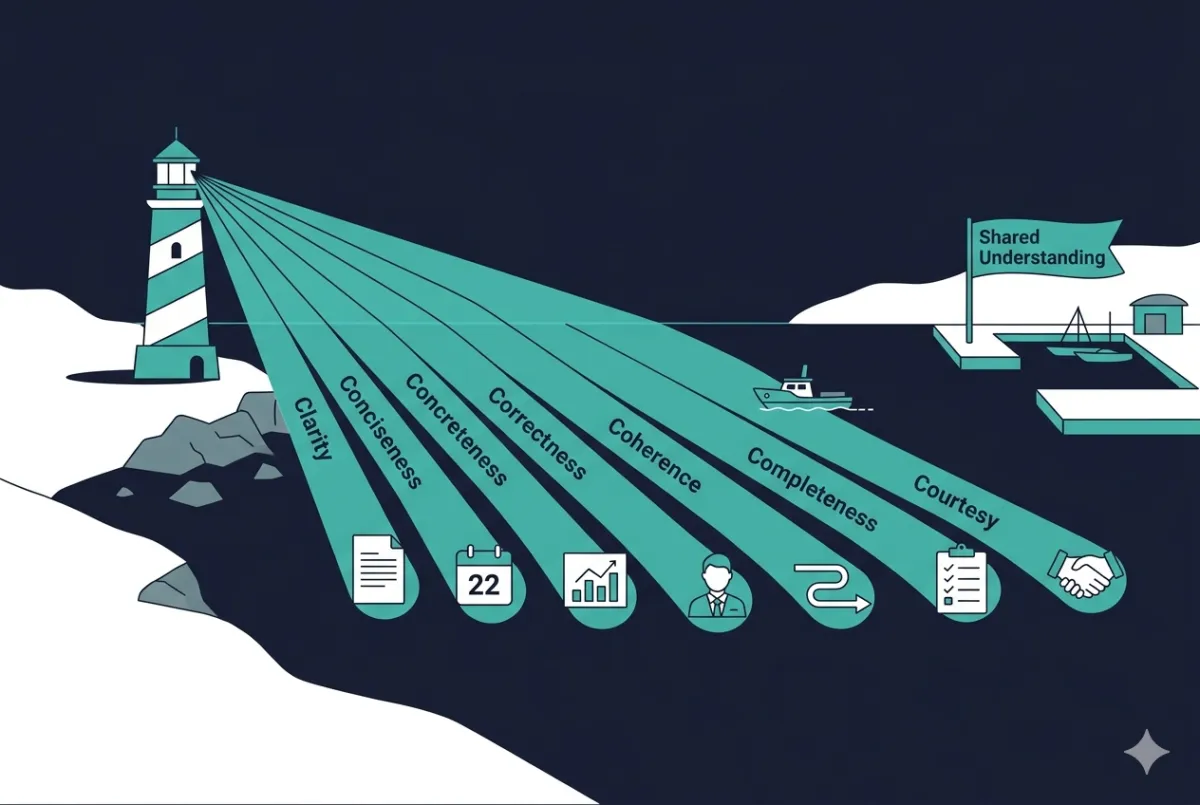
The 7 C's of communication are a set of guiding principles for effective business communication, moving around seven principles: clear, concise, concrete, correct, complete, coherent, and courteous. In the professional practice of business analysis, these are not theoretical ideals. They are diagnostic tools that a practitioner applies before sending any communication that a project decision depends on, from a one-line Slack message to a forty-page business case.
Clarity means the message is easy to understand without the need for further clarification. Conciseness means the message articulates its point quickly and efficiently without taking up more time than necessary. Concreteness means the communication is grounded in specific facts, data, and examples rather than vague statements. Correctness means the information is accurate and the presentation is professional. Coherence means the message flows logically from one point to the next. Completeness means all the information the recipient needs to take action or make a decision is present. Courtesy means the tone is friendly, respectful, and considerate of the recipient's context and pressures.
What makes this framework genuinely powerful in a business analysis context is that each principle addresses a specific failure mode that shows up repeatedly in project communications. A requirement that fails the Clarity test becomes a defect. A business case that fails the Completeness test stalls a decision. An email that fails the Courtesy test damages a stakeholder relationship at exactly the moment the project needs it to be strong. People who practice the 7 C's of effective communication make working with them simpler and less stressful. Job conflicts and friction are quickly resolved because competent communicators focus on identifying solutions rather than defending positions.
Why Mastering This Framework Changes How Projects Perform
It eliminates the most expensive source of project rework. Most rework does not originate from technical failure. It originates from a requirement that was ambiguous, a specification that was incomplete, or an approval that was given based on a misunderstanding. Effective communication reduces employee errors by enabling team members to better understand a task or project's expectations, details, and instructions, eliminating the unnecessary back-and-forth that results in frustration and delays. A message that passes all 7 C's before it is sent is a message that cannot generate that kind of rework.
It builds the credibility that accelerates decision-making. An executive who consistently receives business cases from a business analysts that are clear, complete, and correct learns to trust that document without hunting for missing data. That trust translates directly into faster sign-offs, fewer revision cycles, and a professional reputation that opens doors to more strategic work. Credibility in business analysis is not built in presentations. It is built in the quality of every communication a practitioner sends.
It reduces the interpersonal friction that slows projects down. When trust is developed through efficient communication, team members are more likely to share ideas, which inspires innovation. Strong communicators are typically willing to exchange thoughts without judgment, and disputes that do arise are addressed immediately rather than allowed to fester. Courtesy is not a soft principle layered on top of the more technical ones. It is the foundation that determines whether the people on the other side of your communication remain partners in the project or become obstacles to it.
It turns the business analyst into the clearest voice in a noisy project environment. Every project generates an enormous volume of communication, most of it unclear, incomplete, or both. A business analyst who consistently applies the 7 C's stands out immediately because their requirements are actionable, their status updates are scannable, and their escalations contain exactly what a decision-maker needs to act. That level of communication quality does not just improve individual messages. It raises the entire standard of how the project team exchanges information.
How to Apply the 7 C's in Your Daily Work: A Step-by-Step Framework
Step 1: Check for Clarity and Conciseness Before Anything Else
The first pass through any communication should focus on stripping it of everything that obscures the core message. Corporate language, unnecessary qualifications, and verbose sentence structures are the primary enemies of clarity in business writing.
What to do: Read the message and identify the single most important thing the recipient needs to understand or do. If that point is not the first sentence or clearly signposted in the first paragraph, restructure around it.
Action: Remove every phrase that could be eliminated without losing meaning. If a sentence can be written in ten words instead of twenty, write it in ten.
Goal: A message where the recipient can identify the main point within the first fifteen seconds of reading it, without any prior context about the project.
Step 2: Verify Completeness and Concreteness
The second pass shifts from stripping to checking. A concise message that leaves out critical information forces the recipient to come back with questions, which is exactly what the 7 C's framework is designed to prevent.
What to do: Ask whether the recipient has everything they need to take the next action without sending a follow-up message asking for clarification.
Action: Replace vague language with specific data. Instead of writing that the data is needed soon, write that the Q3 Sales Export in CSV format is required by a specific date and time. Instead of flagging a risk as significant, describe the specific business impact if it is not addressed.
Goal: Specify the exact details of every communication so that all necessary information is present to achieve the intended outcome, preventing unnecessary back-and-forth between parties.
Step 3: Test for Coherence and Correctness
A message can be clear, concise, and complete but still fail if the logic does not hold or the data contains an error. This step is about structural integrity and factual accuracy.
What to do: Read the message aloud from start to finish. If the flow feels disjointed at any point, that is where a transition or reordering is needed.
Action: Verify every figure, date, and technical reference before the message is sent. Cross-check data against the most recent version of the source document, not from memory.
Pitfall: A single error in a financial figure or a requirements specification does not just require a correction. It raises a question in the reader's mind about the reliability of everything else in the document, and that question does not go away with the correction.
Step 4: Apply the Courtesy Layer to Every Message
Manners and politeness go a long way, particularly in the high-stress environments common to many businesses. Avoiding a demanding or brusque tone and opting instead for a friendly, professional, and considerate register is one of the most consistently underestimated communication decisions a practitioner makes.
What to do: Before sending, read the message from the recipient's perspective. Consider what they are currently under pressure about and whether the tone of the message adds to that pressure or acknowledges it.
Action: Frame requests as collaborative next steps rather than directives. Use language that positions the BA and the recipient as partners working toward the same goal rather than a requester and a fulfiller.
Why it matters: In change management and business analysis, the people who respond to your communications are the same people whose cooperation determines whether the project succeeds. Courtesy is not optional. It is a strategic asset.
Step 5: Run the Full Diagnostic Before Every High-Stakes Send
For routine messages, a quick pass through the 7 C's is sufficient. For any communication that a project milestone, stakeholder decision, or professional relationship depends on, the full diagnostic is non-negotiable.
What to do: Before sending any requirements document, business case, executive summary, or escalation email, run it explicitly against all seven principles and treat each one as a checkpoint, not a suggestion.
Action: Build a personal checklist and attach it to your document template so the diagnostic becomes part of your production workflow rather than an afterthought applied under deadline pressure.
Goal: A standard of communication quality that is consistent across every project, every stakeholder, and every format, because the professional reputation that drives career progression in business analysis is built on that consistency.
Frequently Asked Questions
How do I apply the 7 C's when I am communicating with stakeholders who have very different levels of technical knowledge?
Clarity and Concreteness both depend on knowing your audience. The same requirement that is clear to a developer may be impenetrable to a business sponsor. Before drafting any communication, identify where the recipient sits on the technical spectrum and adjust your language accordingly. The principle of Clarity means the recipient does not need to seek further clarification. That standard shifts depending entirely on who the recipient is.
What do I do when I need to be complete but the stakeholder has said they only want a summary?
Completeness does not mean exhaustive. It means the recipient has everything they need to take the next action or make the required decision. When a stakeholder has requested a summary, completeness is defined by what they need to act, not by what you know. Include what is required for the decision, reference where the full detail lives, and let the format serve the stakeholder's stated need.
How do I maintain Courtesy in a high-pressure escalation message without softening the urgency?
Courtesy and urgency are not in conflict. The key is to frame the escalation around the project's business rationale rather than around blame or frustration. A message that states the specific risk, the specific timeline, and the specific decision required is both urgent and courteous. What undermines courtesy in escalations is personalizing the language. Keep it focused on the problem and the path forward.
Is the 7 C's framework relevant for verbal communication or only written?
It applies to both. Verbal communication is essential in business analysis, involving face-to-face meetings, interviews, and conference calls that allow for real-time clarification and dynamic discussion. Effective verbal communication minimizes misunderstandings and ensures that critical details are discussed openly. Before any significant meeting or presentation, a business analyst can run their intended communication through the 7 C's framework just as they would a written document. The same principles that make a requirements document effective make a workshop facilitation effective.
Final Thoughts
The business analysts who consistently move projects forward are not necessarily the most technically capable people in the room. They are the ones whose communications are trusted. Their requirements get built correctly the first time. Their business cases get approved without a second revision cycle. Their status updates get read rather than archived. That level of professional impact does not come from working harder. It comes from communicating with more precision and more intentionality than the environment around them demands.
The 7 C's framework is not a writing style guide. It is a professional discipline that, applied consistently, transforms communication from the most common source of project friction into one of the most reliable sources of project momentum.
Find the most important message you need to send today. Before you send it, run it through all seven principles and identify one place where you can be more concrete and one place where you can be more concise. Make those two changes and send it. That single habit, repeated across every communication on every project, will change how your work is received faster than any other professional development investment you can make.
Get practical insights on change and business analysis delivered to your inbox. Join our mailing list


