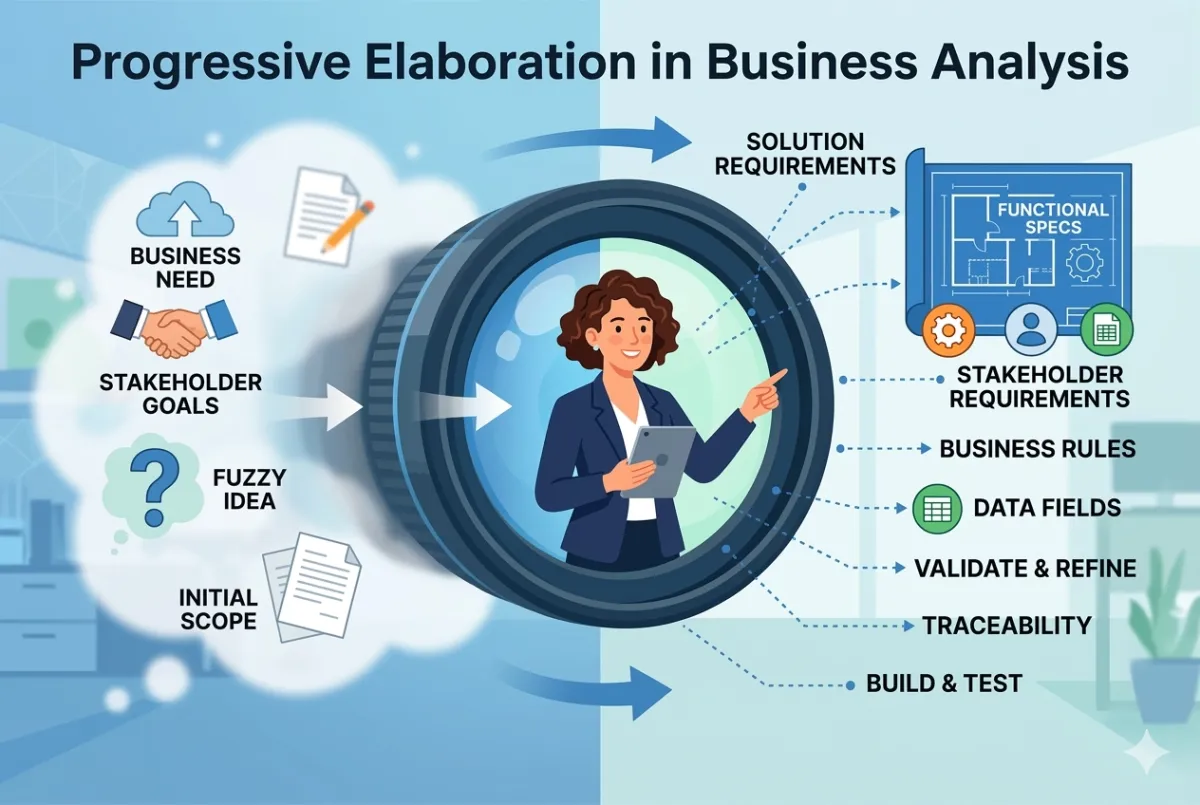
What is Progressive Elaboration and How Does it Solve Analysis Paralysis in Business Analysis?
Introduction
In the early stages of a major business initiative, there is often an intense, almost desperate push to have every single detail finalized, signed off, and set in stone. However, anyone who has navigated a complex business transformation knows that requirements are not static artifacts found under a rock; they are living entities that grow in clarity as the project moves forward. Trying to define the exact dimensions of a technical solution before you have fully explored the problem is a recipe for rework, frustration, and project failure.
Progressive elaboration is the disciplined, iterative process of continuously refining and adding detail to project requirements and plans as more information and better estimates become available. It solves analysis paralysis by allowing business analysts to start with what they know today, the high-level business needs, and systematically drill down into the details as the project environment stabilizes. Instead of waiting for 100% certainty (which never comes), it provides a structured path from the fuzzy front end of a project to a sharp, actionable reality.
Key Takeaways
Embrace Discovery: Requirements are evolved, not just gathered; progress depends on continuous learning.
Focus on the Horizon: Start with high-level business outcomes before diving into technical specifications.
Reduce Risk: Iterative refinement prevents analysis paralysis and ensures the solution stays aligned with stakeholder needs.
Just-in-Time Detail: Only elaborate on requirements when the information is stable and the development team is ready to act.
Maintain Traceability: Always ensure that every detailed requirement maps back to a fundamental business goal.
What is Progressive Elaboration?
Progressive elaboration is a technique used in both project management and business analysis to manage the inherent uncertainty of new ventures. In the context of business analysis, it refers to the practice of starting with a broad understanding of a business problem or opportunity and incrementally adding layers of detail as the project progresses through its lifecycle.
It is often compared to rolling wave planning. Imagine you are standing on a beach looking at the ocean. You can see the big waves coming in from the distance (the high-level goals), but you can’t see the individual grains of sand or the specific movement of the water near your feet until the wave actually arrives. As the project wave moves closer, you gain the clarity needed to define exactly what needs to be built.
In practical terms, this means a business analyst might start with a Business Requirement (e.g., We need to reduce customer churn by 15%). As they conduct interviews and workshops, this elaborates into Stakeholder Requirements (e.g., The customer service team needs a way to identify high-risk accounts). Finally, as the technical architecture is defined, it becomes Solution Requirements (e.g., The dashboard must highlight accounts with no activity in the last 30 days in red).
Why is Progressive Elaboration Important?
In a perfect world, a business analyst would sit down with stakeholders once, document every single requirement flawlessly, and the developers would build it perfectly. In the real world, stakeholders often don't know exactly what they need until they see what is possible, and market conditions change mid-project.
1. Overcoming Analysis Paralysis
Many projects stall because teams are afraid to move forward without perfect requirements. Progressive elaboration grants permission to start. By focusing on the high-level What and Why first, you can begin project setup, budgeting, and high-level architectural planning while the finer details are still being discovered.
2. Incorporating Feedback Loops
When you attempt to define everything upfront (Big Design Up Front), you risk building something that no longer meets the users' needs by the time it’s finished. Progressive elaboration allows you to show stakeholders prototypes or early iterations. Their feedback then informs the next level of elaboration, ensuring the final product actually solves the problem.
3. Improving Accuracy
Estimating the cost and time for a massive, vaguely defined project is largely guesswork. However, as requirements are elaborated, the Cone of Uncertainty narrows. Estimates created during the later stages of elaboration are significantly more reliable because they are based on concrete data rather than assumptions.
4. Managing Complexity
Large-scale transformations are overwhelming. By breaking the requirements discovery process into stages, the work becomes manageable. You aren't trying to solve the entire puzzle at once; you are focusing on one section of the image at a time until the full picture emerges.
How to Practice Progressive Elaboration (Step-by-Step Framework)
Analysis is a journey, not a one-time event. To successfully manage evolving requirements without losing control of your scope, follow this simple step-by-step framework:
Step 1: Define the Strategic Horizon (Business Requirements)
Before you look at features or buttons, you must understand the North Star of the initiative. This is the level where the What and Why live.
What to do: Document the Business Requirements. These are the high-level statements of goals, objectives, and outcomes that describe why the project exists.
Why it matters: If you don't have a clear goal, the subsequent elaboration will lack direction. Everything you define later must be traceable back to this step.
Action: Conduct executive interviews and review business cases to define success metrics (e.g., Increase digital sales by 20%).
Step 2: Broaden the Perspective (Stakeholder Requirements)
Once the business goal is set, you need to understand the people who will live with the solution.
What to do: Identify all stakeholder groups and capture their needs and bridge the gap between business goals and technical specs.
Why it matters: Stakeholders often have conflicting needs. Elaborating at this level helps you identify gaps or contradictions early.
Action: Use workshops, surveys, or job shadowing to document user stories or high-level functional needs. Focus on the user's journey, not the system's mechanics.
Step 3: Detail the Specifications (Solution Requirements)
As the project gains momentum and technical constraints become known (such as which software or vendor is being used), you move into the granular details.
What to do: Elaborate on Functional Requirements (what the system does) and Non-Functional Requirements (how the system performs).
Why it matters: This is the level of detail the development and QA teams need to build and test the solution.
Action: Define data attributes, business rules, security protocols, and interface designs. For example, moving from The system must track sales to The system must capture date, time, and SKU for every transaction in under 2 seconds.
Step 4: Validate and Refine via Feedback
Elaboration isn't just about adding more text; it’s about increasing the quality of the information.
What to do: Present drafts, wireframes, or prototypes to stakeholders for validation.
Why it matters: Seeing a visual representation often triggers I didn't think of that moments for stakeholders. It is much cheaper to add a field during a requirements workshop than during the coding phase.
Action: Host show and tell sessions or walkthroughs. Use the feedback to further elaborate or pivot specific requirements.
Step 5: Finalize for Implementation (Transition Requirements)
The final level of elaboration involves the bridge between the old state and the new state.
What to do: Define what is needed to move from the current state to the future state.
Why it matters: Even a perfect solution will fail if the data isn't migrated correctly or the users aren't trained.
Action: Create detailed requirements for data cleansing, migration rules, user training manuals, and go-live support structures.
Avoiding Common Pitfalls in Progressive Elaboration
While this iterative approach is powerful, it requires discipline to avoid common traps.
The Scope Creep Trap
The biggest risk of progressive elaboration is that adding detail turns into adding more features. To prevent this, every new detail must be validated against the original Business Requirements established in Step 1. If a detail doesn't help achieve the core goal, it is scope creep, not elaboration.
Timing the Elaboration
A common mistake is elaborating too much, too soon. If you spend weeks detailing a feature that is scheduled for development six months from now, there is a high chance that information will be outdated by the time the developers get to it. Aim for Just-in-Time elaboration, having the requirements ready just before they are needed for construction.
Communication Gaps
Stakeholders who are used to traditional Waterfall methods may feel anxious when they see high-level requirements. They might think you haven't done your job. It is vital to communicate that the lack of detail is intentional and that the requirements will become more granular as the project progresses.
Frequently Asked Questions (FAQs)
Does progressive elaboration only work in Agile projects?
No. While it is a core principle of Agile, progressive elaboration is equally valuable in Waterfall projects. In Waterfall, it is often called Rolling Wave Planning. Even in a structured environment, you can sign off on high-level phases while knowing that the sub-phases will be elaborated later.
How do I know when a requirement is elaborated enough?
A requirement is sufficiently elaborated when it is Ready. This means the development team understands what to build, the testing team understands how to verify it, and the business stakeholders agree that it meets their needs. If there is still ambiguity that could lead to different interpretations, it needs more elaboration.
What is the difference between progressive elaboration and scope creep?
Progressive elaboration is adding detail to an existing scope (e.g., defining the specific fields for a customer profile feature). Scope creep is adding new features that were not part of the original business case (e.g., adding a loyalty points system when the project was only supposed to be a basic CRM update).
Who is responsible for progressive elaboration?
The Business Analyst usually leads the process, but it is a collaborative effort. It requires input from Business Owners (for goals), End Users (for functional needs), and Technical Architects (for constraints).
Final Thoughts
Progressive elaboration isn't an excuse for poor planning; it is a strategic approach to better planning. By accepting that business analysis is a journey of discovery rather than a one-time data dump, you allow your projects to remain flexible, accurate, and aligned with reality.
Instead of forcing final answers on day one, give your requirements the space to grow. Start with the big picture, focus on the immediate horizon, and refine the details as the path becomes clear. Your stakeholders, and your sanity will thank you for it.
Reflective Question: Think about a requirement in your current project that feels blurry. What specific piece of information are you missing to make it clear, and who do you need to talk to this week to begin the elaboration process?
Get practical insights on business analysis and change delivered to your inbox. Join our mailing list


