The Stakeholders Who Never Attend Your Meetings Have the Power to Shut Your Project Down
Introduction
Every business analyst maps their stakeholders. They identify the sponsor, the end users, the subject matter experts, and the department heads whose cooperation the project depends on. They schedule workshops, build communication cadences, and invest significant energy in managing the relationships visible on the org chart.
And then a new data privacy regulation drops mid-project, or a competitor launches a product that makes the solution being built look two years behind the market, and the carefully constructed project plan suddenly needs to be reworked from the ground up.
The entities that caused that disruption were never on the stakeholder map. They were never in the workshops. They were never consulted, managed, or even formally acknowledged. And yet they held more power over the project's outcome than most of the people who were.
High-power, low-interest stakeholders, including high-level officials and regulatory bodies, can obstruct a project if their expectations are not managed, even without deep engagement in its details or progress. Understanding how to categorize, monitor, and manage these silent external forces is not an advanced skill reserved for senior practitioners. It is a fundamental competency that every business analyst needs to build into their stakeholder management approach from day one of every engagement.
Key Takeaways
External Stakeholders Belong on Your Map: Stakeholder identification means considering all possible internal and external stakeholders, including project sponsors, team members, customers, suppliers, regulators, and community groups. Leaving external entities off the map does not reduce their influence. It just makes their impact harder to anticipate.
High Power and Low Interest Is Not the Same as Low Risk: A regulator who has no interest in your project's daily operations has the full authority to halt it. Low interest is a characteristic of their engagement style, not a measure of their potential impact on your project.
Compliant Neutrality Is the Goal, Not Collaboration: You are not building a partnership with a regulatory body. You are maintaining a state of informed compliance that gives them no reason to intervene.
External stakeholders define the context in which your project operates. If that context changes through a policy update or a competitor market move, your value proposition must be re-evaluated.
Monitoring Is a System, Not a Task: Keeping external stakeholders on your radar requires a structured watch cadence, not an occasional Google search. The organizations and practitioners who get surprised by regulatory changes are almost always the ones who treat external monitoring as informal rather than systematic.
What Are External Stakeholders and Where Do They Sit on the Power/Interest Grid?
External stakeholders are individuals or groups outside the organization who can impact or are affected by the project. From customers and employees to suppliers, investors, regulators, and even competitors, the list can be extensive, covering both direct and indirect parties whose actions or decisions carry consequences for the project's outcome. In the professional practice of business analysis, this means treating the stakeholder landscape as a boundary that extends beyond the walls of the organization rather than stopping at the edge of the project team.
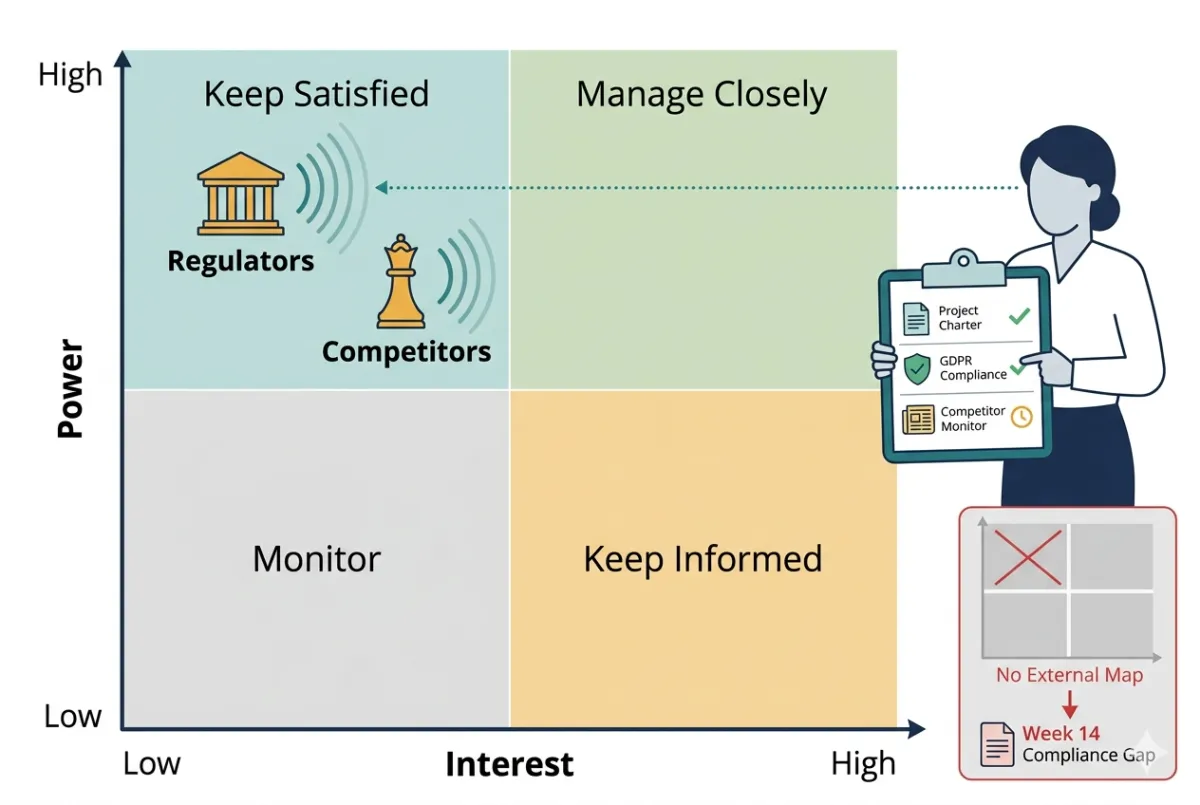
The Power/Interest Matrix plots stakeholders on two axes: their power, which is their ability to shape outcomes formally or informally, and their interest, which is the degree of concern about the decision or initiative. The four quadrants guide engagement: Manage Closely for high power and high interest, Keep Satisfied for high power and low interest, Keep Informed for low power and high interest, and Monitor for low power and low interest.
Regulators and competitors almost always occupy the High Power / Low Interest quadrant. A regulatory body does not care whether your project delivers on time or within budget. They care whether your project operates within the legal and ethical boundaries of their mandate. A competitor does not care about your project at all. They care about their own market position, and their decisions to change it can alter the context your project is operating within overnight. For high-power, low-interest stakeholders, the engagement strategy focuses on maintaining satisfaction without overwhelming them with too much detail, while ensuring their needs are proactively addressed before they become a source of disruption.
Why Strategic Vigilance Protects More Than Reactive Management Ever Could
It prevents the kind of interference that no recovery plan can fully address. A regulatory breach discovered mid-project does not just create a compliance task. It creates a project pause, a legal review, a potential reputational incident, and a conversation with the project sponsor that nobody wants to have. Feeding high-risk external stakeholders and issues into enterprise risk registers and crisis playbooks, and aligning communications across legal and project governance to avoid mixed signals, is what separates organizations that manage external risk proactively from those that respond to it reactively.
It keeps the solution relevant to the market it is being built for. A project team that never looks beyond its own scope can invest months building a solution that is already obsolete by the time it goes live. Competitor monitoring is not a distraction from the project. It is the mechanism that ensures the project's intended value proposition still exists in the market environment that the solution will be launched into. A Business Analyst who watches the competitive landscape while building requirements is protecting the business case the project was approved against.
It protects the project from the cost of discovering compliance gaps late. Requirements must be categorized to include regulatory constraints alongside functional requirements, and each requirement should be linked to a strategic business objective to preserve alignment and support later evaluation. Compliance requirements that are identified and documented early are manageable. The same requirements identified in the testing phase, when the solution is already built to a different specification, are expensive, time-consuming, and damaging to the project team's credibility with the sponsor.
It makes the Business Analyst the most organizationally aware person in the project room. A business analyst who consistently surfaces external context shifts, whether a new data protection regulation, a pending legislative change, or a competitor's market move, is not just doing good analysis. They are demonstrating the kind of strategic awareness that elevates their role from requirements gatherer to trusted project advisor. Establishing a refresh cadence for external monitoring, whether monthly in fast-moving contexts or quarterly in more stable environments, and tracking leading indicators such as policy consultations, platform rule updates, and competitor announcements, is what makes that awareness systematic and sustainable.
How to Analyze and Monitor External Stakeholders: A Step-by-Step Framework
Step 1: Map the Regulatory Landscape Before You Document a Single Requirement
The regulatory environment is not a background condition. It is a project constraint that must be identified, documented, and actively managed from the earliest stage of analysis.
What to do: Identify every external body with legal, ethical, or industry oversight of the domain your project is operating in. This includes national regulators, sector-specific watchdogs, data protection authorities, and any standards bodies whose guidelines your solution must comply with.
Action: Create a regulatory requirements log that captures each relevant regulation, the specific obligation it places on the project, and the consequence of non-compliance. Treat each entry as a non-functional requirement with the same priority status as any other non-negotiable project constraint.
Goal: A complete regulatory map that exists as a formal project document before the requirements baseline is set, reviewed with the legal team, and updated whenever a regulatory change is detected during the project lifecycle.
Step 2: Conduct a Competitor Context Scan Tied to Your Solution Scope
Competitor analysis in a business analysis context is not a marketing exercise. It is a requirements validation activity that ensures the solution being built will still be relevant and competitive when it is delivered.
What to do: Identify the direct competitors whose products, services, or processes occupy the same space as the solution your project is building or improving. Focus specifically on the elements of their current and future state that overlap with your project's scope.
Action: Attach measurable indicators to your competitor monitoring, such as product release frequency, pricing changes, and technology adoption patterns, and integrate findings into your project's context documentation so that shifts in the competitive environment are visible to the project sponsor and solution design team.
Goal: A competitor context baseline that is reviewed at each major project milestone and used to validate that the solution's intended value proposition has not been eroded by market movements since the business case was approved.
Step 3: Place External Entities on the Power/Interest Grid and Define the Engagement Strategy
Once the regulatory and competitive landscape is mapped, each external entity needs a formal position on the stakeholder grid and a defined engagement approach that reflects where they sit.
What to do: Place external stakeholders in the appropriate quadrant based on their power and interest levels, and develop tailored engagement strategies for each group based on their grid position rather than treating all external parties with the same level of attention or the same communication approach.
Action: For regulatory bodies, the engagement strategy is minimalist and compliance-focused. Provide exactly what is required and nothing beyond it. For competitors, the engagement strategy is observational. There is no direct communication; the engagement is a monitoring discipline, not a relationship management exercise.
Goal: A stakeholder engagement plan that formally acknowledges external entities, assigns them an engagement owner within the project team, and specifies the cadence and format of interaction or monitoring for each one.
Step 4: Build a Structured External Watch Cadence
Ad hoc monitoring of regulatory and competitive developments is not a risk management strategy. It is a way of discovering important information slightly before it would have appeared on its own. A structured watch cadence is what converts monitoring from reactive to proactive.
What to do: Establish a formal monitoring system that covers regulatory update channels, industry publications, competitor press releases, and any government consultation processes relevant to your project's domain.
Action: Assign a named team member responsibility for the external watch function. Define the review frequency, the reporting format, and the escalation path for any development that could affect the project's scope, timeline, or compliance posture. Set this up at project initiation, not after the first external surprise.
Goal: A monitoring system that surfaces relevant external developments early enough to be incorporated into project planning rather than late enough to require crisis management.
Step 5: Manage Regulatory Interactions With Precision and Minimal Exposure
When direct interaction with a regulatory body is required, whether through a compliance submission, an audit response, or a formal notification, the communication approach must be disciplined, precise, and strictly bounded.
What to do: Determine exactly what is required for compliance in the specific interaction and provide that, documented completely and accurately, without volunteering additional project detail that has not been requested.
Action: Involve the legal team in any formal regulatory communication before it is sent. Treat every interaction with a regulatory body as a permanent record and ensure that the project team understands the difference between appropriate transparency and unnecessary disclosure.
Goal: A compliance communication posture that satisfies the regulator's requirements completely, protects the project's operational details where appropriate, and creates no grounds for further scrutiny or intervention.
Frequently Asked Questions
How do I know which regulations apply to my project if I am not a legal expert?
This is exactly the reason legal involvement at Step 1 is not optional. Your job as a BA is to identify the domains the project touches, including data handling, employment practices, financial processing, and customer-facing services, and then to bring the legal team into the conversation early enough to define the compliance requirements before the solution design is locked. You do not need to be a regulatory expert. You need to know enough to ask the right questions and involve the people who are.
What if a competitor launches something significant mid-project that directly affects our solution's value proposition?
This is precisely the scenario the competitor context scan is designed to surface early rather than late. When a material competitive development occurs mid-project, it needs to be presented to the project sponsor as a context shift that may require a scope or value proposition review. Frame it as a strategic input rather than a problem, because a project that catches this development in week eight and adjusts is in a far stronger position than one that discovers it at Go-Live.
How do I get the project team to treat compliance requirements with the same urgency as functional ones?
Document them in the same place and in the same format. Regulatory constraints should be categorized alongside functional requirements, and each one should be linked to a strategic business objective so that their relevance to the project's success is explicit rather than implied. When a compliance requirement sits in a separate legal document that the development team never reads, it will be treated as someone else's problem. When it sits in the requirements register with a clear owner and a non-negotiable status, it will be treated as a project deliverable.
Should competitors ever be formally listed on the project's stakeholder map?
Yes, but with a clear designation that distinguishes them from stakeholders who will be engaged directly. Listing them formally ensures they are not forgotten in the risk and context analysis, and it gives the monitoring function a named home in the project governance structure. Their quadrant on the grid is Monitor or Keep Satisfied depending on how directly their market actions could affect the project, and their engagement strategy is always observational rather than communicative.
Final Thoughts
The most strategically aware business analysts are not the ones who manage their internal stakeholders most effectively. They are the ones who also keep one eye on the external environment that those internal relationships are operating within.
Regulators do not need to be in your workshops to stop your project. Competitors do not need to know your project exists to make it obsolete. Both of these realities are manageable when they are anticipated. Neither is manageable when they arrive as a surprise in the middle of delivery.
Build the regulatory map before you set the requirements baseline. Establish the competitor context scan before the solution design is locked. Set up the watch cadence at project initiation. And when external developments surface, treat them not as disruptions but as the context intelligence that your project needs to stay relevant, compliant, and defensible from the first milestone to the last.
Reflective Question: Think about your current project. List every external body that has the legal or market authority to affect its outcome. Is each one formally documented in your stakeholder map? Does each one have an assigned monitoring owner and a defined review cadence? If the answer to either question is no, that is your starting point for this week.
Get practical insights on change and business analysis delivered to your inbox. Join our mailing list


