The Role Confusion Quietly Killing Your Projects (And How to Fix It)
Introduction
Every project team has experienced it. A deadline passes, a deliverable goes missing, and the post-mortem conversation circles back to the same uncomfortable admission: I thought they were handling it. Nobody lied. Nobody was lazy. The work simply fell into the gap between assumed ownership and actual ownership, and by the time anyone noticed, it was too late to recover cleanly.
This is not a talent problem. It is a clarity problem. And it is one of the most expensive forms of project failure precisely because it is so preventable. Business analysts and change professionals who consistently deliver projects without this kind of friction are not just better communicators. They are working with a structured framework that eliminates ambiguity before it has the chance to become a delay. That framework is the responsibility assignment matrix, and the choice between its two most widely used forms, RACI and RASCI, matters more than most practitioners realize.
Key Takeaways
Clarity Before Execution: Role confusion is not resolved by working harder. It is resolved by defining ownership with precision before the work begins, not after the first deadline is missed.
One Accountable Per Task, No Exceptions: The moment two people share accountability for the same deliverable, accountability effectively belongs to neither of them.
Responsible and Accountable Are Not the Same Thing: The person doing the work and the person answerable for the outcome are distinct roles that must be assigned to distinct people.
The Support Role Changes Everything: RASCI’s additional layer of clarity prevents the Responsible person from becoming a single point of failure and gives resource planning an honest foundation.
The Matrix Must Be Socialized: A responsibility matrix that lives in a folder nobody opens is not a governance tool. It is a document. The value comes from the conversation it creates, not the cells it fills.
What Are RACI and RASCI?
RACI and RASCI are responsibility assignment matrices used to define who does what on every significant task, milestone, and decision in a project. In the professional practice of business analysis, this means treating each deliverable not as a shared team effort with vague collective ownership, but as a clearly mapped set of individual roles with no room for assumption. Instead of relying on organizational hierarchy or informal team norms to determine who owns what, a structured matrix makes every expectation explicit before work begins.
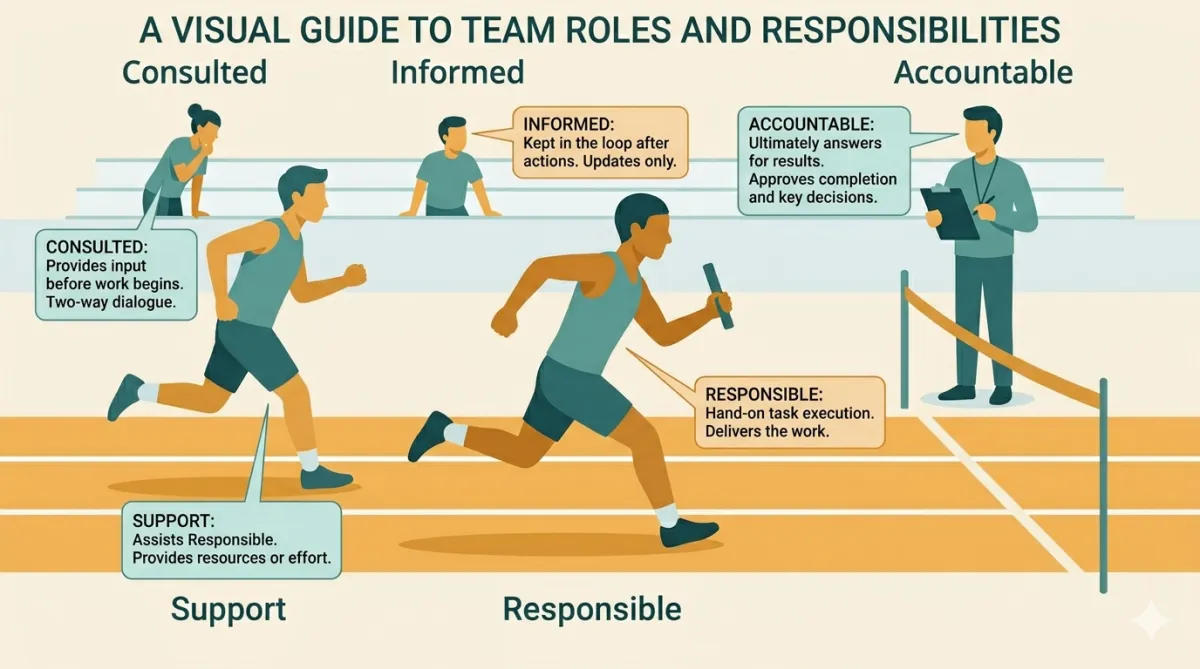
RACI maps four roles across every task. Responsible is the person who performs the work. Accountable is the person who owns the outcome, signs off on the work, and is answerable for its success or failure. Consulted refers to those whose input is sought before the work is finalized, which is a two-way communication relationship. Informed refers to those who are kept updated on progress or completion, which is a one-way communication relationship.
RASCI adds a fifth role that RACI consistently leaves unaddressed. Support refers to the individuals or teams who provide resources, data, or assistance to the Responsible person in order to complete the work. This single addition transforms the matrix from a document that assigns tasks into a tool that reflects how work actually gets done. When you apply both frameworks together, you stop asking “who is responsible for this?” and start asking a far more useful question: who is doing the work, who is helping them do it, who is answerable for the result, and who needs to know when it is done?
Why the Distinction Between These Frameworks Matters
It prevents the Responsible person from becoming a bottleneck. The most common failure mode in a standard RACI is that the person assigned as Responsible ends up carrying the full weight of a task that realistically requires input, data, or labor from multiple people. Without a Support designation, those contributions remain informal and unreliable. When they do not materialize, the Responsible person either absorbs the work themselves or misses the deadline while waiting. The S role makes those dependencies visible and manageable before they become a problem.
It gives resource planning an honest foundation. One of the least discussed benefits of RASCI is what it reveals about organizational capacity. A team member who carries no Responsible assignments but appears as Support across a dozen concurrent tasks is overextended in a way that a standard RACI would never surface. That person is a hidden constraint on the project, and they will not appear as a risk until something breaks. RASCI makes that visibility possible at the planning stage, when it can still be acted on.
It resolves disputes before they escalate. When two people both believe they have the authority to make a final call on a decision, the resulting friction rarely stays contained to that one moment. It erodes trust, slows communication, and creates the kind of interpersonal tension that project managers spend significant time managing. A RASCI matrix with a single Accountable per task eliminates the structural condition that produces that conflict. The question of who makes the final call is already answered before the disagreement has the chance to form.
It separates doing from owning. This is the distinction that most practitioners misunderstand until they experience the consequences of getting it wrong. The Responsible person executes. The Accountable person owns. Those are different cognitive loads, different communication obligations, and different forms of exposure when something goes wrong. Conflating them creates a situation where the person doing the work is also expected to absorb all organizational accountability for the outcome, which is neither fair nor sustainable on a complex project.
How to Build a RASCI Matrix That Actually Works: A Step-by-Step Framework
Step 1: List the Key Deliverables
Before you assign a single letter, you need a complete picture of what the matrix needs to cover. This is not a task list of every minor activity. It is a structured inventory of the work that actually matters.
What to do: Build your vertical axis from the project’s Work Breakdown Structure, focusing on high-level deliverables, milestones, and decision points rather than granular daily actions.
Action: Review the project plan with the project manager and identify the outputs that, if delayed or missed, would directly impact the project timeline or quality.
Goal: A deliverable list that is comprehensive enough to cover real accountability gaps but lean enough to be genuinely usable by the team.
Step 2: Assign the Accountable Role First
This is the most critical step in the entire exercise, and it is the one most often skipped or rushed. Every other assignment in the matrix depends on getting this one right.
The Rule: For every single task, there must be exactly one person Accountable. If two people share the A, neither of them truly holds it. Accountable is the person who says the outcome is mine to answer for, regardless of what else happens.
Action: Assign the A before assigning anything else. This role typically belongs to a sponsor, a workstream lead, or a senior manager with direct authority over the outcome.
Why it matters: Starting with Accountable forces the conversation about ownership to happen at the planning stage, where it is productive, rather than at the post-mortem stage, where it is only painful.
Step 3: Assign the Responsible and Support Roles
With accountability established, the next step is to map the execution layer clearly enough that nobody has to guess who is driving the work or who they can call when they need help.
Action: Assign the R to the person actively driving the task to completion. Assign the S to every person providing data, technical expertise, labor, or any other form of meaningful contribution to the Responsible person’s success.
Tip: If a single task carries multiple R assignments, it is a signal that the deliverable needs to be broken down into smaller sub-tasks, each with its own clean ownership.
Why it matters: The Support designation transforms informal team dependencies into visible, plannable commitments. It also protects the Responsible person from the isolation that causes single points of failure.
Step 4: Map the Consulted and Informed Roles
Determine the communication structure around each task, making a clear distinction between people who influence the work and people who simply need to know about it.
Action: Assign C to those whose input is sought and incorporated before the task is finalized. Assign I to those who are notified of progress or completion without any expectation of input.
Pitfall: An overloaded Consulted column is one of the most reliable early warning signs of a project headed toward decision paralysis. Every C is a two-way communication commitment. Too many of them create a committee where there should be a workstream.
Goal: A communication structure that keeps the right people genuinely informed without creating a bottleneck of approvals and input cycles that slows execution to a crawl.
Step 5: Socialize and Validate With the Full Team
A RASCI matrix built in isolation by a project manager or BA and then distributed without discussion is not a governance tool. It is an assumption document. The value of this exercise comes from the conversation it creates, not the spreadsheet it produces.
Action: Walk through the matrix with every person named in it. For each task, ask directly: does this assignment accurately reflect your understanding of your role and your capacity to fulfill it?
Note: Disagreements at this stage are a feature, not a problem. They surface misalignments that would otherwise remain invisible until a deadline exposes them.
Goal: A matrix that every team member has seen, understood, and had the opportunity to challenge, which means the organizational clarity it creates is genuine rather than assumed.
Frequently Asked Questions
What happens if the Accountable and Responsible person need to be the same individual?
In smaller projects or lean teams, this is sometimes unavoidable. When it occurs, name it explicitly rather than leaving it implied. The person holding both roles needs to understand that they carry two distinct obligations: executing the work and owning the outcome. Conflating those without acknowledging them is what leads to burnout and missed escalation points.
How often should the RASCI matrix be reviewed?
At minimum, the matrix should be reviewed at every major phase gate in the project. As a project moves from Design into Implementation, roles frequently shift. A person who was Consulted during planning may become Support during execution. A Support resource in one phase may carry Responsible ownership in the next. A matrix that is never updated after the kickoff meeting is a snapshot of an organizational structure that no longer exists.
How do I handle a team member who disagrees with their assigned role?
Treat the disagreement as useful data rather than resistance. If someone pushed back on being assigned as Accountable, it may signal a genuine gap in their authority or resources. If someone disputes being assigned as Consulted rather than Responsible, it may reveal an ownership conversation that the team lead and sponsor need to have directly. The matrix creates the structure for that conversation to happen cleanly rather than informally.
Can RASCI be used for decisions as well as tasks?
Yes, and this is one of its most powerful applications. Decision points are often where role confusion is most damaging, because the cost of a contested or delayed decision compounds through every downstream activity that was waiting on it. Mapping Accountable against every major project decision is one of the fastest ways to reduce the kind of governance friction that causes otherwise capable teams to slow down unnecessarily.
Final Thoughts
The most high-performing project teams are not distinguished by the absence of complexity. They are distinguished by the presence of clarity. A well-built RASCI matrix does not make a project simple. It makes every person’s contribution to that project legible, manageable, and accountable in a way that allows the team to focus on delivery rather than on constant clarification of who is doing what.
Used consistently, the matrix becomes more than an administrative tool. It becomes a shared language for ownership, a mechanism for surfacing resource constraints before they become delays, and a reference point for resolving disputes without escalating them. When a team can pull out the RASCI in the middle of a disagreement and settle the question of who makes the final call in thirty seconds, that is not bureaucracy. That is project maturity.
Start with the task in your current project that has caused the most confusion. Build a mini-RASCI for that single deliverable. Assign one A, define the R and the S explicitly, and share it with everyone involved. That one exercise, done honestly and discussed openly, will show you more about where your project’s accountability gaps actually live than any status meeting ever could.
Get practical insights on change and business analysis delivered to your inbox. Join our mailing list


