The Hidden Reason Your Stakeholder Relationships Keep Breaking Down
Introduction
Most project professionals know stakeholder management matters. Very few do it with any real structure. Instead, they default to instinct: giving the most attention to whoever is loudest, sending the same update to everyone on the distribution list, and hoping the quiet executive in the corner does not suddenly become a problem. That approach works until it does not, and when it fails, it tends to fail spectacularly.
The business analysts and change professionals who consistently deliver successful projects are not working harder than everyone else. They are working more deliberately. They have a framework for deciding who gets their time, how much of it, and in what form. That framework is the Power/Interest Grid (PIG), and once you understand how to use it, the way you approach stakeholder engagement will never look the same.
Key Takeaways
Adopt a Strategic View: Effective stakeholder management goes beyond managing individual relationships. It requires understanding how influence and interest interact across the entire project landscape.
Score Before You Engage: Assigning Power and Interest scores to every stakeholder removes guesswork and ensures your engagement decisions are structured and defensible.
Build a Living Roadmap: Your stakeholder map is not a document you create once and file away. It needs to be revisited and updated at every major project milestone.
Protect the Quiet Influencers: High-power stakeholders with low interest are the most commonly overlooked group. The grid keeps them visible before a small oversight becomes a formal objection.
Focus Your Energy Deliberately: Project success depends on spending the right amount of time with the right people, not spreading attention equally across everyone who has a passing connection to the work.
What Is the Power/Interest Grid?
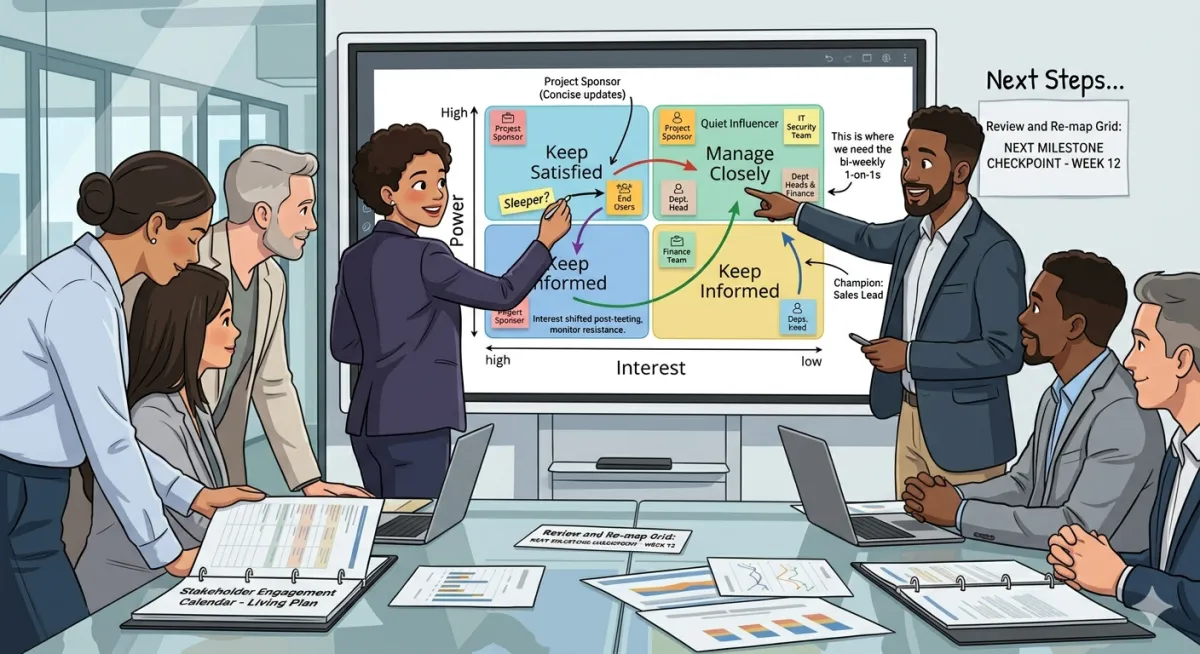
The Power/Interest Grid is a 2x2 matrix that maps stakeholders across two dimensions: how much authority they hold over the project, and how much they care about its outcome. In practice, this means treating each stakeholder not as an individual to be managed in isolation, but as a position on a spectrum that tells you exactly how much energy to invest in that relationship.
Power refers to the level of authority or influence a stakeholder holds over the project's direction, budget, or resourcing. Interest refers to how significantly the change will affect their daily work, their team, or their professional standing.
When you apply both dimensions together, you stop asking "who do I need to keep happy?" and start asking a far more useful question: who has the power to stop this project, and does that person even understand what we are building?
What makes this framework genuinely powerful is the recognition that stakeholder positions are not fixed. A project sponsor who barely glanced at your updates during the Design phase may become intensely invested the moment Testing begins and budget implications come into focus.
An end-user who scored a 3 on Interest in week one might be your most vocal critic by week ten if they feel left out of the process. By treating the grid as a living document rather than a one-time exercise, you stay ahead of these shifts instead of being caught off guard by them.
Why Strategic Prioritization Changes Everything
It protects you from invisible blockers. The most dangerous stakeholder on any project is not the one who pushes back loudly. It is the high-power executive who has been quietly unsatisfied for weeks and finally decides to act on it. The Power/Interest Grid keeps this group in your line of sight, reminding you to deliver timely, well-pitched updates that keep them satisfied before their low interest turns into active resistance.
It eliminates the attention trap. Without a structured approach, the loudest stakeholders absorb the most energy, regardless of whether they have any real influence over the project's outcome. The grid forces you to assign engagement effort based on actual power and interest, not volume or visibility. That shift alone can recover significant hours in your week.
It builds trust across the organization. When stakeholders at every level feel that their engagement experience has been calibrated to their actual needs, something shifts. The high-level executive gets the concise summary they wanted. The end-user gets the detailed update they needed. Neither feels ignored, and neither feels overwhelmed. That kind of precision builds the kind of trust that makes future projects significantly easier to drive.
It keeps the project moving when things get difficult. Every project hits friction. Budgets get questioned, timelines get challenged, and decisions get escalated. When that happens, the projects that survive are the ones with strong political backing from the people who matter most. Closely managing your high-power, high-interest stakeholders is not just good practice; it is your insurance policy against the moments when the project needs a defender in the room.
How to Use the Power/Interest Grid: A Step-by-Step Framework
Step 1: Build a Complete Stakeholder List
The quality of your engagement plan is only as good as the completeness of your stakeholder list. Before you assign a single score or draw a single quadrant, you need to know who belongs on the map.
What to do: Look beyond the org chart. Trace the process you are trying to change and identify every person who provides input into it, receives output from it, or has the authority to block it.
Action: Interview the project sponsor, review existing process documentation, and ask the stakeholders you have already identified who else might be affected by this change.
Goal: A complete stakeholder inventory that includes formal decision-makers as well as the informal influencers who carry weight without the title to match it.
Step 2: Assign Honest Scores for Power and Interest
Rate each stakeholder or group on a scale of 1 to 10 across both dimensions. This is where objectivity matters more than comfort.
Power: How much authority does this person genuinely hold over the project's outcome, resourcing, or approval process?
Interest: How much will this change realistically affect their daily work, their team's workflow, or their professional accountability?
Why it matters: A senior manager might score a 9 on Power but a 2 on Interest if the project has no direct bearing on their budget or team. Inflating scores to manage feelings is one of the most common ways this exercise gets corrupted. Score what is true, not what is comfortable.
Step 3: Place Stakeholders Into the Four Quadrants
With your scores assigned, map each stakeholder onto the grid. This is where your Engagement Roadmap begins to take shape.
High Power / High Interest (Manage Closely): These are your key players. They need frequent, substantive updates, direct access to the project team, and genuine involvement in decisions that affect them.
High Power / Low Interest (Keep Satisfied): These are the Sleepers. They have the authority to derail the project, so keep them satisfied with concise, high-level updates that respect their time and avoid unnecessary detail.
Low Power / High Interest (Keep Informed): These are your Champions, most often the end-users. They care deeply about the outcome. Regular newsletters, town halls, and transparent communication keep their morale high and their resistance low.
Low Power / Low Interest (Monitor): This group needs minimal contact. Allocate limited resources here, but stay alert to any shift in their Interest level as the project progresses.
Step 4: Translate the Map Into a Concrete Engagement Calendar
A stakeholder map that lives in a presentation deck nobody revisits is not a plan. It is a record of good intentions. The goal of this step is to make the engagement plan operational.
Action: Schedule monthly one-on-ones for the Manage Closely group, quarterly executive summaries for the Keep Satisfied group, and bi-weekly newsletters for the Keep Informed group.
Note: Every engagement activity should have a named owner, a defined format, and a recurring calendar slot. If you cannot point to a specific meeting or communication on your calendar, the engagement is not real yet.
Why it matters: Consistency is what builds stakeholder confidence. Stakeholders who hear from you regularly and predictably are far less likely to become anxious, disruptive, or disengaged.
Step 5: Review and Re-map at Every Project Milestone
The grid you built at project kickoff will not reflect reality by the time you reach implementation. Stakeholder positions shift, project dynamics change, and the people who seemed peripheral in week two can become critical by week twelve.
What to do: Build a grid review into every major project milestone as a non-negotiable checkpoint, not an optional task.
Action: At each review, ask whether any stakeholder's Power or Interest score has shifted enough to warrant a change in engagement strategy.
Goal: An engagement plan that is always calibrated to the current state of the project, not the state it was in when you first drew the quadrants.
Frequently Asked Questions
What if a stakeholder finds out where I placed them on the grid?
The Power/Interest Grid is an internal strategy tool and should be treated as such. If the conversation arises, be clear and measured: their placement reflects their influence over this specific project's outcomes, not their broader value as a professional. Keep the conversation grounded in the project context, and redirect quickly toward the engagement approach you have designed for them.
What if time constraints prevent a thorough stakeholder mapping exercise?
Start with the Power axis. Identify your highest-Power stakeholders first, regardless of their Interest level, since these are the people with the greatest capacity to accelerate or derail the project. Then work through your highest-Interest stakeholders, since these are the people most likely to become either your strongest advocates or your most persistent resistors depending on how well they are kept in the loop.
Will involving more stakeholders early actually slow things down?
It will feel that way in the short term. In practice, the opposite is true. A concern raised in a one-hour requirements session costs almost nothing to address. The same concern discovered during implementation, two weeks before Go-Live, can set the project back by months. Early inclusion is not a luxury; it is a risk management strategy.
How do I know when a stakeholder's position has shifted?
Watch for behavioral signals rather than waiting for the next scheduled review. A previously disengaged executive who starts asking detailed questions, a department head who has recently taken on budget responsibility for an adjacent function, or an end-user who has gone quiet after previously being engaged; these are all indicators that a score may need to be updated before the next milestone checkpoint.
Final Thoughts
The most effective project professionals are not the ones who work the hardest at managing relationships. They are the ones who manage the right relationships at the right intensity at the right time. The Power/Interest Grid is the tool that makes that possible.
Used with discipline, it protects you from the invisible blockers, the overlooked champions, and the misallocated energy that quietly drain even the most capable practitioners. It turns stakeholder management from a reactive, instinct-driven activity into a deliberate, repeatable practice that scales with every project you take on.
Start with a blank 2x2 grid and your current project. Place five stakeholders. Ask yourself honestly whether your current communication frequency matches where each of them landed. If it does not, you already know what to fix. That single correction, made consistently across every project from this point forward, is what separates practitioners who manage stakeholders from those who genuinely lead them.
Get practical insights on change and business analysis delivered to your inbox. Join our mailing list


