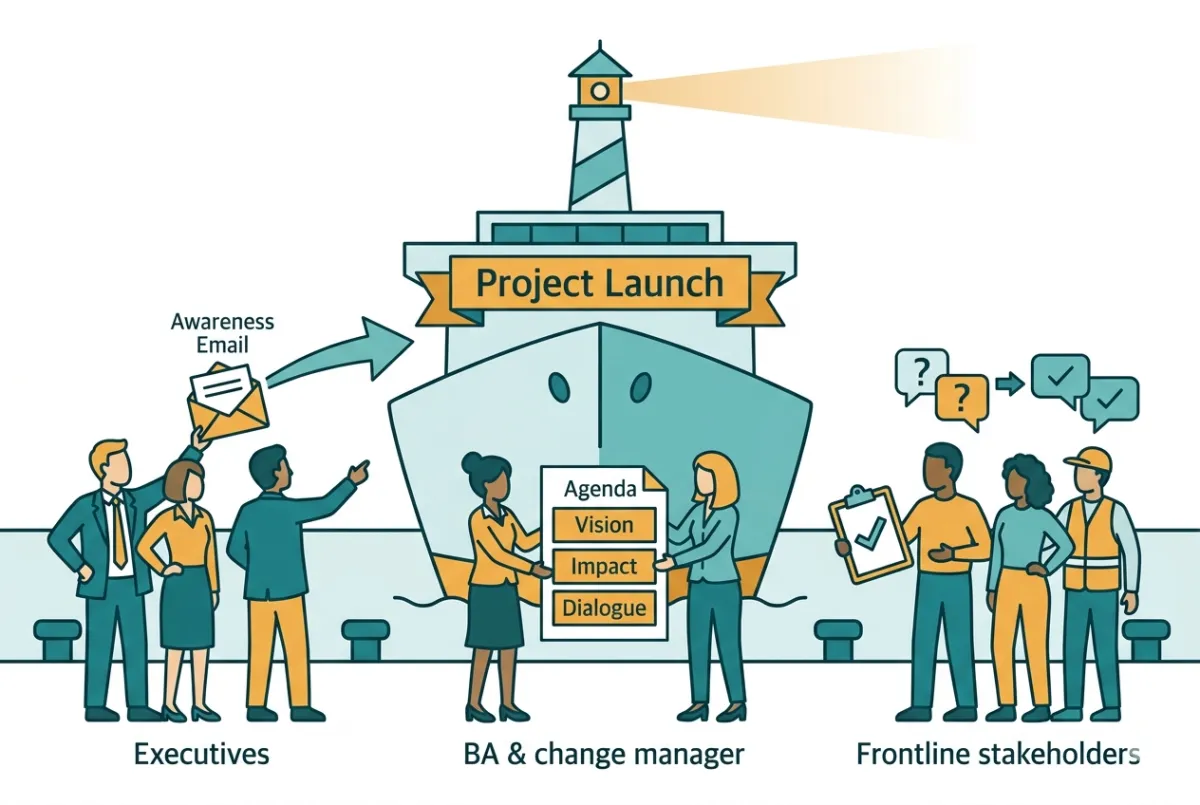
The First 48 Hours Decide Your Project's Fate. Here Is How to Use Them
Introduction
Most projects do not fail at Go-Live. They fail in the first week, quietly and invisibly, before a single requirement has been documented or a single milestone has been set. The failure begins the moment stakeholders hear about the initiative through unofficial channels, form an opinion based on incomplete information, and decide, consciously or not, whether they are going to support it or survive it.
By the time the project team schedules their kickoff meeting, the narrative has already started writing itself. Anxiety is filling the information vacuum. Informal conversations are shaping assumptions that will take months to undo. And the change professional who waits for the official launch to begin managing perceptions has already lost the most valuable window in the entire project lifecycle.
A structured project onboarding is not a formality. It is a strategic intervention that replaces the rumor with the rationale, the anxiety with alignment, and the observer with the partner. The practitioners who consistently launch projects with strong stakeholder buy-in do not wait for people to come to them. They set the narrative on day one, and they do it with a deliberate, repeatable playbook.
Key Takeaways
The Narrative Vacuum Is Real and Costly: When stakeholders receive no official communication about an upcoming change, they do not wait passively. They fill the silence with assumptions, and those assumptions are almost always more threatening than the reality.
Onboarding Is Not a Kickoff Meeting: A kickoff meeting focuses on technical timelines. Onboarding focuses on cultural and operational readiness. The two serve entirely different purposes and must be planned separately.
The Sender of Your Awareness Email Determines How It Is Received: An awareness email from a project manager is an update. The same message from a CEO is a strategic priority. Sender authority is one of the most underused levers in project communication.
Even at the awareness stage, treating everyone with respect and inclusion is good business practice. People may forget the exact tasks they completed, but they will always remember how the launch made them feel as part of the team.
Follow-Up Is Part of the Communication Act: The momentum of a well-executed onboarding meeting evaporates within forty-eight hours without a documented trail. A summary email, a shared repository, and a clear next step are what convert a good meeting into a living project commitment.
What Is Project Onboarding and Why Does It Function as a Strategic Launch Tool?
Project onboarding is the formal process of introducing stakeholders to the need, the change, and their specific role in the solution. It is the moment a project transitions from a concept on a planning document to a reality in the workplace, and it is the change professional's opportunity to shape how that reality is first understood and received.
Unlike a standard kickoff meeting, which tends to center on technical timelines, system configurations, and project governance structures, onboarding centers on cultural and operational readiness. The best onboarding approaches are not static, one-time events. They are living processes that evolve and adapt, treating the experience as a strategic, data-informed cycle that ensures stakeholders have what they need to engage effectively from day one. In a project context, this means designing the initial launch experience around the one question every stakeholder is privately asking: how will this affect me and why should I care?
What makes this framework genuinely powerful is the recognition that first impressions in a project environment are disproportionately durable. First impressions from onboarding influence a significant portion of long-term loyalty and engagement, making them a cornerstone for sustainable adoption rather than a preliminary step before the real work begins. A stakeholder who feels informed, respected, and genuinely considered during the onboarding phase is not just a better partner for the current project. They are a more willing participant in every future change initiative you lead.
Why a Structured Launch Changes the Trajectory of the Entire Project
It neutralizes resistance before it has a chance to organize. Resistance to change does not begin when employees are asked to use a new system. It begins the moment they sense that something is coming and feel excluded from the conversation around it. A structured awareness communication, sent from the right person at the right time, addresses the fear of the unknown before it hardens into active opposition. The change professional who communicates proactively does not eliminate all resistance. They prevent the kind that is rooted entirely in information absence.
It establishes the project's authority and credibility from day one. A well-executed launch signals to the entire organization that this initiative is disciplined, leadership-backed, and worthy of serious engagement. Stakeholders make rapid judgments about a project's legitimacy based on the quality of its first communications. A vague, informal, or delayed launch announcement communicates the opposite of confidence. A structured onboarding playbook communicates that the team behind this project knows what they are doing and that the organization's time will not be wasted.
It reduces the volume of reactive communication throughout the rest of the project. Proactively sharing the right information at the right time can significantly reduce the volume of inbound questions and support requests that consume project team capacity later. Every question that is answered on day one through a well-designed awareness email or onboarding meeting is a question that does not need to be answered individually in week three. The investment in a thorough launch communication pays dividends across the entire project lifecycle in the form of reduced noise, fewer escalations, and more informed stakeholder interactions.
It surfaces hidden concerns while there is still time to act on them. One of the most under-appreciated benefits of a well-facilitated onboarding meeting is what it reveals. Stakeholders who would never raise a concern in a written communication will often voice it in a structured dialogue session. The concerns surfaced in an onboarding meeting are not complications; they are requirements the project team did not know they had. Identifying them in week one is a strategic advantage. Discovering them in week twelve is a crisis.
The Project Onboarding Playbook: A Step-by-Step Framework
Step 1: Craft the Project Awareness Email Using the What-Why-How Structure
The awareness email is the project's first official signal to the organization that change is coming. It is not a detailed briefing. It is a precisely crafted three-part message designed to inform without overwhelming and to generate interest without anxiety.
What to do: Structure the email around three components. The What is a clear, jargon-free description of the initiative in plain language. The Why is the business rationale, expressed in terms of organizational benefit rather than technical achievement. The How is a description of what stakeholders can expect next, including a specific date or timeframe for the onboarding meeting.
Action: Send the email from the highest-level executive sponsor available. The sender's authority determines how the message is prioritized in a stakeholder's inbox and how seriously the initiative is perceived at the organizational level.
Goal: An email that every recipient can read in under ninety seconds, understand without prior context, and walk away from knowing exactly what is happening, why it matters, and when they will hear more.
Step 2: Design an Onboarding Meeting That Builds Alignment, Not Just Awareness
The onboarding meeting is not a presentation. It is a structured dialogue designed to move stakeholders from awareness to alignment by giving them a voice in the conversation before the project's direction is fully set.
What to do: Divide the meeting into three distinct sections with clear time boundaries. Open with ten minutes for the sponsor to establish the strategic importance of the initiative. Follow with twenty minutes for the BA or change manager to walk through the From-To state, describing concretely what is changing and what will remain the same. Close with thirty minutes of open dialogue structured around specific questions that invite genuine input.
Action: Prepare the From-To section using plain language that connects the change to the audience's specific day-to-day reality. Technical detail has no place in an onboarding meeting. Outcomes and impact do.
Goal: A room where stakeholders leave feeling informed about what is changing, respected enough to have been consulted, and confident enough in the project's leadership to begin forming a partner stance rather than a defensive one.
Step 3: Facilitate With Both Empathy and Evidence
The facilitator's role in an onboarding meeting is to hold the space between honest acknowledgment of disruption and credible justification for the change. Neither alone is sufficient.
What to do: Use the Power/Interest Grid internally to prepare tailored WIIFM responses for the different stakeholder groups in the room. A senior leader and a frontline end-user have fundamentally different concerns about the same change, and your facilitation needs to address both without one group feeling the meeting was designed for the other.
Action: When a concern is raised, validate it before responding to it. Acknowledge that the transition will require real effort from real people. Then ground your response in data, outcomes, and a clear picture of what support the project will provide.
Goal: A facilitation style that earns trust through honesty rather than through reassurance, because stakeholders can detect the difference between a change manager who respects their intelligence and one who is managing their emotions.
Step 4: Define the Ways of Working Before the Meeting Ends
Onboarding is the optimal moment to establish the operational norms that will govern how the project communicates and collaborates with its stakeholders going forward. Setting these expectations early prevents the ambiguity that erodes trust in the middle phases of a project.
What to do: Briefly introduce the RASCI matrix or the communication cadence at the close of the meeting. Let stakeholders know exactly when they will be consulted, how decisions will be communicated, and where they can go with questions between official touchpoints.
Action: Make the communication cadence concrete and specific. Not "we will keep you informed" but "you will receive a bi-weekly project update every other Tuesday, and a dedicated Q&A session will be available at each phase gate."
Goal: Stakeholders who leave the meeting knowing not just what the project is about but how they fit into it, when they will hear from the team, and how their input will be incorporated into the project's decisions.
Step 5: Execute the Follow-Up Within Twenty-Four Hours
The goodwill and alignment generated in an onboarding meeting have a short shelf life without documentation. A prompt, well-structured follow-up converts a moment of alignment into a lasting project artifact that can be referenced, shared, and built upon.
Action: Within twenty-four hours of the meeting, send a written summary that captures the key points covered, the questions raised and answered, and a link to the central project repository where stakeholders can access supporting materials.
Note: Include a brief FAQ section that captures the most common concerns from the meeting. This serves as the project's first official resistance management document and as a reference point for stakeholders who were unable to attend.
Goal: A documented onboarding record that ensures no concern raised in the meeting is lost, no commitment made by the project team is forgotten, and every stakeholder who was present has a clear and shared understanding of what was agreed.
Frequently Asked Questions
What if the project sponsor is not available to send the awareness email or lead the onboarding meeting?
This is itself a risk worth naming. Sponsor visibility at the launch of a project is not a preference; it is a readiness indicator. If the sponsor cannot commit to the awareness email or the onboarding meeting, that absence sends a signal to the organization about the priority level of the initiative, regardless of what the project charter says. Escalate the conversation about sponsor visibility before the launch, not after. If a delegate must be used, make the sponsor's endorsement explicit in the communication itself.
How do I handle silence during the open dialogue section of the onboarding meeting?
Silence in a stakeholder meeting is almost never a sign of contentment. It is usually a sign of disengagement, skepticism, or a belief that candid concerns will not be well received. If the room goes quiet, prompt the conversation with a specific, low-stakes question: what is one thing about this project that you are still uncertain about? That framing gives permission for honest input without requiring anyone to take a confrontational stance. Whatever answer comes back, treat it as valuable data.
What is the right size for an onboarding meeting?
There is no universal answer, but a useful principle is to segment onboarding by stakeholder group rather than trying to serve all groups in a single session. A session designed for senior leaders needs a different emphasis than one designed for frontline employees. Mixing groups with very different levels of power and interest in the same onboarding meeting often results in a communication that is calibrated for neither.
How do I maintain the momentum after the onboarding is complete?
Onboarding is not a one-and-done event, especially in a project environment. Continuous communication and support are key to ensuring stakeholders stay on track. Even in a compressed timeline, ongoing touch-points matter. The communication cadence introduced in Step 4 is the mechanism that sustains momentum after the launch. Every touchpoint in the weeks following the onboarding meeting should reinforce the narrative established on day one and incrementally build on it as the project progresses.
Final Thoughts
The change professionals and business analysts who consistently launch projects with strong stakeholder buy-in are not doing something fundamentally different from those who do not. They are doing the same things, but doing them first, doing them deliberately, and doing them in a sequence that respects how human beings form opinions about change.
A project that earns its stakeholders' trust in the first week does not eliminate resistance. It ensures that resistance, when it surfaces, is engaged from a foundation of established credibility rather than an atmosphere of accumulated suspicion. The onboarding playbook is what builds that foundation.
Start today. Pick the most significant upcoming initiative in your pipeline and draft a three-paragraph awareness email using the What-Why-How structure. Do not wait until you are ready to send it. The act of writing it will clarify your own understanding of the project's value, and that clarity is the first prerequisite for communicating it to anyone else.
Get practical insights on change and business analysis delivered to your inbox. Join our mailing list


