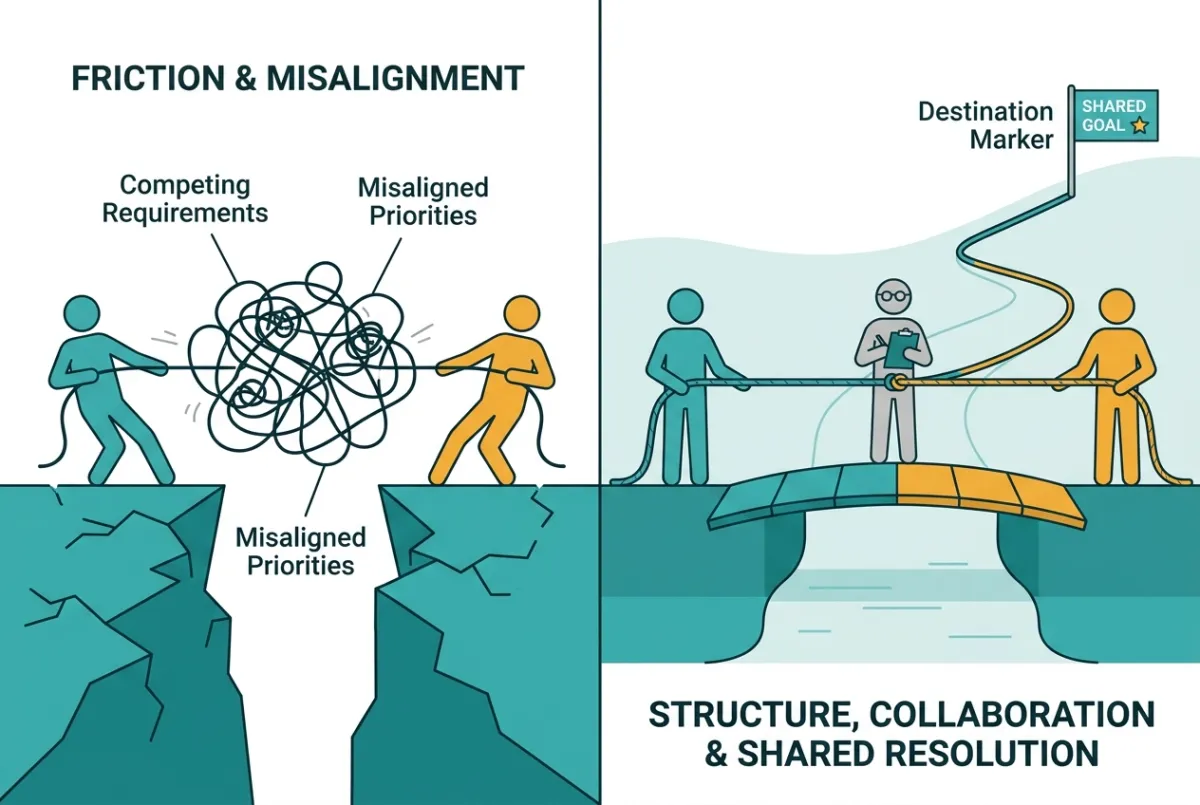
The Conflict Every Project Has and the Framework That Turns It Into Your Greatest Asset
Introduction
Most project teams do not fall apart because of bad strategy or weak execution. They fall apart because two capable, well-intentioned people could not agree on what the right path forward looked like, and nobody had a structured way to resolve it before it became personal. Deadlines pass. Trust erodes. The project slows to a crawl while the real issue, almost always rooted in something deeper than the surface argument, sits unaddressed beneath a pile of meeting notes and unanswered emails.
Conflicts and complaints within multi-stakeholder project environments do not erupt out of nowhere. They arise from unclear roles and responsibilities, competing priorities, differing communication styles, and deep-rooted differences in values and objectives. For a business analyst or change professional, the ability to step into that friction and navigate it with structure is not a soft skill. It is one of the most strategically valuable capabilities you can bring to a project.
The difference between a practitioner who manages tasks and one who leads change is almost always found in how they handle conflict when it arrives.
Key Takeaways
Conflict Is Information, Not Dysfunction: Conflict is often a signal that behavioural expectations, perception, or influence patterns are shifting. Handled structurally, it strengthens alignment and decision-making. Your job is to read that signal, not suppress it.
Position Is Not Interest: Every stakeholder who argues for a specific outcome has a deeper reason driving that position. The resolution lives in the reason, not the argument.
Neutrality Is Your Most Valuable Asset: Your role in a conflict is not to decide who is right. It is to protect the project's business rationale and facilitate a path both parties can commit to.
Early Conflict Costs Less Than Late Conflict: A key point is the need to identify and reconcile differences early in the project, as support from senior management may be required to clarify the business objectives and consolidate an approach if they are left unaddressed.
Resolution Without Documentation Is Not Resolution: An agreement that exists only in memory will be contested the moment pressure increases. Every resolved conflict must be captured formally and reflected in the project record.
What Is Stakeholder Conflict in Business Analysis?
Stakeholder conflict occurs when individuals or groups with a vested interest in a project have differing views about priorities, resources, or outcomes. These disagreements can surface at any stage of the project lifecycle and reflect deeper tensions between business goals, personal motivations, and organizational politics. In business analysis practice, this means treating conflict not as an interpersonal problem to be smoothed over, but as a structural signal that the project's requirements, priorities, or accountability structure needs clarification.
Conflict can be task-related and exacerbated by unclear roles, relationship-related and complicated by differing communication styles, or value-based and originating from deep-rooted differences in beliefs and organizational priorities. Understanding which type you are dealing with before you attempt to resolve it is the difference between a conversation that moves the project forward and one that drives the parties further apart.
The goal of conflict resolution in business analysis is to move each party from a positional stance, where they argue over what they want, to an interest-based stance, where they explore why they want it. The real need behind a conflict can be quite different from the stated need. Investigating the rationale behind a conflict and using that information to resolve it is what separates effective facilitation from surface-level compromise. A business analyst who masters this shift does not just resolve disagreements. They uncover requirements that would never have surfaced in a standard workshop.
Why a Structured Framework Changes Everything
It removes the conversation from the personal and places it in the professional. When conflict is handled reactively, through hallway conversations, escalations, or pointed emails, it almost always becomes about the people involved rather than the problem that needs solving. A structured framework creates a neutral container for the conversation, one where the focus stays on business outcomes rather than personalities, and where both parties feel heard without either feeling attacked.
It compresses the time between friction and resolution. Unresolved stakeholder conflicts are like silent project killers. They often go unnoticed until the damage is done, producing missed deadlines, endless debates that delay decisions, and a project culture where people disengage rather than contribute. A structured approach pushes the group toward a defined decision point rather than allowing the disagreement to cycle indefinitely through status meetings and escalation chains.
It preserves the relationships the project depends on. Effective conflict resolution builds a culture of respect, fosters open communication, and ultimately creates the trust that increases stakeholder engagement and collaboration throughout the project. When stakeholders experience a conflict that is handled fairly and with integrity, they leave the process more invested in the project, not less.
It turns the middle ground into a better solution. Some of the strongest requirements and most creative project decisions emerge from the tension between two competing positions. When the conflict resolution process is structured and outcome-focused, the compromise it produces is not a watered-down version of what either party wanted. It is often a third option that neither party would have proposed without the friction that forced the conversation.
The Stakeholder Conflict Resolution Framework: Step by Step
Step 1: Isolate and Define the Friction Point
You cannot resolve a conflict you have not clearly named. The first task is to reduce the disagreement to its most specific, factual form before any parties are brought together.
What to do: Write the conflict down in a single sentence that describes the specific gap between two positions without assigning blame to either side.
Action: Distinguish between a disagreement over a technical requirement, a timeline, a resource allocation, or a strategic priority, because each type requires a different resolution approach.
Goal: A clear, shared problem statement that both parties will recognize as an accurate description of the disagreement, even if they cannot yet agree on the solution.
Step 2: Identify the Root Cause Beneath the Position
Stakeholders often argue from positions: this must happen. Effective facilitators explore the underlying interests: why does this matter to you? The root cause of a conflict is almost never the thing being argued about on the surface.
What to do: Meet with the conflicting parties individually before bringing them together. Use open-ended diagnostic questions and the 5 Whys technique to surface the concern beneath the stated position.
Action: Ask each party what specifically would need to be true for them to feel confident in a different approach. Their answer will reveal the real requirement driving their resistance.
Goal: A documented understanding of each party's underlying interest, not just their stated position, that can be used to anchor the joint resolution session.
Step 3: Facilitate a Joint Outcome-First Session
Bringing conflicting parties into the same room without establishing shared ground first is one of the most common mistakes in conflict facilitation. The opening of the session must reorient everyone toward the common goal before any solutions are discussed.
What to do: Open the session by restating the shared business objective that both parties are working toward. Make it explicit that the purpose of the meeting is to find a path that serves that objective, not to determine who was right.
Action: Use the shared goal as the filter for every option presented. If a proposed solution cannot be connected back to the business objective, it is not a resolution; it is a preference.
Goal: A room where both parties are competing to solve the same problem rather than competing against each other.
Step 4: Brainstorm Alternative Paths
Once the shared goal is established, the conversation shifts from defense to design. This is where structured creativity produces the resolutions that neither party could see when they were locked in opposition.
What to do: Use What-If analysis to stress-test alternative approaches that address the root causes of both positions simultaneously.
Action: Encourage conflicting parties to find a compromise between alternative solutions, including the possibility that all previously proposed solutions are set aside and an entirely new solution is developed collaboratively.
Goal: At least two viable alternative paths that address each party's underlying interest, even if neither path is identical to what either party originally proposed.
Step 5: Document, Assign, and Close
If even one party who was involved in a conflict resolution is not satisfied with the outcome, the project could lose stakeholder engagement, which in turn could affect the overall project negatively. Documentation is what prevents that outcome.
Action: Update the project's RASCI matrix, impact assessment, or requirements log to reflect the agreed path. Ensure the Accountable stakeholder formally signs off on the resolution so there is no ambiguity about what was decided or who owns the outcome.
Note: Send a written summary of the resolution to all parties within twenty-four hours of the session. A resolution that exists only in memory is a disagreement waiting to resurface.
Goal: A formally closed conflict with a documented decision, a clear owner, and a shared record that can be referenced if the same tension re-emerges in a later project phase.
Frequently Asked Questions
What do I do when one party refuses to engage in a joint session?
This is itself a data point. A stakeholder who refuses to participate in structured conflict resolution is usually signaling that they do not feel safe in a shared environment, that they believe the outcome is already decided, or that they have concerns about their organizational standing. Address those concerns individually before attempting a joint session. Avoidance compounds tension. Surfacing disagreement early prevents positional entrenchment and signals leadership maturity. Silence does not preserve harmony; it delays disruption.
How do I stay neutral when I have a professional opinion about which position is correct?
Your opinion about the right technical or strategic answer is not irrelevant, but it is not your primary contribution in a conflict resolution context. Your primary contribution is the process. If your professional assessment is material to the decision, present it as data, not as advocacy. Frame it as what the evidence suggests rather than what you believe, and let the Accountable stakeholder make the final call informed by that evidence.
What if the conflict resurfaces after it has been formally resolved?
A recurring conflict almost always means that the root cause was addressed at the surface but not at the source. Go back to Step 2 and repeat the individual diagnostic conversations. Something in the underlying interest of one or both parties was not fully addressed in the original resolution, and the agreement is holding only under conditions of low pressure.
When should a conflict be escalated rather than facilitated?
Escalate when the conflict involves a decision that exceeds the authority of the parties in the room, when one party is operating in bad faith, or when the disagreement is fundamentally about organizational priorities rather than project requirements. If all other resolution methods fail, requesting the project sponsor to decide is a legitimate and appropriate final step. Knowing when to escalate is not a failure of facilitation. It is a sign of professional judgment.
Final Thoughts
The business analysts and change professionals who consistently deliver successful projects are not the ones who avoid conflict. They are the ones who know how to move through it quickly, cleanly, and in a way that leaves the team stronger on the other side. Conflict handled well does not just produce a resolution. It produces better requirements, stronger relationships, and a project culture where difficult conversations happen early rather than late.
The framework is not complicated. The discipline required to use it consistently, to slow down when the instinct is to escalate, to ask why instead of arguing what, and to document the resolution even when everyone in the room is tired and ready to move on, is where the real professional development lives.
Pick the one conflict currently simmering in your project that everyone is politely avoiding. This week, schedule a fifteen-minute root cause discovery call with the parties involved. Focus entirely on understanding the why behind each position. You do not need to resolve it in that call. You just need to name it honestly enough to start.
Get practical insights on change and business analysis delivered to your inbox. Join our mailing list


