A Beginner’s Guide to the Business Analysis Core Concept Model (BACCM)
Introduction
Projects often fail not because of a lack of effort, but because of a lack of clarity. When stakeholders are misaligned or the actual "need" is misunderstood, even the most advanced technical solution will fall short.
The Business Analysis Core Concept Model (BACCM) is a conceptual framework designed to prevent these missteps. It serves as a universal language and a diagnostic tool that allows business and change professionals to view any initiative through six essential lenses. By understanding these concepts, you can ensure that your project remains focused, relevant, and valuable.
What is the BACCM?
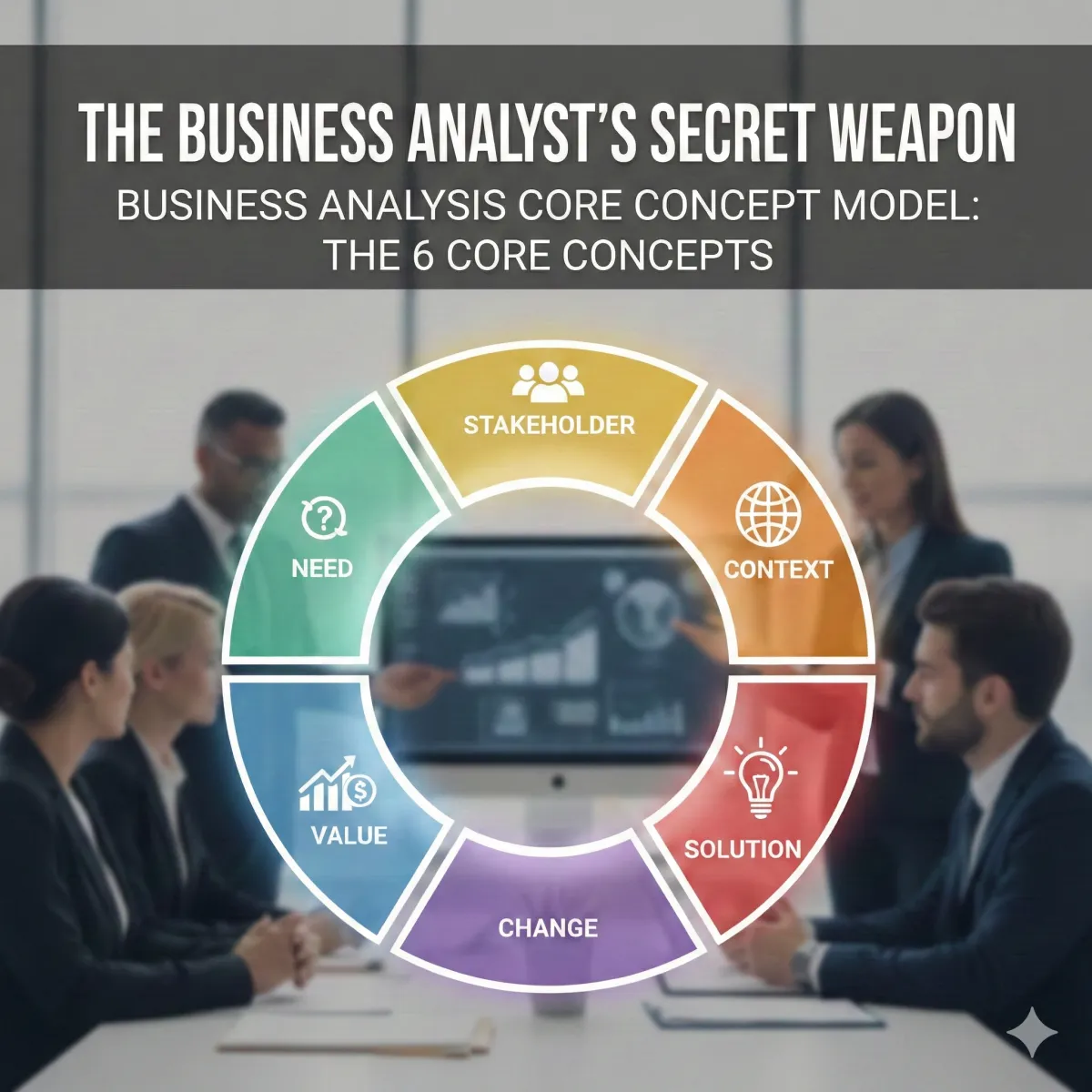
The BACCM is a framework composed of six core concepts that are fundamental to business analysis.
These concepts are not independent; they are deeply interconnected. A change in one concept inevitably impacts the others.
The six concepts are:
Change: The act of transformation in response to a need.
Need: A problem, opportunity, or constraint with potential value.
Solution: A specific way of satisfying one or more needs in a context.
Stakeholder: A group or individual with a relationship to the change, the need, or the solution.
Value: The worth, importance, or usefulness of something to a stakeholder within a context.
Context: The circumstances that influence, are influenced by, and provide understanding of the change.
Why is the BACCM Important?
For anyone involved in business or organizational change, the BACCM is a "sanity check" for your project.
Holistic Perspective: It prevents "tunnel vision" by forcing you to look beyond just the technology or the process.
Alignment: It ensures that every stakeholder has a common understanding of what is being built and why.
Risk Mitigation: By analyzing the Context, you can identify external risks (like regulatory changes or cultural shifts) that might otherwise be overlooked.
Value Focus: It keeps the project team focused on delivering actual Value rather than just completing tasks or "checking boxes."
How to Use the BACCM in Practice (Step-by-Step Framework)
You can use the BACCM as a diagnostic tool at the start of a project or whenever a project feels like it’s losing its way. Here is a simple step-by-step framework you can follow:
Step 1 – Define the Need
Before discussing software or new processes, identify the underlying "Why." What is the problem we are solving? What is the opportunity we are chasing?
Action: Write a clear "Need Statement."
Tip: If you can’t define the need in one sentence, you haven't dug deep enough yet.
Step 2 – Identify the Stakeholders
Who is affected by this? Who has the power to approve it? Who will use the end product?
Action: Map out your stakeholders and determine how the "Need" affects each group differently.
Pitfall: Don't just look at the managers; the end-users are often the most critical stakeholders for adoption.
Step 3 – Analyze the Context
What is happening around the project? Is there a budget freeze? Are there new competitors? Is the company culture resistant to change?
Action: Perform a quick scan of the internal and external environment.
Why it matters: A solution that works in one company (Context A) might fail miserably in another (Context B) due to cultural or environmental differences.
Step 4 – Outline the Required Change
What specifically needs to transform to address the need? This could be a change in behavior, a change in software, or a change in a business process.
Action: Describe the "From-To" state. (e.g., From manual spreadsheet tracking To a centralized automated database).
Step 5 – Evaluate the Solution
Now you define the solution. How will this specific solution satisfy the Need within our unique Context?
Action: Ensure the solution addresses all aspects of the Need, not just the easy parts.
Step 6 – Quantify the Value
If we implement this Solution and execute the Change, what is the worth to our Stakeholders?
Action: Define success metrics. Value isn't always money; it could be time saved, reduced risk, or improved employee morale.
Key Takeaways & Practical Tips
The Model is an inter relationship: If the Context changes (e.g., a new law is passed), you must re-evaluate the Solution and the Value.
Use it as a Communication Tool: When a stakeholder asks for a new feature, ask them: "How does this add Value to the Need we identified?"
No Concept is More Important: You cannot have a successful project if you ignore any one of these six pieces.
Validate Early: Share your BACCM findings with stakeholders early to ensure everyone is on the same page before significant resources are spent.
Conclusion & Next Steps
The Business Analysis Core Concept Model is more than just a theoretical framework; it is a practical compass for navigating the complexities of organizational change. By consistently asking how the Change, Need, Solution, Stakeholders, Value, and Context interact, you can move from simply "doing tasks" to "delivering outcomes."
Next Steps: On your current initiative, take 15 minutes to write down one sentence for each of the six core concepts. If you find a gap for example, if you can’t clearly define the "Value" that is your signal to stop and have a conversation with your project team immediately.


