How Can Business Analysts Use Systems Thinking to Prevent Conflict Across Departments?
Introduction
In the high-pressure environment of corporate projects, it is easy for departments to become silos, each focused exclusively on their own KPIs and deadlines. When a Business Analyst is brought in to solve a problem for one team, such as automating a lead-gen process for Marketing, the natural instinct is to move as fast as possible to satisfy that specific stakeholder.
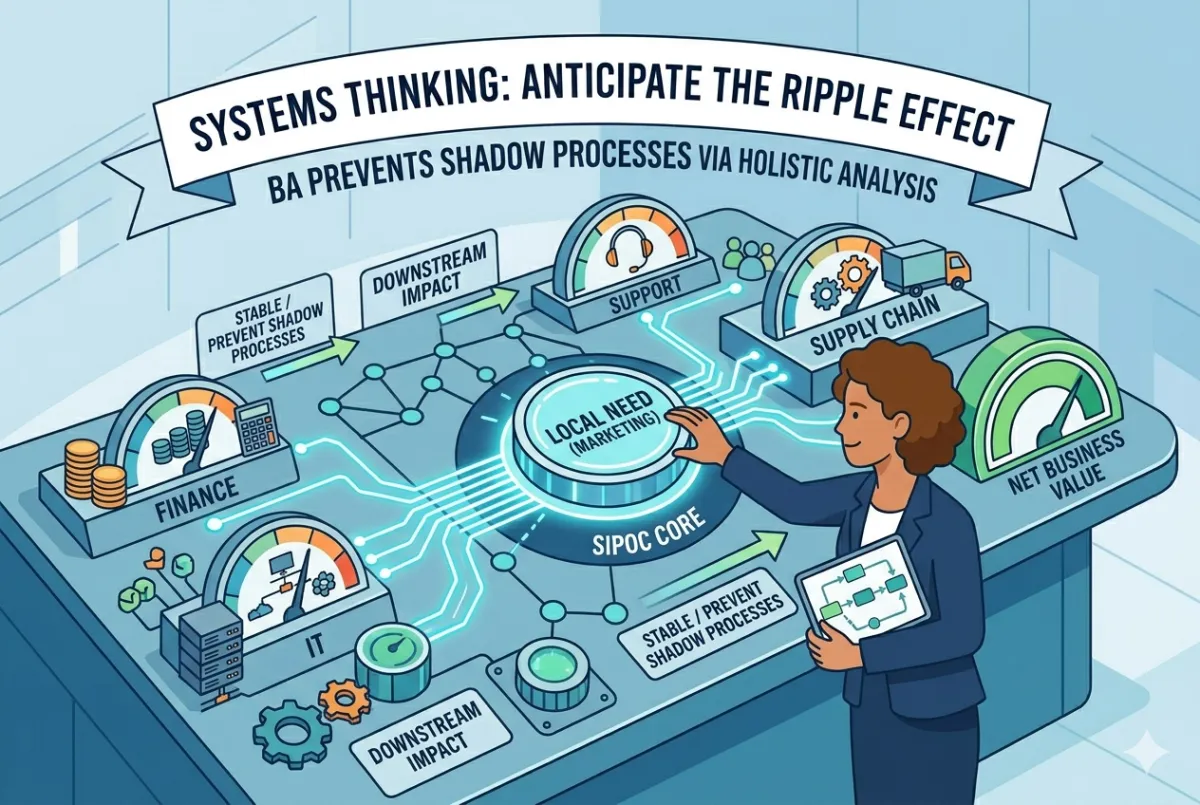
However, without a Big Picture perspective, a win for Marketing can quickly become a fire for Finance or IT. Business analysts can prevent this conflict by adopting systems thinking, which allows them to see the organization as a series of interrelated components rather than isolated functions. By analyzing the upstream and downstream impacts of every requirement, a BA ensures that a local solution does not create a global problem for the enterprise.
Key Takeaways
Adopt a Holistic View: Effective business analysis requires looking beyond a single department to understand how various organizational components are interrelated.
Identify All Impacted Stakeholders: A Big Picture BA identifies everyone who has an interest in, is impacted by, or has influence over the project outcome.
Analyze the Context: Understanding the environment, including culture, regulation, and technology, is vital to ensuring a solution works within the broader organization.
Focus on Total Business Value: Success is not just meeting a single requirement; it is delivering a solution that provides tangible and intangible benefits to the entire organization.
Prevent Project Rework: Identifying cross-functional impacts early in the requirements lifecycle prevents catastrophic delays and expensive adjustments later.
What is Systems Thinking in Business Analysis?
Systems thinking is a fundamental diagnostic mindset that views an organization as a complex ecosystem where every change has a ripple effect. In the professional practice of business analysis, this means treating a requirement not as a standalone task, but as a node in a larger network of people, processes, and technology. Instead of having a narrow vision that focuses on one tiny bit of a problem, a systems-thinking BA looks at the whole picture to understand how different parts of the company interact.
This approach is rooted in the Business Analysis Core Concept Model (BACCM), which defines the practice of business analysis through six interrelated concepts: Change, Need, Solution, Stakeholder, Value, and Context. When you apply this model, you stop asking, Does this work for Marketing? and start asking, How does this change the data flowing into Finance, and do the other departments have the capacity to handle these new requirements?. It forces the analyst to think beyond the what and consider the why, the who, the how, and the where.
A systems thinker recognizes that organizations are not just collections of departments; they are interrelated systems. For example, if you change how a sales order is captured, that change impacts how Finance reconciles accounts, how Supply Chain manages inventory, and how HR tracks sales commissions. By using this holistic approach, the business analyst acts as a context engineer, ensuring that the new solution aligns with the organization's culture, infrastructure, and regulatory requirements.
Why is a Holistic View Critical for Project Success?
In a perfect world, every department would have perfectly aligned goals. In reality, departmental friction often arises from misaligned objectives rather than difficult personalities. A holistic view is critical because it identifies these misalignments before they lead to project failure.
1. Preventing Shadow Processes and Data Integrity Issues
When a change in one department breaks another team's workflow, those employees do not simply stop working. Instead, they create shadow processes, which are manual, underground workarounds designed to help them survive the disruption. These workarounds often lead to data integrity issues because information is being captured in unofficial spreadsheets rather than the centralized system. By taking a big picture view, a BA identifies these risks early and designs a solution that supports everyone's workflow, eliminating the need for underground processes.
2. Reducing Project Rework and Delays
Identifying an impact on the Finance department in the second week of a project is a minor adjustment. Finding that same impact in the twenty-second week, right before the scheduled Go-Live event, is a catastrophic project delay. The business analyst must plan their work effectively to avoid jumping into solution mode too quickly. Through diligent planning and broad elicitation, the BA uncovers these cross-functional requirements early, ensuring the implementation team has the right information from the start.
3. Building Cross-Functional Trust and Social Capital
A business analyst's success depends heavily on their interaction and relationship-building skills. When other departments see that you have considered their needs, even though they are not the primary clients of the project, you build significant social capital. This trust makes it easier to drive future changes and ensures that you are viewed as a neutral strategic partner rather than an advocate for just one silo.
4. Ensuring True Return on Investment (ROI)
Business value represents the worth or significance of a solution to the stakeholders. A solution that saves Marketing $10,000 but costs Finance $15,000 in additional manual labor is a net loss for the organization. A holistic BA analyzes the expected business value across the entire enterprise, ensuring that the recommended solution delivers a positive return when all costs and benefits are considered.
How to Be a Big Picture BA (Step-by-Step Framework)
To ensure your local solutions do not create global organizational problems, follow this structured step-by-step framework during your next analysis engagement:
Step 1: Map the Value Stream and Supplier-Input-Process-Output-Customer (SIPOC)
You must trace the lifecycle of the data or the customer journey from start to finish, regardless of which department owns a specific segment.
What to do: Perform an organizational analysis to identify every department that touches the process you are trying to change.
Action: Create a cross-functional SIPOC diagram to identify suppliers (who provides the data), inputs, the process steps, outputs, and customers (who receives the data).
Goal: Identify all stakeholders who have an interest in or are impacted by the work, ensuring no one is left out.
Step 2: Conduct an Upstream and Downstream Impact Scan
For every new requirement you document, you must ask two specific questions to verify its impact on the rest of the organization.
Upstream: What information must be provided to this process for this requirement to work? Can the source department actually provide that information in the required format and timeframe?
Downstream: Once this process is complete, where does the output go? Is the receiving department ready for the change in format, volume, or timing of that information?
Why it matters: This ensures that you are not solving a problem for one team by moving the burden to another team.
Step 3: Identify and Invite Observer Stakeholders
Do not just invite the people who want the change to your workshops: invite the people who might be burdened by it.
What to do: Identify stakeholders who may have low interest in the project but will be highly impacted by the outcome.
Action: Include representatives from Finance, HR, or Operations in your requirements review sessions.
Note: Their role is not to block the project, but to serve as a safety check for their department's interests.
Step 4: Analyze Context and Second-Order Effects
Think two steps ahead. Every solution occurs within a context that includes culture, technology infrastructure, and government regulations.
What to do: Use What-If analysis to stress-test how a solution might impact company-wide capacity.
Example: If we automate this process and increase output by 50 percent, what happens to the support teams that have to handle the resulting customer queries?
Why it matters: Understanding the environment helps you determine what is truly relevant to the project and provides a setting for stakeholders to identify their relationship to the change.
Step 5: Validate the Net Value with the Project Sponsor
Before finalizing your requirements and moving into implementation, you must ensure the solution is a win for the entire organization.
What to do: Compare the current state (the problem) against the future state (the expected value) to identify the true gap.
Action: Present the cross-functional impacts and any trade-offs to the project sponsor.
Goal: Ensure the sponsor is comfortable with the trade-offs and that the solution embodies the desired outcome for the business as a whole.
Frequently Asked Questions (FAQs)
How do I handle a stakeholder who only cares about their own department?
This is a common challenge in stakeholder management. Use empathy to understand their position, but then use the Big Picture data you have gathered to show them the risks to the organization. Explain that if the project breaks a downstream process in Finance, it will eventually circle back to impact their own department's budget or reputation.
What if I don't have enough time to do a full cross-functional analysis?
Business analysts must often prioritize their work. If time is limited, focus on the most significant changes and trace their path to the departments that receive the output of those changes. Ask yourself, Who else uses this data? or Who else sees this report? to identify the most critical impact points.
Will inviting observer stakeholders slow down my project?
While it may feel like adding more people to a workshop slows things down, it actually saves time in the long run. It is much faster to address a concern in a one-hour meeting today than it is to fix a major technical defect during the implementation phase because a critical requirement was missed.
How do I know if I've identified all the right stakeholders?
Identifying stakeholders is an ongoing process. Use techniques like document analysis, organizational analysis, and snowballing, where you ask one stakeholder to identify others who might be impacted. Always ask, Whose job title, tools, or processes will need to change because of this solution?.
Final Thoughts
A Big Picture business analyst is a protector of the organization's health. By adopting a systems thinking mindset, you ensure that your projects drive genuine progress rather than just shifting a burden from one department to another. Your value as a practitioner lies in your ability to see the connections that others miss and to build the bridges that allow those connections to function smoothly.
Instead of focusing only on the immediate request, focus on the total value. Start with the strategic goals, analyze the context, and always consider the people at the end of the process. When you think in systems rather than silos, you become an indispensable strategic partner to the entire enterprise.
Reflective Question: Look at your current requirements list. Pick the most significant change and trace its path. Which department receives the output of that change? Reach out to a peer in that department this week and ask, We are thinking of changing this specific process; how would that impact your team’s daily routine?
Get practical insights on change and business analysis delivered to your inbox. Join our mailing list


