Every Requirement You Miss Traces Back to the Same Root Cause. You Had No Plan
Introduction
There is a pattern that repeats itself on projects where requirements are missed, timelines slip, and stakeholders feel blindsided. The business analyst was capable. The project was adequately resourced. And yet somewhere between the first stakeholder meeting and the final sign-off, something important fell through. A dependency was never elicited. A workshop that should have happened in week three happened in week eight. A stakeholder whose input was critical to a core requirement was never formally engaged.
The cause is almost never incompetence. It is almost always the absence of a plan.
When business analysis planning is bypassed, it becomes difficult to understand the scope of work, stakeholder expectations, and the appropriate amount and level of business analysis required for the project. This makes estimation difficult and results in unrealistic expectations by those involved in requirements activities. Business analysts who begin elicitation sessions without a well-thought-out roadmap will often find themselves pressed for time and rushing through activities to meet a schedule, to the detriment of the project.
A business analysis plan is not a formality. It is the document that transforms a skilled practitioner into a strategic one, and the absence of it is the single most consistent factor behind projects that deliver the wrong thing on time.
Key Takeaways
The PM's Plan and the BA's Plan Are Not the Same Document: Business analysis planning and scheduling is not performed independently of project management. It is best practice for the PM and BA to work closely together while the approach and plan are formulated. However, the BA must develop a work plan to cover the activities they are specifically responsible for performing, integrated into but not replaced by the overall project schedule.
Business analysis planning sets expectations with the sponsor, project team, and key stakeholders as to the business analysis approach. It ensures that roles are identified, understood, and communicated to everyone participating in the process.
Your Approach Dictates Everything That Follows: The decision between a predictive and an adaptive methodology is not an administrative choice. It determines the frequency of stakeholder interaction, the format of deliverables, the structure of elicitation sessions, and the way requirements will be approved and changed throughout the project.
Estimation Is Not Guessing With a Deadline Attached: Business analysis planning relies heavily on estimation techniques used to provide a quantitative assessment of likely amounts or outcomes. These must account for not just the activity itself but the preparation, documentation, and revision cycles that surround it.
The Plan Is a Living Document: Planning, even in a relatively predictive project, is an iterative process. As you develop requirements, you learn more about the scope and often need to revisit what is possible within the constraints of the project.
What Is Business Analysis Planning and Why Does It Function as the Foundation of Everything Else?
Business analysis planning covers the activities performed to ensure that the optimal business analysis approach is selected for the project and that stakeholders are thoroughly identified and analyzed, business analysis activities and deliverables are defined and agreed to, processes for validating, verifying, and approving requirements are established, and key stakeholders are aware of and support the activities and time commitments required to complete the work. In professional practice, this means treating planning not as preparation for the real work but as the first and most consequential piece of the real work itself.
The plan business analysis approach task defines and creates the methods that will be used while performing business analysis activities. It determines the timeline of the project, what and when activities will be performed, and which deliverables are expected. It also identifies suitable techniques and tools to be used over the course of the project. When this task is executed well, every subsequent activity in the requirements lifecycle has a defined home in the project schedule, a named owner, and a realistic estimate behind it. When it is skipped, every subsequent activity competes for time it was never allocated.
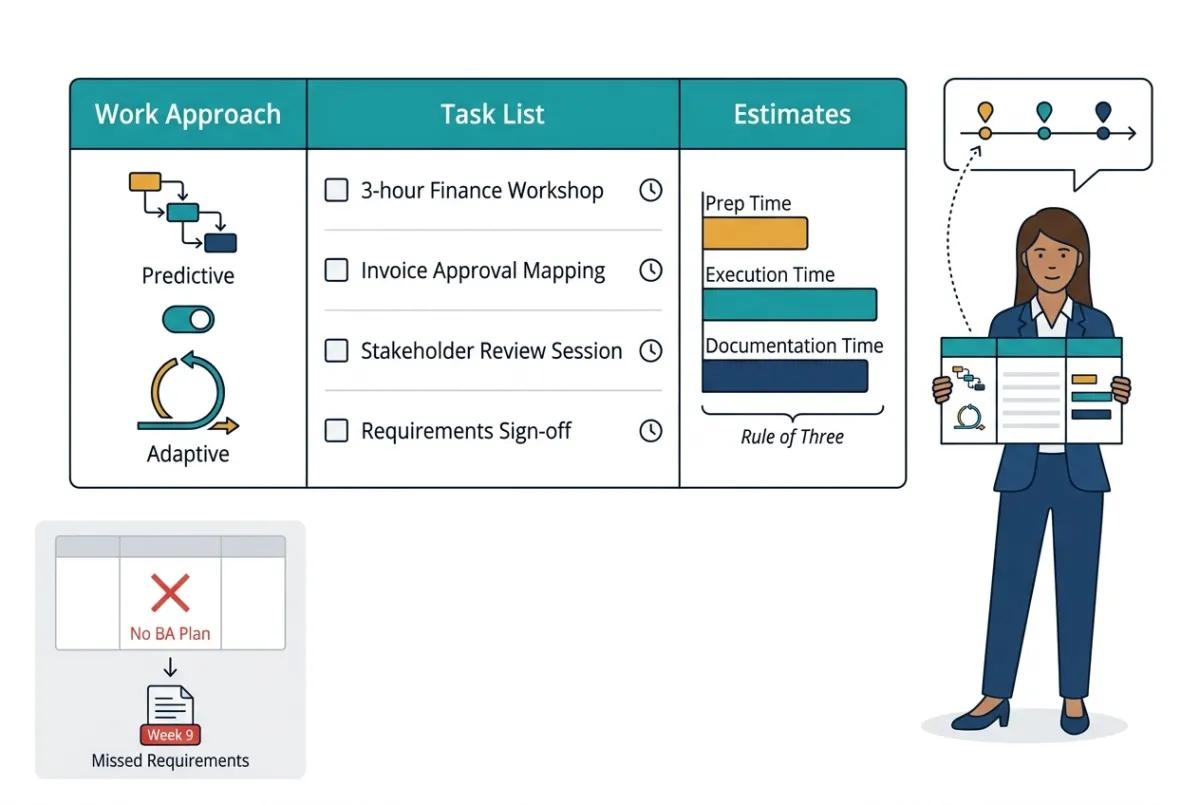
The BA plan covers three distinct areas that a general project plan consistently overlooks. The Work Approach defines the standards, tools, and techniques that will govern how analysis is conducted throughout the project. The Task List breaks down every elicitation session, analysis activity, and validation meeting into a specific, named deliverable with a defined purpose. The Estimates translate each task into a realistic calculation of time that accounts for preparation, execution, documentation, and the revision cycles that follow. Together, these three pillars convert the practice of business analysis from a reactive response to project events into a proactive, organized discipline that shapes them.
Why a Dedicated BA Plan Produces Measurably Better Projects
It makes the invisible work visible to everyone who depends on it. Requirements work contains a significant volume of activity that never appears in a standard project schedule: the preparation before a workshop, the analysis after an interview, the time required for a stakeholder to review a draft and provide feedback, and the revision cycle that follows. A detailed plan allows key stakeholders to see the estimated amount of time needed to complete the analysis effort. In some cases, the BA may use this plan as a basis for negotiating more time or resources on the project, because the scope of the work is now visible rather than implied.
It protects the project from the most common form of scope underestimation. The requirements that are missed on a project are rarely the obvious ones. They are the ones that emerge from a workshop that was scheduled too late, from a stakeholder group that was never formally engaged, or from a dependency that a proper task breakdown would have surfaced in week two instead of week twelve. A BA plan with a structured task list and a realistic estimate for each item is the mechanism that prevents these gaps from forming in the first place.
It establishes the BA as a strategic partner rather than a requirements scribe. The most skilled business analysts consciously tailor their business analysis approach for each project, considering key project dynamics alongside their own competencies to get the most productivity and value out of their analysis efforts. A practitioner who presents a structured BA plan in the project's first week is demonstrating exactly that level of strategic thinking. A practitioner who shows up to the first stakeholder meeting without one is demonstrating the opposite.
It gives requirements change control a structural home. Requirements will change on every project. The only variable is whether there is a defined process for managing that change or whether each new requirement is absorbed informally and without accountability. The BA plan must define how decisions are made about requirements and designs, including reviews, change control, approvals, and prioritization, so that the governance of requirements is explicit from the start of the engagement rather than improvised in response to the first scope change request.
How to Build a Business Analysis Plan That Actually Drives the Project: A Step-by-Step Framework
Step 1: Select Your Analysis Approach Before Anything Else
The approach decision is the foundation on which every other planning decision rests. Getting it wrong at this stage produces a plan that is misaligned with the project's actual delivery model, which means the activities it defines will be in conflict with how the project is actually being run.
What to do: Determine whether the project requires a predictive approach, where analysis is largely completed before development begins and requirements are documented in a formal specification, or an adaptive approach, where requirements are developed iteratively through a prioritized backlog and refined throughout the delivery lifecycle.
Action: Document the approach decision and its implications explicitly. If the project is adaptive, define the iteration cadence, the backlog management process, and the format of requirements deliverables. If it is predictive, define the sign-off gates, the specification format, and the review and approval process.
Goal: A clearly defined approach that determines the timeline of the project, what and when activities will be performed, and which deliverables are expected, before a single elicitation session is scheduled.
Step 2: Conduct a Stakeholder Analysis That Goes Beyond the Org Chart
You cannot build a task list until you know who you are working with, how available they are, and what kind of input each person is expected to provide. Stakeholder analysis at this stage is not about engagement strategy. It is about planning the logistics of the requirements process.
What to do: Identify every person whose input is required for any requirements deliverable in the project. For each stakeholder, document their role in the analysis process, their availability constraints, their preferred communication format, and the specific activities they will be needed for.
Action: Plan stakeholder engagement by establishing the collaboration approach for each stakeholder, understanding their roles and relevance, and identifying their needs so that the requirements activities scheduled around them are realistic rather than aspirational.
Goal: A stakeholder engagement plan that is embedded directly in the BA task list, with named stakeholders assigned to specific activities and availability constraints reflected in the project schedule before the analysis work begins.
Step 3: Build a Specific, Named Task List
The most common failure in BA planning is the task list that consists of a single line labeled Gather Requirements. That entry is not a plan. It is a placeholder that makes the BA's work invisible and makes realistic estimation impossible.
What to do: Break down every requirements activity into its most specific, named form. A three-hour workshop with the Finance team to map the invoice approval process is a task. A job-shadowing session with two customer service representatives to observe the escalation workflow is a task. A review session with the project sponsor to validate the business objectives is a task.
Action: Use the Work Breakdown Structure approach to decompose each major requirements deliverable into the specific activities required to produce it, ordered in the sequence they need to be completed and tied to the project milestones they feed into.
Goal: A task list that can serve as the basis for negotiating time and resources, because the scope of the analysis work is now specific, visible, and defensible rather than hidden inside a single generic line item.
Step 4: Create Realistic Estimates Using the Rule of Three
Estimating only the meeting time for an elicitation activity is one of the most consistent sources of schedule pressure on requirements-heavy projects. The meeting is not the activity. It is one third of it.
What to do: For every elicitation activity, apply the Rule of Three: one hour of workshop requires approximately one hour of preparation and one hour of documentation and analysis afterward. This ratio will vary by activity type and complexity, but it provides a reliable baseline for initial estimates.
Action: Apply estimation techniques such as bottom-up estimation, where individual task estimates are built from the ground up based on the specific activities involved, rather than top-down percentage allocations that have no connection to the actual work being planned. Built in a ten to fifteen percent buffer for discovery, the requirements that do not yet exist at the time of planning but will emerge during elicitation.
Goal: A set of estimates that reflect the full effort of requirements work, not just the visible meeting time, and that can be honestly defended to the project manager and sponsor when the schedule is being set.
Step 5: Define the Change Control Process Before the First Requirement Is Documented
Requirements will change. The question is not whether a new requirement will arrive mid-project but whether there is a defined process for deciding what happens to it when it does.
What to do: Establish explicitly who has the authority to approve a new or changed requirement, how the impact of that change on the project schedule and budget will be assessed, and how the approved change will be documented in the requirements baseline.
Action: Integrate the change control process into the BA plan as a named section, not as an appendix or a reference to a separate document. The people who need to follow the process are the same people who will be reading the BA plan.
Goal: A change control mechanism that is understood and agreed to by all key stakeholders before the first requirement is documented, which means that when a scope change request arrives, there is a defined path for handling it rather than an improvised negotiation that consumes project team time and erodes sponsor confidence.
Frequently Asked Questions
How detailed does a Business Analysis plan need to be for a small or short-term project?
The time and formality applied to business analysis planning should be proportional to the project's complexity, duration, and risk profile. Even a simple project benefits from a short, structured plan, because the act of creating it forces the BA to think through the activities, stakeholders, and estimates that would otherwise be assumed rather than examined. For a short engagement, the plan might be a single-page document. For a complex transformation, it may be a multi-section governance artifact. The format is less important than the discipline of building it.
How do I handle a project where the scope keeps changing before I can finalize the Business Analysis plan?
Build the plan around what is confirmed and flag what is provisional. A BA plan built on a shifting scope is not a reason to delay planning indefinitely. It is a reason to make the plan's assumptions explicit and to include a clear trigger for updating the plan when significant scope changes are confirmed. Planning in an iterative project is an iterative process. As you develop requirements, you learn more about the scope and often need to revisit what is possible within the project's constraints. The plan should reflect that reality rather than pretend the scope is stable when it is not.
What is the difference between the Business Analysis plan and the requirements management plan?
The BA plan covers the full scope of business analysis activities: the approach, the stakeholder engagement, the task list, and the estimates. The requirements management plan is a subset of the BA plan that focuses specifically on how requirements will be documented, traced, approved, and changed throughout the project. In larger projects, these may be separate documents. In smaller ones, they are typically sections within the same BA planning artifact.
How do I get stakeholder buy-in for a structured Business Analysis planning process when the project team wants to move straight into elicitation?
Present the plan as a risk management tool rather than an administrative overhead. A BA plan that takes one day to produce and prevents three weeks of rework is not a delay to the project. It is an investment in its success. Business analysis planning produces a more efficiently run requirements process because activities are not missed or excessively duplicated. That efficiency is the argument, and it is most convincing when presented with a specific example of what happens when the planning is skipped.
Final Thoughts
The practitioners who consistently deliver requirements that are trusted, complete, and acted upon are not the ones who elicit the fastest or document the most. They are the ones who plan the most deliberately. A BA plan does not slow a project down. It is the document that prevents the kind of schedule slippage, requirement gaps, and stakeholder surprises that slow projects down in ways that no amount of effort in the execution phase can fully recover from.
Build the plan before the first workshop. Make the task list specific enough to be scheduled. Make the estimates honest enough to be defended. Define the change control process before the first requirement is documented. And when the project evolves and new complexity surfaces, update the plan rather than abandoning it.
Reflective Question: Look at your current project. Do you have a BA-specific task list for the next two weeks, not the PM's schedule but your own, that names every workshop, review session, and documentation activity you are responsible for completing? If the answer is no, that list is what you build today before anything else.
Get practical insights on change and business analysis delivered to your inbox. Join our mailing list


