Can Mastering the 6 IIBA Knowledge Areas Transform Your Business Analysis Career?
Introduction
Embarking on a career in business analysis often feels like stepping into a vast, uncharted territory. While the day-to-day tasks — facilitating meetings, drawing process maps, and documenting requirements — are highly visible, the underlying structure that holds these activities together is frequently hidden from view. To transition from simply doing tasks to performing high-value professional work that drives organisational change, you need a reliable compass.
The answer to whether these areas can transform your career is a resounding yes. By aligning your work with the six Knowledge Areas defined by the International Institute of Business Analysis (IIBA), you move beyond being a reactive order-taker and become a disciplined, strategic partner. These Knowledge Areas are not chronological steps or a rigid project phase model — they are interrelated categories of tasks that a business analyst performs to enable change in an enterprise, applicable across industries, methodologies, and organisation sizes.
Key Takeaways
Global Standardization: The Knowledge Areas provide a common language for practitioners worldwide, ensuring consistency across industries and contexts.
Holistic Discipline: Business analysis is not just about software. It is about enabling change by considering people, processes, and technology together.
Lifecycle Management: Requirements are living assets that must be managed from inception through to retirement — not abandoned once a solution goes live.
Value-Centricity: The ultimate goal of every business analysis activity is to ensure the final solution delivers measurable value to stakeholders. Value can be tangible or intangible, and can represent gains, improvements, or avoided losses.
Continuous Improvement: Solution evaluation should continue long after go-live to ensure the solution remains effective and continues to deliver the value it promised.
What Are the Six Knowledge Areas?
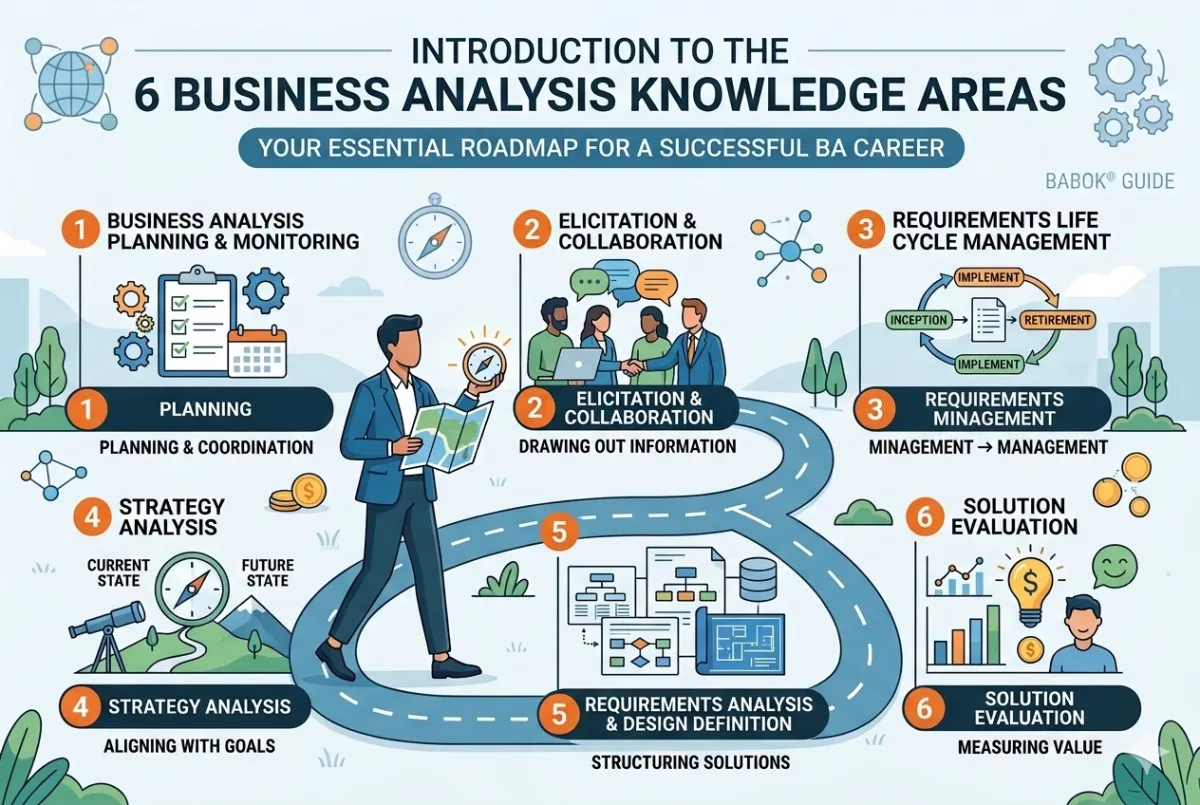
The Knowledge Areas represent the complete spectrum of business analysis work. They are not sequential steps — you will iterate between them throughout any initiative. The six Knowledge Areas are:
Business Analysis Planning and Monitoring: Organising the business analysis approach and coordinating stakeholder efforts.
Elicitation and Collaboration: Drawing out information from stakeholders, confirming results, and maintaining ongoing collaboration throughout the initiative.
Requirements Life Cycle Management: Managing and maintaining requirements and design information from inception through to retirement.
Strategy Analysis: Identifying business needs and aligning the change strategy with higher- and lower-level organisational goals.
Requirements Analysis and Design Definition: Structuring and organising requirements, specifying and modelling requirements and designs, and identifying solution options that deliver value.
Solution Evaluation: Assessing how well a solution performs, the value it actually delivers, and what actions are needed to increase that value.
Why Is Understanding the Roadmap Important?
Navigating a complex initiative without this framework is risky for both the analyst and the organisation. Relying on a structured roadmap is essential for several reasons:
Professional Credibility: Aligning your work with international standards signals to employers and peers that you are a disciplined professional. It moves you from being a scribe who simply records what people say to a consultant who provides expert guidance. This is a foundational requirement for achieving global certifications such as the ECBA, CCBA, or CBAP.
Elimination of Gaps: The roadmap ensures you do not skip critical steps that are often overlooked to a project's detriment. For instance, many teams stop at go-live — but the framework requires Solution Evaluation to confirm the investment actually delivered its intended value.
Scalability and Flexibility: These standards are context-neutral. Whether you are implementing a small process change in a local clinic or managing a large organisational transformation for a global bank, the core principles of elicitation, analysis, and evaluation remain the same.
Business Agility: Understanding how requirements fit into the bigger picture allows an organisation to be more agile. By managing the requirements lifecycle effectively, you can identify where reuse is possible and where gaps will need to be addressed as the initiative evolves.
How to Navigate the Standards — A Step-by-Step Framework
To move beyond note-taking and start practicing high-value business analysis, follow this practical framework based on the six Knowledge Areas:
Step 1 — Plan the Business Analysis Approach
Before diving into a problem, define how you will perform your work. It is risky to enter any initiative without proper planning.
Identify stakeholders: determine who is impacted by the change and what their influence is.
Define the repository: establish where documents will be stored so the team can collaborate effectively.
Coordinate communication: agree on meeting frequency and which tools will be used for modelling or tracking.
Step 2 — Perform Strategy Analysis
Focus on the big picture before looking at specific requirements. You must understand where the organisation is today and where it wants to be.
Analyse the current state: use techniques such as document analysis or organisational research to understand existing pain points.
Define the future state: what does success look like in six months or a year?
Assess risks: identify what could go wrong during the transition and how it might impact business goals.
Step 3 — Conduct Elicitation and Collaboration
This is active investigative work. Elicitation is not a single bounded phase — it is iterative and continuous throughout the initiative, occurring at every level as understanding evolves.
Prepare for elicitation: develop your questions and select your techniques, such as interviews, workshops, or observation.
Draw out the truth: be an active listener and look for gaps where information may be missing.
Confirm results: play back what you heard to stakeholders to surface conflicting requirements or misunderstandings.
Step 4 — Define Requirements and Design
Turn raw information into a structured plan for a solution. Use critical thinking to understand why each requirement matters and what it will cost to deliver.
Model the process: create diagrams that show how people, processes, and technology will interact in the future state.
Prioritise work: you cannot solve every problem at once. Work with stakeholders to decide what provides the most value immediately.
Analyse design options: look at different ways to solve the problem and recommend the option that best aligns with the defined strategy and delivers the greatest overall value.
Step 5 — Manage the Requirements Life Cycle
Requirements are living assets. They change as the initiative moves from inception to implementation and eventually to retirement.
Establish traceability: link requirements back to the original business goal so you can demonstrate why each feature exists.
Assess changes: when a stakeholder requests something new, evaluate how it impacts existing scope, budget, and timeline before accepting it.
Maintain for reuse: document requirements clearly so they can be referenced and reused on future initiatives.
Step 6 — Conduct Solution Evaluation
Your role does not end when the solution goes live. You must verify that the solution is actually doing what it was designed to do and delivering the value it promised.
Perform post-go-live activities: check for defects or issues that need immediate attention.
Measure value: after implementation, assess whether processes are more efficient or whether business goals have been achieved.
Recommend improvements: if the solution is not delivering value, identify what needs to change whether the limitation lies within the solution itself or within the broader enterprise environment.
Frequently Asked Questions
Are these Knowledge Areas chronological steps?
No. While they are often presented in a specific order, you will find yourself iterating between them. For example, while conducting elicitation, you might discover a new risk that requires you to revisit your strategy analysis or update your business analysis plan.
Do I need a technical background to understand these areas?
No. While being technically aware helps, these standards focus on business needs. A solution is composed of people and processes just as much as technology. The business analyst's role is to act as a translator between the business world and the technical world.
Which Knowledge Area is the most difficult?
Many practitioners find Elicitation and Collaboration the most challenging because it involves managing people, differing opinions, and conflicting requirements. It requires strong interpersonal skills and empathy to navigate effectively.
Does every initiative require all six Knowledge Areas?
Yes, but the intensity varies. A small process change might only require light planning and a single elicitation session, whereas a large digital transformation will require deep, rigorous work across every area.
Final Thoughts
The six Knowledge Areas provide the essential framework for a successful, high-impact career in business analysis. By moving beyond checking boxes and embracing these six areas as an integrated practice, you elevate your work from a set of administrative tasks to a professional discipline that delivers real value to your organisation.
Look at your current initiative today. Which of the six Knowledge Areas are you spending the most time in?
This week, try to identify one specific metric you can track to evaluate whether your last project actually delivered its promised business value.
True professionals do not just launch solutions they ensure those solutions solve the right problems.
Get practical insights on change and business analysis delivered to your inbox. Join our mailing list


