Are You Building a Bridge or Remodeling a Kitchen? How to Choose the Right Business Analysis Approach Before Your First Workshop
Introduction
Every project starts with a decision that most business analysts make too quickly, too informally, or not at all. It happens before the first stakeholder is interviewed, before the first requirement is documented, and before the first workshop is scheduled. It is the decision about how the analysis work will be done, not which tools will be used or which templates will be filled out, but which fundamental methodology will govern the entire requirements journey.
Choose wrong and the consequences compound quietly. A team using a predictive approach on a project with rapidly shifting requirements finds itself locked into documentation cycles that cannot absorb the changes arriving every two weeks. A team using an adaptive approach on a project with fixed regulatory requirements and a hardware dependency finds itself in an endless discovery loop that never converges on a deliverable. Both scenarios produce the same outcome: a project that is working hard and delivering little.
The choice between predictive and adaptive approaches matters more than ever as organizations navigate rapid market shifts and evolving stakeholder expectations. Understanding when to use each approach can determine whether your project delivers real value or struggles to stay relevant. For a business analyst, this decision is not a preference. It is a diagnostic conclusion drawn from four specific characteristics of the project environment, and getting it right before the first workshop is scheduled is one of the highest-leverage contributions a BA can make to a project's eventual success.
Key Takeaways
Methodology Is a Strategic Decision, Not a Default Setting: The approach you choose governs how you gather requirements, engage stakeholders, structure deliverables, and manage change. Defaulting to the approach you used last time, without diagnosing the current project's specific characteristics, is one of the most common and most costly mistakes in business analysis practice.
The predictive approach is best suited for projects with well-defined and stable requirements where the scope is clear and unlikely to change, while the adaptive approach is best suited for projects with rapidly changing or poorly defined requirements where customer involvement and rapid delivery are a priority.
Stakeholder Availability Is a Methodology Variable, Not a Logistics Detail: An adaptive approach depends on frequent, engaged stakeholder participation. If the business experts cannot commit to that level of involvement, the methodology will fail regardless of how well the BA executes within it.
Hybrid Is a Legitimate Strategic Choice: The hybrid approach contains features of both predictive and adaptive methodologies, entailing a high-level strategy at the beginning of the project while allowing for flexibility and modification as the project develops. It is ideal for projects requiring a balance of predictability and flexibility.
The Cost of Changing Your Mind Determines Everything: If a requirement change mid-project would require significant rework of physical, regulatory, or architectural components, the project needs the discipline of a predictive approach. If change is cheap and fast, the adaptive approach will deliver more value.
What Are Predictive and Adaptive Approaches in Business Analysis?
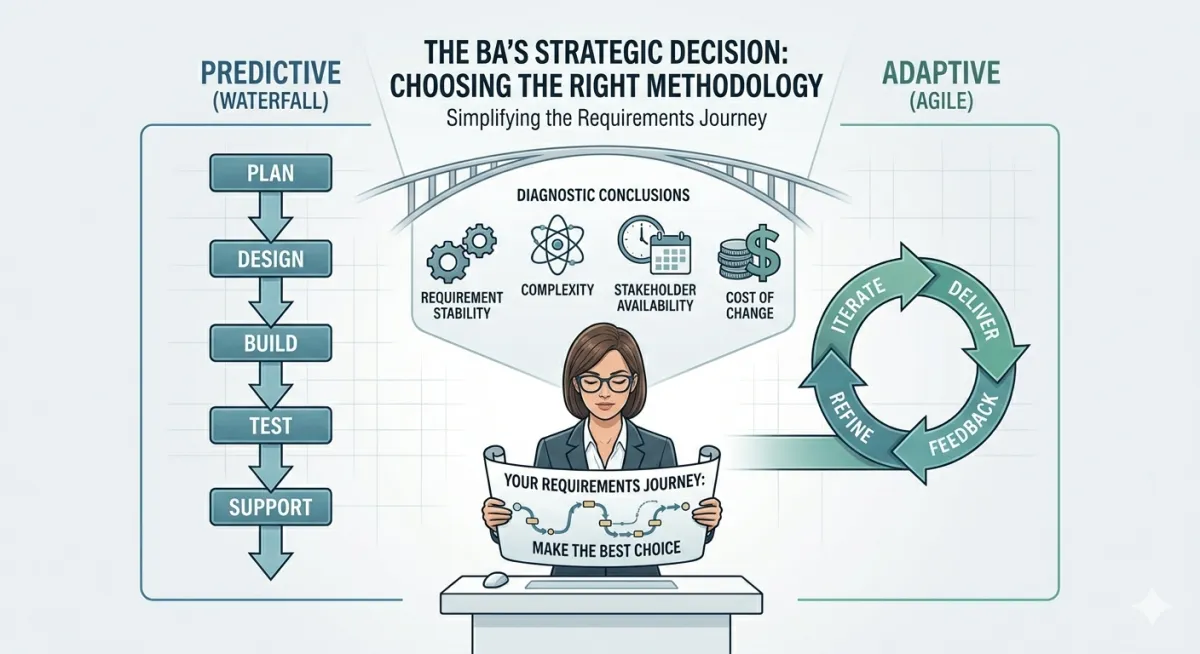
Predictive approaches like Waterfall emphasize comprehensive upfront planning and structured phases, while adaptive methods like Agile prioritize iteration and responsiveness to change. In the professional practice of business analysis, this distinction is not primarily a technical one. It is a philosophical one about where the uncertainty in a project lives and how that uncertainty should be managed.
A predictive approach assumes that requirements can be defined, analyzed, and documented with sufficient completeness before development begins. The traditional project management approach is linear, where all phases occur in sequence. It depends on predictable tools and predictable experience, with the entire project planned upfront without scope for changing requirements. Each project follows the same lifecycle: feasibility, plan, design, build, test, production, and support. The BA's role in this model centers on exhaustive documentation and ensuring that every specification is verified before a single line of code is written or a single component is built.
An adaptive approach recognizes that requirements will evolve as the project progresses. Adaptive approaches acknowledge the dynamic nature of business environments and prioritize iterative cycles of development and feedback, allowing for continuous inclusion of evolving requirements and fostering collaboration and innovation. They are most effective in projects where requirements are subject to change or where stakeholder involvement is crucial throughout the process. The BA's role in this model shifts from exhaustive upfront documentation to continuous elicitation, backlog refinement, and facilitation of feedback loops between the business and the delivery team.
What makes the methodology decision genuinely consequential is that neither approach is universally superior. In the predictive world, the team may identify changes once they get hold of the product and start using it, but the project is already complete, making change difficult to entertain. In the adaptive approach, changes are recommended throughout and added to the requirements list that is regularly updated, with benefits beginning to trickle in earlier as the team hands over parts of the solution incrementally. The right approach is the one that matches the reality of the project environment, not the one that matches the BA's personal preference or the organization's default setting.
Why Choosing the Wrong Approach Costs More Than Starting Over
It locks the team into a delivery model that the project's reality cannot support. A predictive approach on a high-innovation project produces a business requirements document that is outdated before the ink is dry, because the stakeholders did not know what they needed until they saw the first iteration. An adaptive approach on a regulated, hardware-dependent project produces a backlog that never converges, because the flexibility the methodology assumes does not exist in the project's actual constraints. Neither failure is a skill problem. Both are methodology mismatches.
It misaligns stakeholder expectations from the start. This choice fundamentally shapes how your team works, when value gets delivered, and how stakeholders experience the project. A stakeholder who expects to review a comprehensive specification at the end of the analysis phase and receives sprint demos instead is not going to engage productively with either the methodology or the BA leading it. A stakeholder who expects iterative involvement and receives a document for sign-off once a month is going to disengage at exactly the moment their input is most critical.
It produces the wrong deliverables for the project's governance structure. A predictive approach requires formal, comprehensive documentation that serves as the basis for design and construction decisions. An adaptive approach requires a clear, prioritized product backlog that guides iterative delivery cycles. Producing one when the project governance structure expects the other creates a documentation debt that consumes significant project team time to resolve and often generates its own scope disputes along the way.
It makes the Business Analyst reactive rather than strategic. The BA who diagnoses the project environment, selects the appropriate approach, and explains the rationale to the project manager and sponsor is operating as a strategic partner. The BA who defaults to the approach used on the last project, regardless of the current project's characteristics, is operating as a process follower. The methodology decision is one of the clearest opportunities in the entire project lifecycle for a BA to demonstrate the kind of analytical judgment that distinguishes a practitioner from a technician.
How to Choose the Right Business Analysis Approach: A Step-by-Step Framework
Step 1: Assess Requirement Stability Before Anything Else
The single most reliable indicator of which methodology a project needs is the stability of the requirements at the point of initiation. This is not about whether requirements will change, because they always will. It is about whether enough of the solution is understood today to support upfront planning.
What to do: Conduct structured conversations with the project sponsor and key subject matter experts specifically designed to surface the depth of current requirements knowledge. Ask them to describe the end state in concrete, specific terms.
Action: If the stakeholders can clearly articulate approximately ninety percent of the needs today and the remaining uncertainty is in the detail rather than the direction, the project favors a predictive approach. If the dominant answer is that they will know it when they see it, or that the requirements depend on what the first version teaches them, the project is adaptive by nature.
Goal: A documented requirements stability assessment that forms the first input into the methodology decision, grounded in stakeholder conversations rather than project management convention.
Step 2: Evaluate Complexity and Innovation Level
The degree to which a project is doing something the organization has done before is a direct indicator of how much upfront planning is possible and reliable.
What to do: Assess whether requirements are well understood and stable, pointing toward predictive planning, or likely to evolve as the team learns more, suggesting an adaptive approach would better serve the project's actual dynamics.
Action: Low-innovation projects, such as a standard infrastructure upgrade, a compliance documentation update, or a process that mirrors a previous implementation, favor predictive because the uncertainty is low and the planning assumptions are reliable. High-innovation projects, such as an AI-driven customer experience platform, a new digital product with no internal precedent, or a process redesign in a domain the organization has never operated in before, favor adaptive because the uncertainty is structural rather than incidental.
Goal: A clear categorization of the project's innovation level that either confirms or challenges the initial requirements stability assessment, giving the methodology decision a two-dimensional foundation rather than a single data point.
Step 3: Confirm Stakeholder Availability and Engagement Appetite
An adaptive approach is a commitment, not just a preference. It requires frequent, substantive involvement from business experts throughout the delivery lifecycle. If that involvement is not available, the methodology will fail regardless of how competently the BA executes within it.
What to do: Have a direct, specific conversation with the project sponsor and key business stakeholders about the level of engagement the methodology requires. Do not describe it in abstract terms. Describe it in calendar terms: what percentage of their working week, how many hours per sprint, and what the consequence is if that commitment cannot be honored.
Action: Assess whether the organization can manage constant change effectively, whether the team includes sufficient senior expertise to make iterative decisions without extended escalation cycles, and whether the business model sees requirements and customer expectations change frequently enough to justify an adaptive approach. If stakeholders are available for weekly demos and feedback sessions, adaptive will deliver higher value. If they can only commit to monthly touchpoints, predictive is the safer choice.
Goal: A stakeholder availability confirmation that is specific enough to appear in the BA plan as a documented constraint, rather than an optimistic assumption that erodes when the project reaches its first delivery sprint.
Step 4: Calculate the Real Cost of Changing a Requirement Mid-Project
The cost of change is the final and most definitive variable in the methodology decision. It is the one that overrides the others when there is a genuine conflict between what the requirements stability and innovation assessments suggest and what the project's technical and regulatory constraints will actually allow.
What to do: Identify the highest-cost change scenario for this specific project. What would it cost, in time, money, and organizational disruption, to change a core requirement after the solution design is locked? After development has begun? After the first deployment?
Action: If the cost of a mid-project requirement change is high because of physical dependencies, regulatory approval cycles, hardware procurement timelines, or contractual commitments, stay predictive and invest heavily in upfront elicitation to reduce the probability of that scenario. If the cost of change is low because the solution is software-based, modular, and not subject to fixed regulatory specifications, embrace adaptive and use iteration as the primary mechanism for requirement refinement.
Goal: A change cost profile that is documented alongside the other methodology inputs, giving the project sponsor and project manager a clear, evidence-based picture of why the methodology recommendation is what it is, rather than a preference the BA is defending without analytical backing.
Frequently Asked Questions
What if the project has characteristics of both approaches? Is hybrid always the answer?
Hybrid is a legitimate and often optimal choice, but it requires the same diagnostic rigor as the pure approaches. A hybrid approach entails drafting a high-level strategy at the beginning of the project while allowing flexibility and modification as the project develops, making it ideal for projects requiring a balance of predictability and flexibility. The most common and effective hybrid model uses a predictive approach for high-level scope, budget, and timeline governance while applying adaptive techniques to the requirements elicitation and delivery cycles within that boundary. The key is being explicit about which parts of the project are governed by which approach, rather than blending the two informally and generating the governance confusion that undermines both.
What if the project manager has already committed to a methodology before the Business Analyst is engaged?
This is more common than it should be and more manageable than it feels. Your first step is to conduct the diagnostic anyway and document the findings. If the committed methodology is misaligned with the project's actual characteristics, present that misalignment as a risk to the project manager and sponsor with specific, evidence-based examples of what that misalignment is likely to produce. You are not challenging the project manager's decision. You are providing the analytical input that was not available when the decision was made.
How do I adapt my documentation approach to match the chosen methodology?
The documentation standard follows the methodology, not the other way around. A predictive approach requires a formal Business Requirements Document or equivalent specification that is comprehensive enough to serve as the basis for design decisions made without ongoing stakeholder input. An adaptive approach requires a clear, prioritized product backlog with acceptance criteria defined at the story level, refined iteratively as the team learns more. Attempting to produce predictive documentation on an adaptive project, or to manage an adaptive project with a predictive specification, is one of the most consistent sources of BA-related project friction.
When is it appropriate to change the methodology mid-project?
The signal that justifies a methodology change mid-project is a pattern of major requirement changes arriving faster than the current approach can absorb them. If you have experienced more than five significant requirement changes in a recent period and are using a predictive approach, the project environment may be telling you that the adaptive approach would better serve its actual dynamics. The decision to change methodology mid-project is not one the BA makes unilaterally. It requires a structured conversation with the project manager and sponsor, supported by the change log data that makes the case.
Final Thoughts
The methodology decision is not a box to check on the project initiation form. It is the strategic foundation that every subsequent BA activity either benefits from or is undermined by. A BA who chooses the right approach for the right reasons, based on a structured diagnosis of the project's requirements stability, innovation level, stakeholder availability, and cost of change, is not just completing a planning task. They are protecting the project's ability to deliver value in the environment it actually exists in, rather than the one the planning assumptions imagined.
Build a bridge when you know exactly where it needs to go, how heavy it needs to be, and what the ground beneath it will support. Remodel the kitchen when you are not sure what you will find behind the first wall, and when the homeowner's preferences are going to evolve the moment they see the tile in real light. Both are valid. Both require skill. Neither is right for the other's project.
Reflective Question: Think about your current project. Pull up the change log. How many significant requirement changes have arrived in the last four weeks? Does the frequency of those changes match the methodology you are currently using? If the answer is no, that conversation with your project manager starts today.
Get practical insights on change and business analysis delivered to your inbox. Join our mailing list


